










































Panchayati Raj Campaign
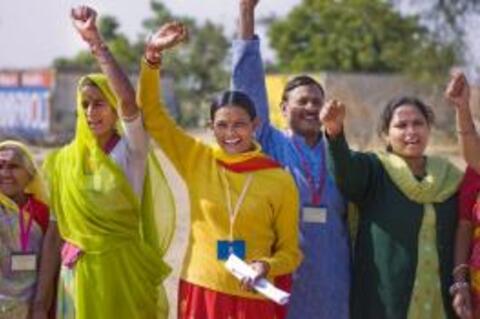
THP holds that effective bottom-up strategies for ending hunger and poverty combine 3 factors: mobilising people at the grassroots level to build self-reliance, empowering women as key change agents, and forging effective partnerships with local government and non-governmental organisations (NGOs). Through partnerships with 55 local NGOs across 14 states, THP state and national staff trained more than 800 staff trainers of these organisations to lead workshops and provide ongoing empowerment to women leaders. These organisations make up a national alliance that advocates for change at the state and national levels. Drawing on this multi-pronged approach, THP's Panchayati Raj Campaign implements specific interventions in each year of a woman leader's term in an effort to empower her to succeed.
In the first year after election, women participate in a 3-day Women's Leadership Workshop (WLW) that alerts women to their human rights, educates them about their powers and responsibilities as panchayat leaders, builds their capacity to create a vision and plan actions to achieve it, and links them with government and other resource people in their area. This is reinforced 3 months later in a follow-up workshop and through needs-based workshops that women request to strengthen their skills in communication, finances, and knowledge of laws and government programmes. Women leaders are trained to organise the women of their villages into self-help groups (SHGs) for mutual support and economic activity. SHGs become a constituency to stand with the elected leader for women's priorities. The SHGs are mobilised to attend mandatory open meetings known as gram sabhas, where they can hold panchayats to account. They are empowered to meet beforehand to prepare a clear list of priorities.
In Year 2, THP works with panchayats to create bottom-up plans ("microplans") for villages to meet basic needs. These plans involve assessing available resources and creating strategies for actions that people can take themselves. When governmental resources are required, planning includes establishing good partnerships with local officials. During Year 2, there are additional capacity-building workshops for elected women leaders, and THP takes additional action to mobilise women to participate in the gram sabhas.
The focus in Year 3 is on creating federations of elected women representatives. THP has observed that, as villages take action, they inevitably run up against bureaucratic obstacles. To overcome these obstacles - and to sustain villages' process of empowerment on their own - federations are formed at the block (100+ villages), district, and state levels. Block-level federations provide regular monthly forums for mutual support, and state federations rally elected women to demand change at the policy level.
In Year 4, THP ensures that panchayats have successfully implemented their plans and that lives have truly improved on a sustainable basis. In addition, where leaders have run up against major legal obstacles, the women demand policy changes and engage in public-interest litigation. For example, in Bihar in 2004, THP mobilised 2,000 women to protest the failure of the state government to implement key provisions of the 73rd amendment, and then followed up with litigation for change.
In the run-up to elections, THP carries out campaigns to encourage the participation of women - both as independently minded voters and as candidates. As the reserved seats rotate to different areas each term, new women are encouraged to step forward to run for those seats. In addition, women who have already served are encouraged to stand for re-election against men in unreserved seats.
Creating publications to document this process and its impact is part of THP's strategy for reinforcing and spreading the word about women's promise and progress as leaders. Volume I of "'We Are Here to Make a Difference:' Women Leaders in Village Panchayats" includes profiles of 51 women leaders who are trying to bring food security, water, electricity, and health facilities to their villages and communities. Volume II features 118 elected women leaders who are "ensuring that children attend school, that their villages are equipped with adequate health facilities and that all sections of the population are aware of and can access government schemes....This compendium is an attempt to ensure that the trials and tribulations of elected women leaders are acknowledged, and their voices are heard." Click here and scroll down to access options for downloading these publications.
Women, Democracy and Governance.
Founded in 1977 in the United States, THP is a global nonprofit organisation whose goal is to end hunger in Africa, South Asia, and Latin America. To date, THP has worked to empower 70,000 elected women representatives as part of the campaign described above. According to THP, "When women, who have traditionally been denied a voice in decision-making, come to power, they transform the development agenda toward the human component - focusing on health, nutrition, education, water, sanitation and better family income. They tackle long-ignored problems such as domestic violence, alcoholism and corruption."
B. Rani Devaraj (President, Jakkanarai Gram Panchayat, Block Kotagiri, District Nilgiris, Tamil Nadu) attended the WLW organised by THP. "According to Rani, the leadership skills she learned at the workshop helped her deal with the challenges of her panchayat. She says that the training gave her an understanding of how a panchayat works, especially her role in it. After her training, she was able to exercise her leadership and hold meetings with other panchayat members. According to Rani, elected members who have attended The Hunger Project's Women's Leadership Workshops are very cooperative as they are all united in recognizing the need to bring about changes in the panchayat."
Women's United Nations Report Network (WUNRN) listserv, March 25 2009; and THP website.
- Log in to post comments