










































Once We Have It, Will We Use It? A European Survey on Willingness to Be Vaccinated against COVID-19
Erasmus University Rotterdam (Neumann-Böhme, Brouwer, van Exel); Bocconi University (Varghese); Nova School of Business and Economics (Sabat, Barros); University of Hamburg (Schreyögg, Stargardt)
"Understanding which groups in the population are not willing to be vaccinated and why remains vital for the design of policy responses to vaccination hesitancy."
In the European Union (EU), vaccine delays and refusals - that is, expressions of vaccine hesitancy - have contributed to declining immunisation rates in several countries and have led to increases in disease outbreaks. These trends are relevant in the context of the COVID-19 pandemic, which has sparked unprecedented efforts worldwide to find an effective vaccine against the coronavirus SARS-CoV-2. The question is: Will sufficient numbers of individuals be willing to be vaccinated to attain herd immunity? This article provides some insights into the willingness to be vaccinated, based on a multi-country European study.
The researchers investigated people's attitudes about vaccination against COVID-19 in an online survey among representative samples of the population (in terms of region, gender, age group, and education) in 7 European countries (N=7,662). [Click here for details on the survey.] Between April 2 and 15 2020, they asked respondents about their worries and beliefs about COVID-19, as well as attitudes about vaccination and their willingness to be vaccinated.
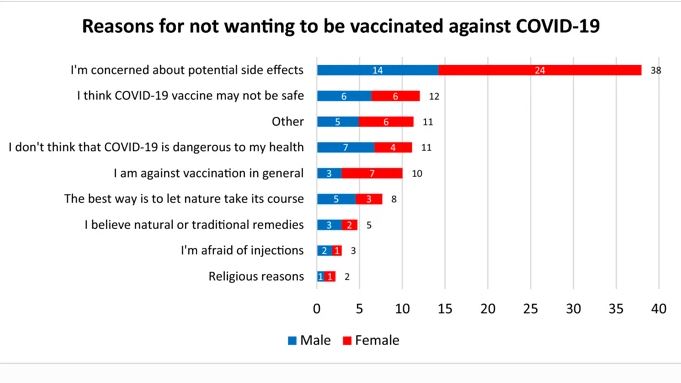
In total, 73.9% of the participants from Denmark, France, Germany, Italy, Portugal, the Netherlands, and the United Kingdom (UK) stated they would be willing to get vaccinated against COVID-19 if a vaccine were available. A further 18.9% of respondents said they were not sure, and 7.2% said they would not get vaccinated. The largest proportions of the population opposed to a COVID-19 vaccination were observed in Germany (10%) and France (10%), while France also had the largest group of people who were unsure about getting vaccinated (28%). The uncertainty among women was higher in all age groups and largest for women between the ages of 45 and 54 (26%). In fact, an overall rejection of vaccination was more than twice as common among women (7%) than among men (3%).
More than half (55%) of respondents who were unsure about being vaccinated said they were concerned about potential side effects of a vaccine; this concern was more frequent among women (36%) than men (19%). Around 15% of respondents worried that a vaccine might not be safe, with no notable differences between genders. A common concern seems to be that a COVID-19 vaccine might be experimental, without any studies on side effects, and that the vaccine may not be safe for specific groups (e.g., pregnant women). This finding highlights that while the current focus seems to be on developing a vaccine quickly (about 10 times faster than usual), it is important to reassure the public that any vaccine that becomes available so quickly would still be safe and effective. Otherwise, there is a risk of losing public trust in the particular vaccine and in coronavirus vaccination altogether. Open-ended questions revealed concerns not only about safety but also comments about conspiracy theories and a general rejection of vaccines.
In light of the findings of the survey, the researchers explore steps policymakers could take to decrease vaccine hesitancy in preparation for a coronavirus SARS-CoV-2 vaccine. They organise their thoughts along the approach to vaccine advocacy that suggests "vaccine adoption = access + acceptance":
- Access: In the case of the coronavirus vaccine, access will prove quite challenging since, at the early stages of availability, the demand for this vaccine worldwide will be much greater than the (short-term) production capacities. Therefore, policymakers need to strategise about how access can be organised equitably and effectively.
- Acceptability: Perhaps gains could be made among the sizeable proportion of the population (i.e., 18.9%) that is unsure whether they want to get vaccinated. If this group needs to be convinced to be vaccinated to get to herd immunity, clear communication about safety and potential side effects of the vaccine is important. Another avenue to explore could be to emphasise the social benefits of vaccination. Notably, outbreaks in particular communities may occur even if overall vaccination rates are high, highlighting the role of religious communities and travellers in this context. This may be an area for communicators to focus.
In conclusion: "improving our understanding of vaccination hesitancy in the context of COVID-19, as well as finding and using policies to overcome it, may be as important as discovering a safe and effective vaccine."
The European Journal of Health Economics https://doi.org/10.1007/s10198-020-01208-6.