










































No Evidence that Omission and Confirmation Biases Affect the Perception and Recall of Vaccine-related Information
Durham University (Jiménez, Tehrani); University of Exeter (Jiménez, Mesoudi)
Despite evidence of the contribution of vaccines to disease prevention, pockets of opposition persist and are amplified and exacerbated through the widespread diffusion of anti-vaccination information online and through the media. One influence on the perception and recall of vaccination-related (mis-)information might be cognitive biases acting against vaccination. This study tests whether the omission and confirmation biases play a role in the transmission of vaccine-related information, and directly compares both biases.
Reviewing the literature, the researchers explain that an omission bias describes the tendency to perceive as worse, and recall better, the bad outcomes resulting from commissions (e.g., vaccine side effects) compared to the same bad outcomes resulting from omissions (e.g., symptoms of vaccine preventable diseases, or VPDs). Another factor influencing the perception and recall of vaccination-related information might be people's attitudes towards vaccines. A confirmation bias would mean that pre-existing pro-vaccination attitudes positively predict perceptions of severity and recall of symptoms of vaccine preventable diseases and negatively predict perceptions of severity and recall of vaccine side effects.
To test for these hypothesised biases, the researchers recruited a sample of participants aged 18-60 years who spoke English as a first language and who were of British or American nationality. Only women (202 in total) were included in the experiment, as their pre-screened anti-vaccination attitudes were more reliable than the ones reported by men. Two items were included to measure attitudes towards vaccination: "If I had a baby to care for, I would want him/her to get all the recommended immunizations", and "I believe that scheduled immunizations are safe for children". A 7-point Likert scale was used to collect the participants' responses.
In the online experiment, featuring a between-subjects experimental design, participants imagined they had a 1-year-old child who suffered from either vaccine side effects (commission condition) or symptoms of a VPD (omission condition). They then rated a list of symptoms/side effects for their perceived severity on a 7-point Likert scale. Finally, they completed a surprise recall test in which they recalled the symptoms/side effects previously rated.
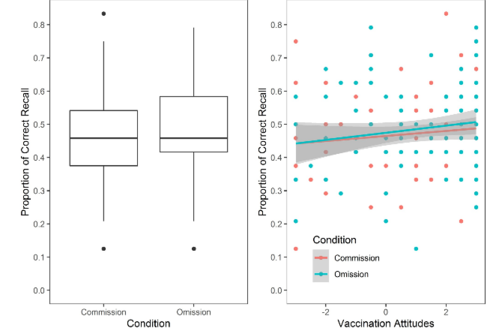
The researchers found that the same physical conditions were rated as equally severe and recalled equally well when described as disease symptoms and as vaccine side effects, contrary to the prediction that side effects should be rated stronger and recalled better. Therefore, the researchers did not find support for the omission bias. There was also no evidence for the confirmation bias in either severity ratings or recall. Participants' stance on vaccination had no effect on their severity ratings or recall of disease symptoms and vaccine side effects, contrary to the prediction that pro-vaccination participants would rate more severely and recall better disease symptoms than vaccine side effects, and anti-vaccination participants the reverse.
Thus, contrary to the hypotheses, perceptions of severity and the recall of symptoms/side effects were not associated with experimental condition, failing to support the omission bias; nor did they interact with attitudes towards vaccines, failing to support the confirmation bias. This casts doubt on the possibility that the spread of anti-vaccination claims can be explained by these particular cognitive biases. The null finding with respect to omission bias contrasts with the many supportive studies reviewed in the opening sections of the paper. However, as the researchers of the present study argue, many of the earlier studies may suffer from methodological problems.
In conclusion, the "lack of convincing evidence for the omission bias suggests that the spread of anti-vaccination messages might not be explained by an omission bias acting against the practice of vaccination. Instead, the messages transmitted by people with anti-vaccination beliefs might spread due to having particular characteristics (e.g. being simple, concrete, emotional, unexpected, narrative, etc.) that make them especially 'sticky' in human minds....Importantly, the same characteristics of these messages might also be used to promote vaccination..., providing a more optimistic prospect for countering anti-vaccination information."
PLoS ONE 15(3):e0228898. https://doi.org/10.1371/journal.pone.0228898
- Log in to post comments