










































New Opportunities in Monitoring Safety of Journalists through the UN's 2030 Sustainable Development Agenda
UNESCO
"This gives journalists' safety a particular framing that is both significant conceptually and politically, thereby enabling new opportunities to cast light on its relevance as an issue to society, both by advocates and by news media..."
The safety of journalists, and the monitoring thereof, is recognised within the United Nation (UN)'s Sustainable Development Goals (SDGs). A specific indicator treats the safety of journalists as a benchmark for tracking progress on SDG target 16.10, which specifies "public access to information and fundamental freedoms" as a development aspiration in the lead-up to 2030. In this article, Guy Berger reflects on the "strong catalytic potential" of the inclusion of this indicator in the SDGs, here highlighting the potential for new research stimulated by this development, particularly at country level, and the increased and more standardised monitoring of a range of aspects of the safety of journalists that could result.
Berger explains that the SDG 16.10.1 indicator comprises 5 attacks on human rights, as endured by journalists: killing, kidnapping, enforced disappearance, arbitrary detention, and torture. The idea is that assessing the extent of these crimes (also through a gender lens) can help identify the extent to which a society enjoys public access to information and respect for human rights and freedoms. "Framed within SDG 16, this indicator further points us towards assessment of the fulfillment of duty by the State in ensuring that fundamental freedoms are protected in accordance with justice, the rule of law, and strong institutions, or whether impunity prevails for those who perpetrate the designated violations."
There is also further elaboration within the discourse of the SDGs, in what is termed the "metadata" about the indicator, which involves a framing in terms of "who did what to whom, where and when, and with what effect". So, for example, the "whom" - the subject of the harm - would be understood within the elaboration of the term "journalists", or everyone who observes, describes, documents, and analyses events, statements, policies, and any proposition that can affect society. The SDG metadata, informed by the Universal Human Rights Index and International Classification of Crime for Statistical Purposes (ICCS) frameworks, offers a typology that is endorsed by the UN, which "makes it an authoritative and central point that researchers can consider".
According to Berger, there are also a number of areas where research in relation to 16.10.1 can be further elaborated, and even where kinds of crimes against journalists other than the 5 major types referred to in indicator 16.10.1's list are committed and go unpunished. For example, harassment, intimidation, assault, and cyber-attacks are serious in terms of journalists exercising their freedom of expression and facilitating public access to information. In its 2019 Resolution A/C.3/74/L.45/Rev.1, the UN General Assembly (UNGA) includes a clause that condemns specific attacks on women journalists and media workers, such as gender-based discrimination and violence, including online and offline sexual harassment, intimidation, and incitement to hatred against women journalists.
Berger then explores the United Nations Educational, Scientific and Cultural Organization (UNESCO)'s monitoring of safety in relation to operationalising SDG indicator 16.10.1. He asserts that UNESCO's mandate for monitoring journalism safety, limited to the data points of killings and impunity, predates the SDGs. For instance, in 2015, UNESCO initiated a Research Agenda for Academics with a list of 10 suggested research topics on safety issues under the frame of the UN Plan of Action on the Safety of Journalists and the Issue of Impunity. The organisation now also feeds information into SDG monitoring at global level. The constraint in UNESCO's role appears to be less of a political issue than a practical one: the immensity of monitoring all these issues at global level is beyond the capacity of the organisation.
However, there are country-level research instruments facilitated by UNESCO that could support the production of data by countries on indicator 16.10.1. For instance, UNESCO's country-based Media Development Indicators (MDIs) assessments have been carried out in more than 20 countries to date. In selected countries, national monitoring of the safety of journalists can also be synergised with the specialised UNESCO/International Programme for the Development of Communication (IPDC) Journalists' Safety Indicators. UNESCO is not directly involved in national-level SDG monitoring or reporting, which is a voluntary issue for each Member State. At the 2018 expert meeting at UNESCO (see below), the suggestion was made that UNESCO should supplement its Journalism Safety Indicators with a model data collection template to offer to actors at national level. Following this, UNESCO has developed a voluntary guideline as a contribution to the UN Development Programme (UNDP)'s technical assistance to states in SDG monitoring. Thus, both the MDIs and the Journalists' Safety Indicators offer opportunities at national level to feed into country-based monitoring and reporting systems on SDG 16.10.1.
Berger reports that a meeting of experts concerning indicator 16.10.1 at UNESCO in May 2018 "was premised on the idea of assessing the potential for actors involved in monitoring safety to align and expand their work on the range of attacks as per the metadata. At the same time, the concept note for the occasion also took cognizance of a counter argument that rather than spreading resources on monitoring and reporting on additional attacks, priority instead be given to ramping up co-operation around killings and impunity. At the same time, the note further observed that under SDG's monitoring scenario, countries also have the opportunity to elaborate their own indicators. Also reflected in the note was the question of whether global work could contribute at national level, to building domestic capacity (possibly on a multi-stakeholder model) in the form of sustainable local mechanisms for monitoring attacks and impunity (e.g., based in national statistics commissions, human rights commissions, justice ministries, or other bodies)."
Additional data could be gleaned from efforts undertaken as part of case studies documenting non-fatal attacks, such as threats of death and other physical harms to journalists and their families in a given society; assessments could then be made of whether such data serves as a reliable predictor of a threshold for when violent acts actually get committed. Data from case studies might also enrich research events on the safety of journalists, such as those that have accompanied UNESCO's global World Press Freedom Day conferences in Helsinki (in 2016), Jakarta (in 2017), Accra (in 2018), and Addis Ababa (in 2019), as well as events around the annual International Day to End Impunity for Crimes Against Journalists (IDEI). Other possibilities of data are suggested by work on the part of the Centre for the Freedom of the Media at Sheffield University, which has created a Facebook-based journalism safety research network and, along with others, has organised panels at annual conferences of the International Association for Media and Communication Research (IAMCR). Likewise, the Worlds of Journalism study consortium has decided to include safety-related questions in their next round of global research; data relevant to 16.10.1 may emerge from this endeavour.
Berger concludes that "there is much momentum and there is also much potential for research at national level to become part of making history in harnessing efforts to the opportunity of SDG 16.10.1. This can also help develop standard categories and data sources that can facilitate comparisons from year to year and improve potential for aggregation of data across countries. The outputs can help ensure the knowledge needed for achieving safety of journalists. In turn, this can help inform change so as to progress public access to information and fundamental freedoms, as well as to power momentum in each concerned country towards achieving peace, justice, and strong institutions, and the synergies between these objectives and the rest of the SDG agenda."
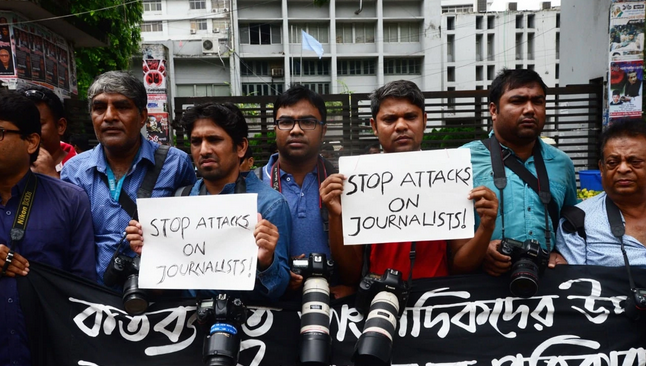
Media and Communication 2020, Volume 8, Issue 1, Pages 78-88. DOI: 10.17645/mac.v8i1.2660. Image credit: Mamunur Rashid Nur Photo via Getty Images
- Log in to post comments