










































Modelling the Impact of Vaccine Hesitancy in Prolonging the Need for Non-Pharmaceutical Interventions to Control the COVID-19 Pandemic
MRC Centre for Global Infectious Disease Analysis; and the Jameel Institute, School of Public Health, Imperial College London
"...vaccine-hesitant individuals have a substantial impact on the pandemic trajectory, which may challenge current efforts to control COVID-19. In order to prevent such outcomes, addressing vaccine hesitancy with behavioural interventions is an important priority in the control of the COVID-19 pandemic."
In response to the COVID-19 pandemic, non-pharmaceutical interventions (NPIs) such as social distancing and mobility restrictions were put in place worldwide to reduce transmission of the virus. Because these interventions are unsustainable in the long term, hopes to control the pandemic rely heavily on vaccination. However, vaccine hesitancy - a delay in acceptance or refusal of vaccines despite availability - has the potential to threaten the successful roll-out of SARS-CoV-2 vaccines globally. This study aims to understand the likely impact of vaccine hesitancy on future control of the pandemic, using a mathematical model to explore vaccine hesitancy through its impact on population coverage.
The researchers capture the effect of reduced coverage using measured levels of vaccine hesitancy from behavioural survey data on self-reported intention to be vaccinated. (Attitudes towards COVID-19 vaccination were obtained from the Imperial College London YouGov Covid 19 Behaviour Tracker Data.) Survey results, extracted February 8-15 2021 for 10 European countries, are disaggregated by age and translated to vaccination coverage ranges per age group. Pandemic trajectories with low vaccination coverage due to vaccine hesitancy are compared to an ideal counterfactual assuming no vaccine hesitancy, in which the researchers assume that a small proportion (5%) of the population cannot be reached for vaccination. They model each scenario with both a high (94% efficacy against infection) and a moderate (63% efficacy against infection) vaccine efficacy profile. For both vaccines, they assume an additional 60% efficacy against hospitalisation for breakthrough infections, resulting in an overall vaccine efficacy against hospitalisation and death of 98% for the high-efficacy vaccine and 85% for the moderate-efficacy vaccine.
Informed by the vaccine roll-out in high-income countries, the model assumes that vaccination started in January 2021 and is implemented at a rate that results in a total campaign of 10 months to fully vaccinate the population above 15 years old (about 78% of the population). A simulation was run for each vaccine coverage scenario for both adult-only vaccination campaign and vaccination campaign including children aged 5-15 years. As an output for each simulation, the researchers estimated the number of deaths and hospitalisations associated with COVID-19 over the 2-year period from January 1 2021 to December 31 2022.
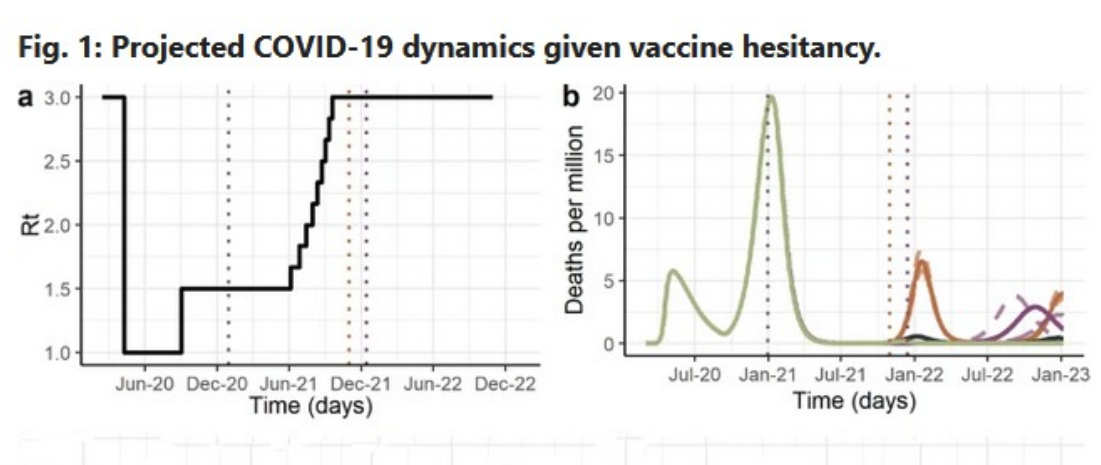
In the presence of vaccine hesitancy, lifting NPIs and relying on vaccine-induced immunity for control is predicted to lead to periodic outbreaks determined by the duration of naturally induced immunity. For a high-efficacy vaccine, daily deaths per million at the peak of the first outbreak are projected to be 11.5 (10.1-13.2) times higher than under the ideal scenario, which translates to a cumulative impact of 532 (457-612) more deaths per million population in the 2 years after vaccination begins. In the results, fewer deaths are projected for a vaccine of moderate efficacy compared to a higher-efficacy vaccine - partly due prolonged NPIs being required to maintain herd immunity where efficacy is lower, resulting in an outbreak that is more spread out. For a moderate-efficacy vaccine, the cumulative impact of vaccine hesitancy is projected to lead to 456 (416-504) extra deaths per million population.
Vaccine hesitancy varies between countries. To evaluate the impact of these variations, the researchers chose three European countries with different vaccine acceptance views - France, Germany. and the United Kingdom (UK) - and modeled the trajectory of the pandemic under an ideal vaccination and a vaccine hesitancy scenario for each country independently. For a vaccine with high efficacy, they project 1.2 (1.1-1.3), 5.0 (4.0-6.3), and 6.6 (5.7-7.6) times more deaths in 2021/2022 in a scenario with hesitancy compared to an ideal scenario in the UK, Germany, and France, respectively. For both high and moderate vaccine efficacy, the highest impact on total deaths is for the oldest age groups, and it increases in countries with higher vaccine hesitancy.
In short, the results suggest that mortality over a 2-year period could be up to 7.6 times higher in countries with high vaccine hesitancy compared to an ideal vaccination uptake if NPIs are relaxed. Furthermore, for some scenarios analysed, longer and more stringent public health measures would be required to compensate for lower vaccine uptake.
The researchers stress that the analysis necessarily makes many simplifying assumptions, and the future trajectory of the epidemic will depend on the complex interactions between vaccination uptake, behaviour, and government interventions. However, the results make clear that reducing vaccine hesitancy is an important public health priority. Interventions that aim to build trust in vaccines - for example, featuring community-based public education or via positive role models - are among those that have been, and can be, used to address hesitancy.
In conclusion, "this work demonstrates that vaccine hesitancy might have a substantial health impact on the population, and therefore, it is a public health priority to increase trust in vaccines."
Communications Medicine (2022)2:14. https://doi.org/10.1038/s43856-022-00075-x.
- Log in to post comments