










































Migration Media Usage Survey
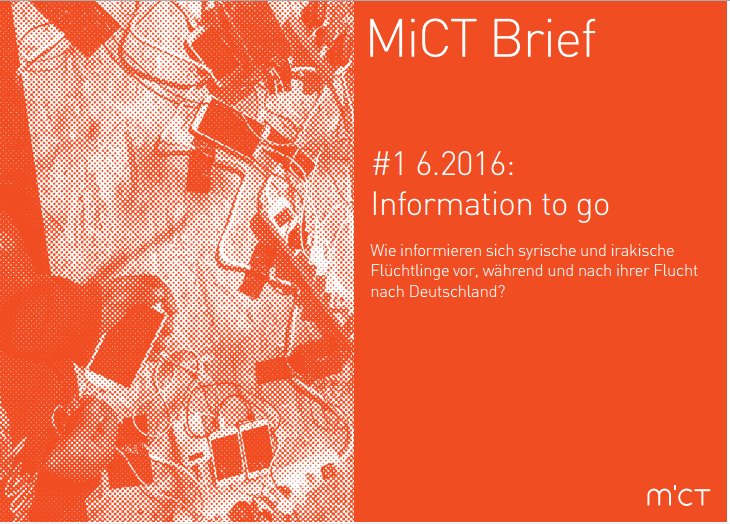
From November 2015 to February 2016, the Media in Cooperation and Transition (MiCT) research unit conducted in-depth interviews and focus-group discussions with 88 refugees from Iraq and Syria in Berlin, Germany. The central aim was to investigate which sources of information refugees were using, before, during and after their transit, in order to find out more about their routes, their risks, and their destinations, as well as any other relevant information. This report describes the results of this study, which MiCT contends can be used as starting points for media development and humanitarian projects inside the refugees' own countries as well as in transit and destination states.
When it came to preparing for a planned transit in their homeland and their access to relevant information regarding this, the majority of the interviewees said they felt they were well informed, mostly thanks to networks on social media like Facebook and due to personal contact with other refugees. The interviewees were well aware of the risks and dangers they faced - in particular, the risk of drowning in the Mediterranean or becoming victims of violence, fraud, or theft. The most trusted information about routes and risks was interpersonal communication with individuals who had freshly arrived in the European Union (EU). Traditional media was not a primary source for any of the interviewees and, in fact, descriptions of traditional media included "not believable", "polarising", "lies", and "politically biased". All this said, "it is worth noting the discrepancy between feeling informed, subjectively, and actually having the facts about the living conditions of refugees in Europe. This is a discrepancy that only became clear to the refugees after they arrived in Germany." After fears about security, the second-most important subject was often the lack of job prospects, so better information could include news about local labour markets.
"Psychological and security-related needs were a firm focus during the refugees' transit. Listening to the interviewees in this study, it also became clear that in order to satisfy their basic needs - such as food, security and housing - the right information was essential. The survival of individuals and families was dependent upon their access to, and membership of, the aforementioned cycle of relevant information. This is why the provision of communications equipment and ongoing access to information during transit was described as a 'meta-need' and one that was prioritised above other needs. Smartphones, batteries and SIM cards were some of the most important things that interviewees owned during their transit. At the same time this study also indicated that the system providing the refugees with information while they were travelling, worked fairly well. The refugees formed themselves into a community that demonstrated considerable solidarity, in which members gave, and took, information as they had it or needed it, and without any overarching management or leadership. Instant Messenger and applications like WhatsApp helped the refugees organise themselves into groups online. Some aid organisations also prepared further applications for the refugees to assist navigation through transit countries."
It was only upon arriving in Germany that the refugees began to feel less well informed. The interviewees had researched topics like the rules around family reunions and how to seek asylum but had not often gone much deeper into topics around long-term migration. Many of the refugees described themselves as confused about life in this new country due to limited access to mainstream media in their new countries, due to language barriers and the lack of appropriate technology in the refugee homes. The majority of interviewees had to go back to their smartphones to access Facebook and online Arabic-language news portals in order to ascertain what was going on in Germany or to find out what happening back home. One option would be to look at participatory initiatives that have come from the asylum seekers and refugees themselves. An example might be the newspaper Abwad, which was started by Syrians in Germany.
MiCT contends that the processes for seeking asylum and other migration procedures need to made more transparent so that refugees understand their rights and their limitations. These kinds of messages must somehow be introduced into the cycle of interpersonal communications that refugees have with friends and relatives in their homelands if they are to have any impact on refugees' decision-making, because interpersonal messages are the kinds of communications that are most trusted and valued. It is also important to consider that behind those needs for information lie the hidden demands of integration, which must be addressed in order to encourage participation. "Thanks to a lack of access to German public discourse, refugees and migrants were not just left confused, they also lost any possible opportunity to react to it in social situations. This feeling of powerlessness increased frustration and made integration even more difficult. The interviewees were not complaining about the fact that they were victims and as such, that they were not heard - even though this is definitely the case. Instead they were more concerned because, as actors within a civil society, they wanted to understand the discourse and to take part in it. Here too there are examples of media projects for refugees that could be expanded, given the right means, that offer the refugees a better connection to German public life."
Click here for the 12-page report in English.
Click here for the 12-page report in German.
MiCT website, June 28 2016.