










































Message to Aid Workers: Go Mobile - or Get Lost!
TVE Asia Pacific
In his blog on the role of mobile communication in humanitarian assistance, Nalaka Gunawardene gives an example of a Short Message Service (SMS) text message sent from a mobile phone from Dagahaley refugee camp in Dadaab, Kenya, to two United Nations (UN) officials in London and Nairobi explaining that people in the camp were not receiving sufficient food. The camp resident had obtained the telephone numbers through an internet cafe in the camp. Based on this example of the depth and reach of computer and telephone technology, the article challenges those working in the field of development to make more effective use of mobile phone technology in disaster relief and humanitarian aid communication.
According to the author, "All available indicators suggest that the future of humanitarian assistance is going to be largely dependent on mobile communications." As quoted from The Economist, the logistical operation of disaster relief is furthered by both mobile communication and internet communication tools like spread sheets, much in the same way that a private sector global courier would operate. Further, the article suggests that digital networks support emergency responders with increased flow of information in otherwise chaotic circumstances.
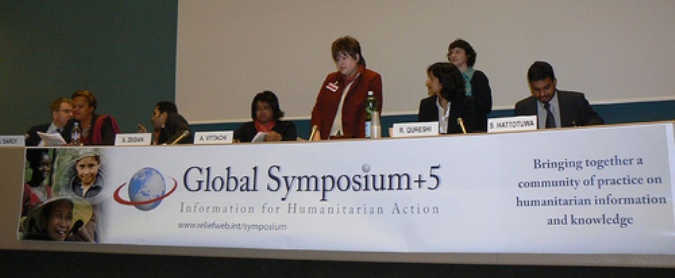
From his survey of conference presentations at the Global Symposium+5 on ‘Information for Humanitarian Action’, Palais des Nations, Geneva, Switzerland (October 22 - 26 2007), Gunawardene questions the emphasis on computer-related tools when mobile phone networks are already widely available. Answers he received from conference presenters include both problems of mobile-computer network interface and the negotiation with private sector service providers required for to access mobile networks. However, he recognises a "mobile phone revolution sweeping Africa, Asia Pacific and... Latin America" and not being fully utilised by communication for development.
In one panel discussion, panellist Rima Qureshi, head of Ericsson Response, part of the global mobile phone manufacturer’s social responsibility initiatives, prophesied that the 3.4 billion mobile phones in the world would soon begin to have the same capabilities of a personal computer. Already, phones have global positioning (GPS) capability enabling rescue workers to locate the people carrying them (and raising ethical issues about who has access to this information). Wind-up phone chargers, lower prices, and higher durability are attributes and accessories that make phone usage more versatile. Commercial operators with some development funding are trying to roll out further coverage of rural areas.
In his conclusion, Gunawardene implies, through a cartoon, that it may be more creative organisational utilisation of communication tools, or as quoted in the article, "more imagination in applying already available technologies for new and better uses" that is the missing piece in fully engaging mobile technology.
Email from Nalaka Gunawardene to The Communication Initiative on October 28 2007.
Comments

Perhaps what the author doesn't tell you is that in his/her own country--Sri Lanka--mobile communications (that aid workers in the north and east rely on for quick security messages) are often cut by the government with little or no warning. This happened to me on several occasions during 2007 and will--given the current situation in Sri Lanka (and in other countries, no doubt) happen a lot more in the coming year. Mobile communications have their limitations--for aid workers and rights holders alike. Far too many aid programmes are operational in countries where this very situation--heavy handed government control--is the reality... What then?
Sadly cannot open the link to reach the document.
Editor's note: I am not sure why you cannot view this link. It appears to be working fine. Please contact info@comminit.com if you are unable to view it? Thank you.
- Log in to post comments