










































Literacy Project for Girls and Women - Projet D’alphabétisation des Jeunes Filles et Jeunes Femmes (PAJEF)
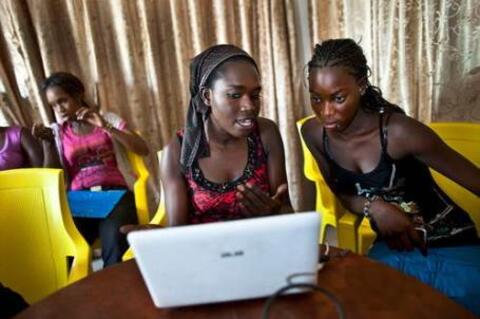
In the first stage of the project, literacy classes were launched in April 2012, under the slogan "Re-write the future", in partnership with a variety of stakeholders such as government, local education authorities, civil society, and the private sector. Classes took place in existing literacy centres and new ones opened as part of the project, focusing on the seven regions most affected by illiteracy (Diourbel, Fatick, Kédougou, Matam, Saint-Louis, Tambacounda, and Dakar). Courses were also made available on CD, on television, online, and on mobile applications
For the project, UNESCO received 200 digital classroom kits from the "Sankoré" programme, a joint partnership for education between the Public Interest Group for Digital Education in Africa, the French Ministry of Foreign Affairs, and UNESCO Dakar. The digital blackboard kits were used for teaching literacy skills, as well as computer skills for newly literate participants. The kit includes the software "Open Sankoré" and different components to facilitate teaching. As outlined by UNESCO, "For example they [teachers] can directly make comments and underline their lesson on the digital board, add pictures, videos, etc, and adapt teaching according to the progression of the learners." Teachers received training in how to use the resources, the internet, and mobile phones to improve teaching.
By 2012, the following had been achieved:
- "3,998 girls and women enrolled in the programme; 193 physical classrooms were opened; 2,300 girls and women were admitted and some tested an online learning course using an application developed together with the Coalition of Literacy Practitioners;"
- support was provided to nearly 1,000 girls facing difficulties in their schooling to prevent them from dropping out of primary school;
- "110 teachers were trained to teach PAJEF courses and 23 regional literacy officials received training in monitoring, evaluation and management; 66 literacy coaches, 45 literacy workers, 40 outreach workers and 4 supervisors were trained;
- "academic support was given to 794 young girls at risk of dropping out of primary school; 96 percent of girls in the programme passed their exams or were promoted to the next class while 4 percent repeated the class;"
- "of the 93 learners enrolled in the school leaving certificate exam BFEM, 84 percent passed."
Senegal’s national TV station also joined the partnership, and news and education programmes about issues such as nutrition, health, and the environment were made available in the classrooms.
Based on the Senegalese initiative, a similar literacy project was rolled out to Nigeria in March 2014. "The Nigeria project seeks to accelerate and underpin national efforts to achieve Education for All. The aim is to benefit 60,000 girls and women in the Federal Capital Territory and Rivers State within the next three years." Prior to the roll-out, a Nigerian delegation travelled to Senegal to visit PAJEF classrooms and familiarise themselves with the educational radio and television structure within the Senegalese Ministry of Education.
Girls, Literacy, Education, Gender
According to UNESCO, "Senegal is one of the ten countries in Africa where over half of the adults are illiterate. The majority of these illiterates are women." Some noted achievements of the project include the following:
UNESCO, Procter & Gamble, Government of Senegal, National Literacy Directorate (DALN), National Centre for Educational Resources (NWRC)