










































Life on Hold
"It's less about being informed and more about feeling something and being moved by it." - Filmmaker Reem Haddad
Al Jazeera's 2-part interactive web documentary highlights the struggles of 10 Syrian refugees, with a focus on young people, and their lives in Lebanon's camps. It also allows viewers to send the story subjects viewable online messages. Life on Hold seeks to tell the personal stories of refugees displaced by the crisis in Syria though interactive features and engagement on social media to encourage viewers to "look beyond the numbers" and "make it personal" - for instance, by sending messages to the individuals portrayed in the documentary.
The violent conflict in Syria has raged on since 2011; more than 100,000 people have lost their lives. Over two-and-a-half million Syrian refugees have fled across their country's border in search of safety. Lebanon, Syria's smallest neighbour, has borne the brunt of this forced migration. It hosts an estimated two million refugees, half of whom are unregistered, and forced to shelter in re-purposed factories, hospitals, and prisons. Syrian refugees are now believed to account for over one-quarter of Lebanon's population, itself a complex and already fragile country burdened by the aftermath of its own recent civil war.
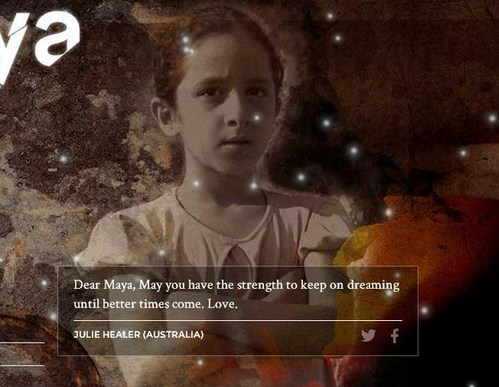
The youngest of the refugees featured in the documentary is 7; the oldest is 70 years old. Their living conditions range from affluent apartments in downtown Beirut to informal tented settlements and shanty towns in the northern Lebanese town of Tripoli. Each character has his or her own page in the documentary, featuring various video modules which users can click on and explore. In addition to that person's "main story", which is on average 7 minutes long, there are include shorter clips such as 'The Journey', which explains how they became a refugee and travelled to Lebanon. Doing it this way allows the viewer to decide what parts of the story he or she wishes to explore, in contrast to more traditional documentaries. Although the content is linear, it can be viewed and listened to in any order and fashion the user choses with the navigation segmented into 10 panes - one for each character. The narrative is enhanced by a custom evolving visual piece by Syrian artist Tammam Azzam. Based on the memories of each of the 10 characters, the 10 pieces of art have 10 different states that evolve or decay according to the number of days since the refugee left Syria. The more time passes, the more their memories, represented in Tammam's collage, deteriorate and erode. Many little glowing stars float atop the portrait's memories; hovering over a star lets the viewer discover a short message left by one of the visitors of the site.
The documentary has been enabled for tablets although not yet for mobile. Al Jazeera partnered with a company called Kung Fu based in Montreal, Canada, to produce the documentary. The video theme has also been extended to Facebook, Instagram (@AJ_LifeonHold ), and Twitter (@ajlifeonhold), where Al Jazeera is encouraging people to show support and solidarity for those affected by the crisis by posting short clips and photos using the hashtag #iRefugee whenever posting online about the subject of refugees. Ideas include: Where you are from, where you are seeking refuge or asylum, what you miss about home, a message to other refugees, and/or a comment on the current refugee situation.
Filmmaker Reem Haddad said: "It's not easy to film in the crowded streets and alleyways there, people are often suspicious of camera crews and we had a few run-ins with some angry young men. Many expressed resentment that the focus has shifted away from the plight of Palestinian refugees to the Syrians. From others we heard frustration that journalists and filmmaker's come and go, but that the conditions on the ground and the hardships in the camps persist despite all the media attention."
Publishers
"Al Jazeera Web Doc Will Mark Anniversary of Syrian Conflict", by Abigail Edge, February 26 2015, Journalism.co.uk; "Life on Hold: Al Jazeera Web Documentary Reflects on the Syrian Refugee Crisis", by Jess Linington, May 6 2015, i-Docs; "Sabra: Lives on Hold", Al Jazeera, October 4 2015; and Life on Hold website - all accessed on June 24 2016. Image credit: © Al Jazeera