Learning from the Extremes
Demos
This research project, detailed in a white paper from Cisco Systems, Inc., explores how social entrepreneurs are "creating radically different approaches to learning in the extreme conditions of slums and favelas of fast-growing cities in the developing world". (Quoted material below is from the document's "Executive Summary" and from "Part VI: Transform: Alternatives to School".)
The document points to inadequacies of education systems that were established more than a century ago, because they fail to reach and motivate large portions of the population - particularly the large number of rural economically poor who are moving to urban areas globally. "These ingrained problems of low aspiration and achievement among the most disinvested communities in the developed world are proving resistant to traditional treatment....This report outlines four basic strategies governments in the developing and developed world can pursue to meet these challenges: improve, reinvent, supplement, and transform schools and learning.
Improve School: Essential But Not Enough The most obvious strategy is to spread and improve schools. By 2015 most eligible children will have a place at a primary school. The lesson of high-performing schools systems such as Finland’s is that to get good results, you have to attract, train, and motivate good teachers and provide them with good facilities to work in. Too much schooling in the developing world delivers too little learning.... sustained investment in schools and teachers has not led to expected improvements in educational outcomes. School improvement on its own will not be enough to meet the need for learning....Governments must turn to more innovative strategies that will come from outside the traditional school system.
Reinventing School: Cracking the Code Different kinds of schools are needed to teach new skills in new ways. Around the world, innovators such as the Lumiar Institute in Brazil, charter schools in the US [United States], and independent schools in Sweden are reinventing school by using technology more creatively and providing more personalized, collaborative, creative, and problem-solving learning, in schools that have many informal spaces for learning as well as classrooms.
Supplement School: Invest in Families and Communities Even reinvented schools, however, may not be enough to change cultures in communities where learning is not valued. Families and communities have a huge bearing on whether children are ready to learn at school. That is why innovation beyond the classroom is vital to supplement schools. The Harlem Children’s Zone and the preschool play groups run by Pratham in India are prime examples of social innovation to promote learning in communities, outside schools and often without formal teachers.
Transformational Innovation: A New Logic to Learning However, to get learning at scale to the hundreds of millions who will want it in the developing world, transformational innovation will be needed. Transformational innovation will create new ways to learn, new skills, in new ways, outside formal school. Transformational innovation is being pioneered by social entrepreneurs such as Sugata Mitra’s Hole in the Wall and the Barefoot College in India, the Sistema in Venezuela, the Centre for Digital Inclusion in Brazil, and many others.
These programs:
- Pull families and children to learning by making it attractive, productive, and relevant
- Rely on peer-to-peer learning rather than formal teachers
- Create spaces for learning where they are needed, rather than just using schools
- Start learning from challenges that people face rather than from a formal curriculum
The test of these approaches is whether they get useful knowledge into the hands of people who need it...."
The document calls for a "wholesale shift of emphasis in education policies. School improvement is still a vital goal. But more emphasis will need to be put on innovation that supplements school, reinvents it, and transforms learning by making it available in new ways, often using technology." It states that entrepreneurship and disruptive innovation in education, starting in the margins rather than the mainstream to find new and more effective approaches to learning, may come from social entrepreneurs who often seek to meet huge need without the resources for traditional solutions: teachers, textbooks, and schools. Such education projects already are using a range of technologies for learning, including computers, the web, and mobile phones. They are "pulling children into learning by making education intrinsically more interesting - for example, by building pedagogy around play and by making it extrinsically more rewarding, by making it pay and solve the problems people face."
Examples of approaches include: classical music training, circus skills, sport, dance, art, and the paedagogy of play. "The most comprehensive learning system based on play has been developed by Taio Rocha...in Belo Horizonte, Brazil’s third-largest city. Rocha has devised more than 2000 learning games, of which about 200 are used in the local schools....The Program for Active and Creative Mathematics has developed new games-based ways to promote math teaching in Costa Rica, where children falling behind in math are one of the main reasons for high dropout rates and grade repetitions." Other examples include: the Escuela Nueva schools of Colombia in which learning starts from a discussion among pupils in a circle to decide what questions to pursue; the Business School on Wheels of the Mann Deshi Mahila Business School for Rural Women in India which takes business start-up courses to rural villages; and Fundación Gente Nueva in Argentina running schools, including 10 community-managed schools, from primary through technical schools for enterprise development that invest in the businesses that students propose. Non-school locations for education are also part of the innovation needed and include waste collection centres (where informal and vocation education occurs around recycling), homes (where women can be educated in underground systems when they are otherwise denied education), and railway platform schools. Where there are no teachers, peers, mentors, and training programmes are possible solutions.
Old and new technologies for learning include:
- Television - including educational soap operas
- Post - "The Digital Study Hall creates video content of good teachers teaching the national curriculum in India" and distributes the videos through the mail.
- Radio: "In Zambia, the Freeplay Foundation is using radio to promote education, through the Learning at Taonga Market (LATM) program. Lifeline radios are powered by hand or solar energy..."
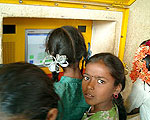
- Computers - For example, Sugata Mitra’s Hole in the Wall puts computers with specifically designed programmes in the hands of children for self-organised learning.
- Phones - "As the mobile phone spreads around the world and becomes the main point of access to the web, its potential to promote low-cost learning will also spread."
The document recommends that: "Governments should continue to look to the very best school systems to guide improvement strategies. But increasingly they should also look to social entrepreneurs working at the extremes who may well create the low-cost, mass, participatory models of learning that will be needed in future."
ONLINE EDUCA BERLIN News Service - 2nd Edition, August 2 2010.