











































Listen clearly, so others can hear you
Summary:
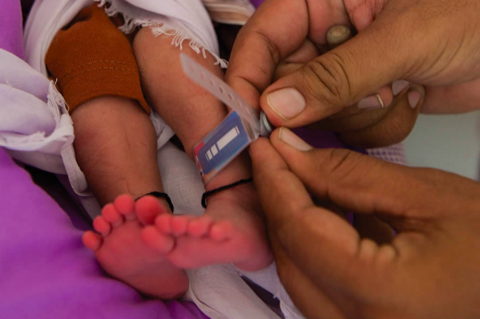
The Vaccine Indicator and Reminder Band (VIR) is a low-cost silicon band with a built-in Timestrip indicator to remind parents when it is time to return to the vaccination center for timely completion of Routine-Immunization schedule. VIR band community acceptance formative evaluation study was completed in Kebbi State, Nigeria and Karachi City, Pakistan. The objective of the qualitative study was to understand what factors facilitated and hindered parents' uptake of a new intervention. Focus group discussions were conducted with parents and healthcare workers and key informant interviews were conducted with community gatekeepers to refine the intervention design. A total of 1000 infants were enrolled to receive the VIR band and during each vaccination follow-up visit, qualitative and quantitative data was collected from their parents. In Karachi a total of 308 exit interviews were also conducted when the infant completed Penta-3 vaccine to capture the overall experience with the VIR band and if parents would recommend it to family and friends. Though a continent apart the two communities had more similarities than differences. In Karachi, community healthcare workers suggested that facility-based vaccination staff should provide the VIR band. In Kebbi, mothers informed that they cannot leave the house soon after birth so help from TBA to take the child to the vaccination center would facilitate timely initiation. Engaging the community and listening to their information and facilitation needs resulted in universal acceptance of the intervention and community's enthusiasm for the continuation of VIR band intervention.
Background/Objectives:
The Vaccine Indicator and Reminder Band (VIR) is a low-cost silicon band with a built-in Timestrip indicator to remind parents when it is time to return to the vaccination center for timely completion of the vaccination schedule. The VIR band was designed using human-centered design method and tested in 2015 with 367 infants for safety and functionality. During 2016-18 the VIR band community acceptance formative evaluation was completed in Kebbi State, Nigeria and Karachi City, Pakistan. The objective of the qualitative study was to understand what factors facilitated and hindered parents' uptake of a new intervention.
Description of Intervention and/or Methods/Design:
Focus group discussion were conducted with parents and healthcare workers and key informant interview were conducted with community gatekeepers to refine the intervention design. The participants were purposively selected and the interviews were analyzed thematically. This was done to increase VIR band acceptance and continued use of a novel intervention. A total of 1000 infants were enrolled to receive the VIR band and during each vaccination follow-up visit the qualitative and quantitative data was collected from their parents. In Karachi a total of 308 exit interviews were also conducted when the infant completed Penta-3 vaccine to capture the overall experience with the VIR band and if parents would recommend it to family and friends. In Kebbi State, 18 IDI and 7 FGD were conducted at end-line to gauge communities' wiliness to continue the intervention. Participation in qualitative study and enrollment in the VIR band intervention was voluntary.
Results/Lessons Learned:
Though a continent apart the two communities had more similarities than differences. In Karachi, community healthcare workers suggested that facility-based vaccination staff should provide the VIR band and an incentive of up-to 1$US would encourage them to participate in referral of new born infants for timely initiation. In Kebbi, mothers informed that they cannot leave the house soon after birth so help from TBA to take the child to vaccination center would facilitate timely initiation. Parents in both study sites appreciated the information they received about vaccination and stated that it helped them better understand the need for timely initiation and completion. This finding was used to design an elaborate community engagement and communication campaign in Karachi and jingle in Hausa for Kebbi radio, just before the start of the enrollment phase. The VIR band acceptance rate was at 98% in both study sites.
Discussion/Implications for the Field:
Prior to the VIR band intervention roll-out, it was important to understand communities' perceptions around vaccination, reminder mechanisms and if they would be willing to accept an innovative device to secure on the ankle of their infant. The feedback from parents, healthcare providers, and policymakers were incorporated in the VIR band intervention. Engaging the community and listening to their information and facilitation needs resulted in the universal acceptance of the intervention and community's enthusiasm for the continuation of the VIR band intervention. Vaccination program managers also expressed their support for the VIR band after feedback from community leaders.
Abstract submitted by:
Dr Noor Sabah Rakhshani - Consultant Public Health Practitioner
Approved abstract for the postponed 2020 SBCC Summit in Marrakech, Morocco. Provided by the International Steering Committee for the Summit. Image credit: Harry Giglio & Shehzad Noorani