










































Introducing Adolescent Livelihoods Training in the Slums of Allahabad, India
Population Council
This briefing describes a livelihoods project for economically poor girls from the testing of the feasibility and acceptability of a pilot livelihoods project through implementation, evaluation, and lessons learned. In India, by ages 15-19 more than 40 percent of boys are economically active compared to about 25 percent of girls. "For girls, the lack of opportunities to generate income is coupled with restricted physical mobility within the community and limited decisionmaking power within the household...."
The Population Council and its partners are promoting a “livelihoods approach” that aims to expand the decisionmaking power of young women by building social networks and developing financial and income-generating capacities with the hope that girls, communities, and families will change how they perceive the possibilities for girls.
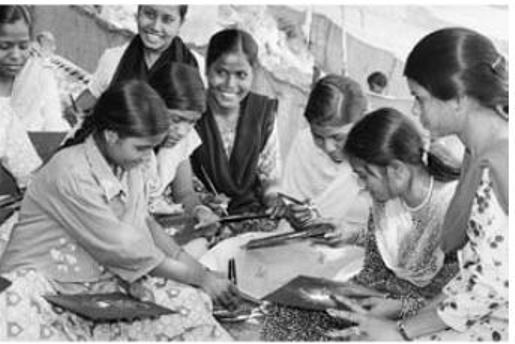
The Council’s pilot project integrated livelihoods activities for adolescent girls aged 14-19 into CARE’s reproductive health programme for slum dwellers. Literate girls, aged 14-19, were trained as peer educators. They conducted group sessions on reproductive health in their homes weekly in both experimental and control communities. Experimental groups were given vocational counseling, savings account information, and follow-up support from a peer educator, as well as a choice of 19 vocational courses. Baseline and endline surveys measured the effect of the project by comparing changes in various behavioural and attitudinal outcomes for adolescents in the control and experimental areas before and after the intervention.
Baseline surveys measured reproductive health knowledge, inclination to save, time spent on chores, degree of permission seeking done by the girls within the family, and likelihood of travel. The endline survey showed the experimental group was: likely to know about safe locations for unmarried women to congregate, be a member of a group, score higher on indexes measuring social skills and self-esteem, be informed about reproductive health, and spend time on leisure activities. "On the other hand, the project did not have a demonstrable effect on gender role attitudes, mobility, work expectations, time use, or labor market work, likely because of the short duration of exposure, as well as the limited number of times that groups convened." More than 80 percent of participants in the experimental areas continued to use their vocational skills after the project ended, and more than 50 percent were able to open savings accounts in their name at the local post office. However, only 10 percent earned income from selling products that they made.
Lessons learned include: "Short-term projects can raise awareness, self-esteem, social skills, knowledge of safe spaces, and group identification; however, they cannot be expected to alter the structure of opportunities available to adolescent girls. To reduce deeply entrenched gender disparities and enhance girls’ ability to influence their own lives, future projects should incorporate greater interaction with other participants and with older family members. Moreover, increased effort should be devoted to developing group cohesion and improving young women’s communication, negotiation, and decisionmaking skills."
The Population Council website, accessed July 29 2013.
- Log in to post comments