










































Innovating, Learning, and Progressing: Misinformation Management and Digital Community Engagement Unit [Presentation from the Sharing Learning from Polio SBC Side Event at the 2022 SBCC Summit]
United Nations Children's Fund (UNICEF)
"Misinformation is and will always be a part of the information ecosystem. We can 'manage' misinformation but can never fully 'eradicate' it."
Delivered at the Sharing Learning from Polio SBC: Misinformation, Social Data and Conflict side event at the 2022 International SBCC Summit, this presentation explores the work of UNICEF Polio Team's Digital Community Engagement Unit (DCEU) around digital engagement and misinformation management in the wake of the COVID-19 pandemic. DCEU is an initiative that UNICEF piloted in five countries in partnership with Public Good Projects (PGP); it is reaching more than 38 countries as of this presentation.
As Adnan Shahzad explains, COVID-19 forced the temporary cessation of all oral polio vaccine (OPV) communication and campaigns. When the campaigns restarted, there was a lot of misinformation flowing around the COVID-19 vaccines; polio workers were observing that community concerns around COVID-19 vaccines were affecting polio vaccine acceptance. So, UNICEF started tracking the misinformation regarding polio and was inspired to set up the DCEU. DCEU activities include: online social listening, messaging and content design, rapid response and message distribution, digital social mobilisation, and impact assessment. The UNICEF Polio Team also offers workshops, capacity building, technical support, and access to related tools and technology to all polio endemic, outbreak, and at-risk countries.
DCEU uses online social listening tools to analyse the social media landscape and to track circulating narratives around polio vaccines. These narratives include rumours/misinformation, such as questioning religious permissibility of OPV. DCEU then alerts the relevant UNICEF regional and country offices to these communication challenges. Once analysed for potential impact, DCEU partners with UNICEF country offices to create misinformation response campaigns. DCEU's preexisting messaging repositories can help increase the speed of campaign deployment by up to 50% for both pre-bunking and debunking of misinformation.
Lessons learned to date through this work include:
- Misinformation is natural: Analysis of more than 2 million social media posts regarding polio identified information gaps and misinformation narratives in 80% of covered polio outbreak and endemic countries.
- Digital is not optional: Over 63% of the world's population is online, and the impact of social media is well documented, even in areas without internet. Yet few social and behaviour change (SBC) teams have digital engagement specialists.
- Polio is not the only priority: Governments and teams in polio outbreak and endemic countries are dealing with dozens of emergencies and outbreaks including but not limited to polio, cholera, Ebola, and COVID-19.
Recommendations include:
- Create and support misinformation management task forces.
- COs that have a task force are more likely to respond to misinformation.
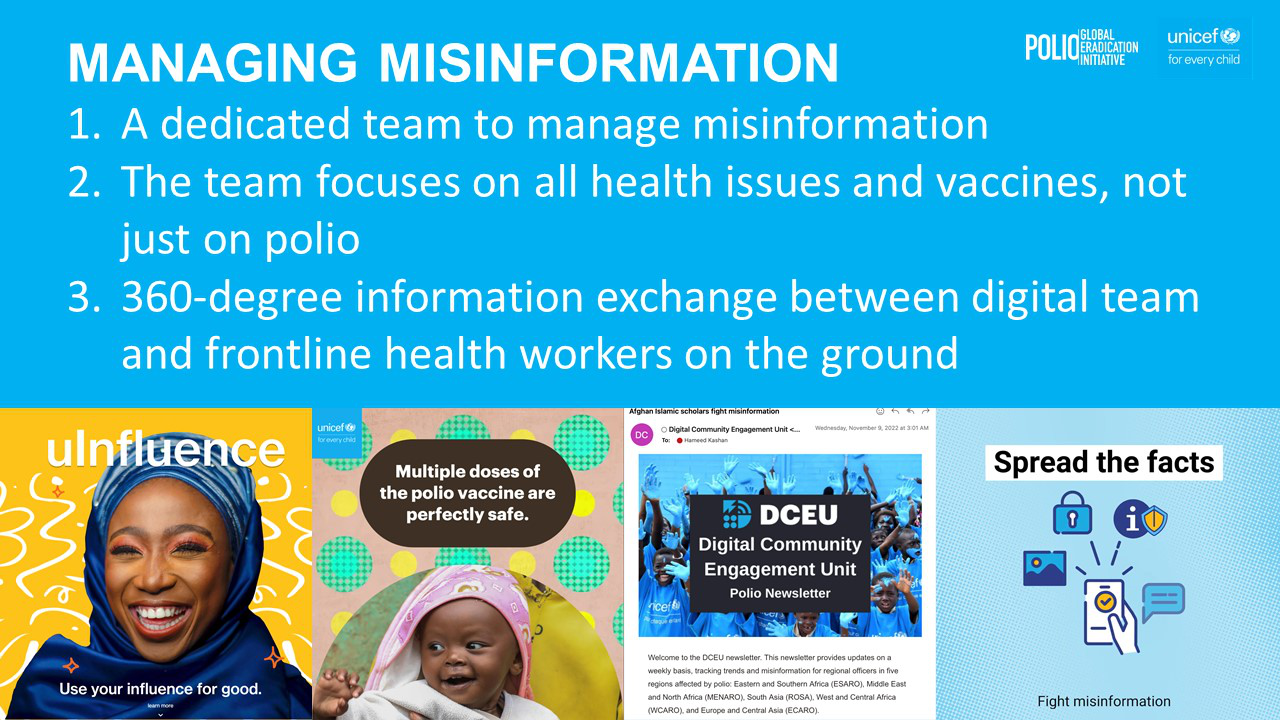
- Task forces must focus on all health issues and vaccines, not only polio.
- Members of the task force must include all stakeholders, particularly Global Polio Eradication Initiative (GPEI) partners.
- Include digital engagement in every SBC plan.
- Data from online social listening is a great indicator of community sentiment.
- Digital engagement is more cost effective than other mass media options.
- Messaging can be highly tailored to the local context and audience.
Among the audience questions and observations raised was one about the extent to which co-creation can contribute to an effective misinformation response. At DCEU, with all the top rumours, they develop generic content and then work with UNICEF country offices to customise it for local context before deployment. DCEU has used this approach in a few countries and found it to be highly time efficient. Polio endemic, outbreak, and at-risk country teams are encouraged to reach out to DCEU for digital engagement and misinformation management support. Shahzad also clarified that, while messaging is part of what DCEU does, it's not all about messaging. Rather, it "is a combination of creating conversations and encouraging dialogue."
Click here, and then click on the Part 1 video recording, to locate and watch Shahzad's presentation (beginning at approx. 2 hours and 40 minutes into that recording).
Poliokit.org, January 6 2023. Image credit: UNICEF Polio via Twitter