










































The Infinity Loop for Optimising Development of Empathy
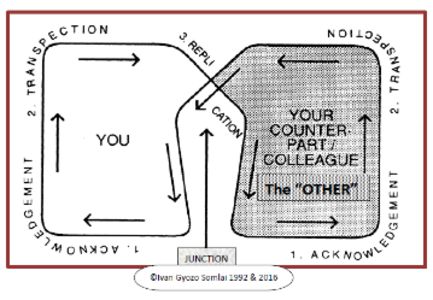
"Be it bureaucratic disagreements, political imbroglios, development project multinational team disagreements or violent security circumstances, it has often been exceedingly difficult to attempt - let alone actually engage in - useful dialogues with adversaries, disputants or counterparts....Yet dialogic efforts are indispensible in increasing understanding among conflicting or adversarial parties."
In this paper, Iván Gyozo Somlai outlines a process integrating socio-anthropological and psychological techniques for more harmonious and effective communication between counterparts, disputants, or adversaries in an effort to systematically optimise the development of empathy amongst dissident stakeholders. Somlai has used the "Infinity Loop" he describes during efforts to find meaningful ways of interacting between expatriates and hosts so as to enhance mutual understanding and thereby promote more effective cross-cultural, multiethnic collaborations. He has facilitated discussions about this model and efforts to utilise it in Nepal, Pakistan, Indonesia, Russia, and Canada.
Somlai describes "the empathy issue" as "the paucity of efforts to develop empathy amongst belligerents and government; or between insurgents and villagers; or between criminals and security services simply abet continuation of misunderstandings over certainty; suspicion over trust; contempt over respect; shallowness over profundity." Understanding "the Other" - referring to the interlocutor on the other side - requires "mutual, deep analysis and relationship building that explores and analyses one another's metacontext: society, culture, language, history, personal household circumstances, education, occupations, motivations and so on." The hope is that sincere understanding can elicit empathy, which thereafter facilitates acceptance and adoption of changes in attitudes, behaviours, and values.
The process involves 3 complementary stages:
- Acknowledgment - All stakeholders should try to understand and accept that there are, indeed, differences in the majority's culture generally and the subgroups specifically in patterns of thought, behaviour, attitudes, and ethics. Hopefully avoiding a relativistic morality, the parties (i.e., you and the Other) would do well to candidly admit that, while one stakeholder does not necessarily agree with any or all differences, there is nonetheless a recognition that local context obligates or shapes these differences. "As such, these differences have innate - if somewhat incomprehensible - validity."
- Transpection - "Were the first step completed honestly, the respective individuals would be open to other ideas and ways of doing, i.e. ameliorated attitudes and behaviours. Then, they could endeavour to step into the minds of their counterparts and explore the reasons behind the differences; this process helps to develop empathy." So how does one get into another's mind? Somlai borrows from interdisciplinary insights in describing approaches for optimising the Transpection stage: the Set; the Exchange; and the Transition. These steps involve, for example, optimising the non-verbal environment when meeting with "the Other".
- Replication - An iterative process for encouraging the "Other" to open up to you involves: (i) predetermining what you would like the "Other" to discuss or explain and (ii) delving into the "Other's" motivations for believing why he or she should open up with you, not why you think he or she should.
"Regardless how the interaction might turn out - meeting confirmed or not; dialogue informatively rich or not - as long as the 'Other' felt comfortable with you, there is a good chance that same person would be willing to again interact with you; and if patience, optimism and confidence are sustained, progress and peaceful resolutions have a chance to emerge....With increased trust comes understanding and the evolution of empathy. Empathy can nurture harmony, respect, compassion and incentive for mutual exploration of common ground."
Pakistan Journal of Peace & Conflict Studies Vol. 1, No. 1. Jan-Jun 2016, pp. 15-29 - sent via email from Iván Gyozo Somlai to The Communication Initiative on February 22 2017. Image credit: © Iván Gyozo Somlai, 1992 & 2015
- Log in to post comments