










































Increasing Black, Indigenous and People of Color Participation in Clinical Trials through Community Engagement and Recruitment Goal Establishment
Fred Hutchinson Cancer Research Center (Andrasik, Broder, Wallace, Chaturvedi, Bock, Oseso, Aina, Kublin); Walter Reed Army Institute of Research (Michael); Johns Hopkins Bloomberg School of Public Health (Beyrer); FHI360 (Lucas); National Institutes of Health (Wilson, Mensah)
"Effectively engaging BIPOC communities in clinical research is critical to addressing the history of ethical research abuses and the development of trustworthy reputations and relationships. Establishing these conditions should increase vaccine confidence, acceptability, and uptake..."
Longstanding social and economic inequities elevate health risks and vulnerabilities for Black, Indigenous, and People of Color (BIPOC) communities in the United States (US). Meaningfully involving these communities in vaccine trials is seen as crucial for inclusive vaccine acceptance and uptake efforts. However, data highlight the underrepresentation of BIPOC communities in infectious disease research - in part due to perceptions that there are too many barriers to engaging with BIPOC communities. This paper describes and assesses the effectiveness of the community engagement methods used to enrol BIPOC volunteers in the COVID-19 Prevention Network (CoVPN)-sponsored vaccine efficacy trials in order to inform future efforts to ensure inclusive research participation.
As organisers explain, when the HIV Vaccine Trials Network (HVTN) Leadership Operations Center became part of the CoVPN in March 2020, the Community Engagement Team led community engagement efforts for COVID-19 vaccine efficacy trials. The HVTN has worked to prioritise community engagement across its preventive HIV vaccine trials since its founding in 1999. Their efforts centre around relationship building, trustworthiness, and bidirectional communication. Community members are at the heart of these efforts, which are guided by behavioural theories and based on Good Participatory Practice (GPP). For example, community working groups (CWGs) and community advisory boards (CABs) are convened to provide guidance and direction for efficacy trials, with clear lines of communication to clinical research site staff and leadership. Clinical research sites are also required to develop annual work plans that outline processes and goals for community engagement efforts with measurable objectives that are reviewed and approved by the HVTN Community Engagement Team.
Pivoting to COVID-19 work required reaching out to new and existing partners, engaging in conversations to understand how COVID-19 was impacting their respective communities, exploring barriers to trial participation and challenges to vaccine confidence and acceptability, and identifying processes to ensure community input into research protocols and community engagement efforts. These conversations informed a four-part community engagement strategy that was executed by the CoVPN:
- Increasing community awareness and knowledge to address and correct misperceptions, misinformation, and myths, which was based on use of community-based participatory research (CBPR) approaches and collaboration with partners such as the Community Engagement Alliance (CEAL) Against COVID-19 Disparities. "Effective community engagement involves community members at all stages of the research. As protocols were being developed, a CoVPN CWG composed of clinical research site community engagement staff and CAB members was convened to offer insight into needed educational materials, review materials in development, and provide general guidance and direction for community engagement efforts....Access to these materials and information in English and Spanish was facilitated through the development of a US-focused website, the use of a toll-free call center with Spanish language capacity, and a publicly accessible Dropbox that included infographics, educational videos, social media posts, animations, and slide sets....In addition to general public education, the materials drove COVID-19 vaccine inquiries to the website by referencing the URL [of the CoVPN]. Each page on the website included a prominently displayed 'Volunteer Now' link that directed interested parties to the Volunteer Screening Registry and its pre-screening survey."
- Working in partnership with institutions and organisations with whom longstanding trusting relationships have been established, such as social service providers, advocacy organisations, physician and medical professional associations, media, academic institutions, local/state/national government partners, and faith-based organisations, particularly those who serve BIPOC communities. "The HVTN and its clinical research sites have relied on such partnerships to assist in...efforts to communicate and share information with communities and potential participants with humility and authenticity. This involves knowing and understanding community context and needs, actively listening to fears and concerns of community members, being truthful and transparent at all times, ensuring that all information is provided in plain language, and making resources available from trusted sources to help community members make informed decisions."
- Leveraging the breadth of established relationships from the HVTN's history of engagement in faith communities, which involved the CoVPN Faith Initiative's establishment of a faith-based advisory council to provide guidance and direction for a national faith-focused CoVPN education programme that used anti-racism, anti-homophobic, anti-transphobic and other principles. "Six Faith Ambassadors, representing clergy from a variety of faith traditions, were identified across the US to support educational activities and speak to the intersection between faith and science, with a focus on BIPOC communities. Faith Ambassadors worked closely with more than 30 regional faith leaders to engage congregations and faith-based organizations and to identify additional channels for message dissemination."
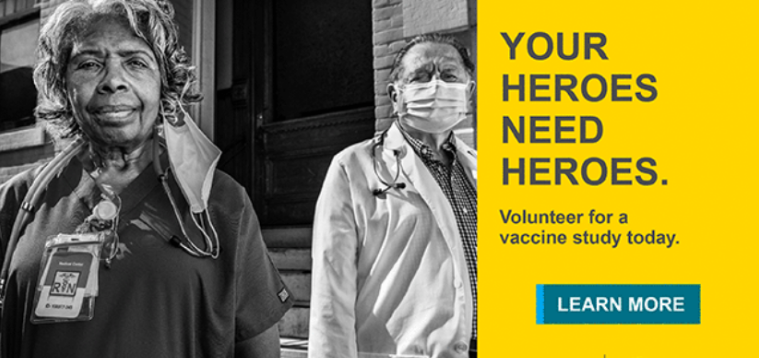
- Integrating in-language and in-culture marketing into the outreach strategy, whereby the CoVPN launched a cross-platform campaign focused on Latino/a/Hispanic and Black/African American communities. The campaign, "Help End the Uncertainty", was developed from audience insights gathered through consumer research with priority audiences. Campaign tactics for generating 600,000 volunteer signups on the CoVPN study registry involved "a robust media mix including TV, connected TV, radio, internet audio, digital platforms and social media, as well as partnerships and sponsorships with trusted organizations such as the American Association of Retired People, BlackDoctor.org and celebrity personalities....[T]he campaign consisted of hundreds of content pieces in Spanish and English-broadcast and digital ads, sponsored content, videos, quizzes, interviews, testimonials, and advertising spots that combined user-generated testimonials with a Harrison Ford [US actor] voice-over." In addition, the CoVPN established a blog, "COVID-19 Vaccine Matters" with the goal of providing "clear, current, and engaging information on the trials as they progressed, addressing issues of concern and giving stakeholders a 'front-row seat' as the science unfolded."
To assess the effectiveness of the community engagement strategy, the researchers analysed the racial and ethnic demographic data of enrolled participants across the Moderna, AstraZeneca, Johnson & Johnson (J&J), and Novavax trials for the US-based CoVPN-affiliated clinical research sites only. Across the four trials for which data are available, 47% of participants enrolled at CoVPN sites were BIPOC. "In general, the CoVPN sites were more successful in recruiting BIPOC participants than non-CoVPN sites..." Author Dr. Michele Andrasik said in an interview that she hopes these results show that the perceived barriers to BIPOC involvement in infectious disease research are surmountable and that "it is possible to overcome them through long-term investments in relationships within the community and by building reputations of trustworthiness as researchers and institutions."
Reportedly, trials opening later benefitted from strengthened community engagement efforts and greater and more diverse volunteer registry records. However, despite robust fiscal resources and a longstanding collaborative and collective effort, enrollment of White persons outpaced that of BIPOC communities. To ensure the equitable enrollment of BIPOC individuals, the researchers urge, intentional efforts are needed, including an emphasis on diversity of enrollment in clinical trials, establishment of enrollment goals, ongoing robust community engagement, population-specific trials, and research to inform best practices.
In conclusion: "it is clear that prolonged and directed engagement with priority communities can yield equitable inclusion. Ongoing commitment to these standards and partnerships will help communities view researchers and research institutions as trustworthy, and build and strengthen rapport between communities, researchers, and research institutions."
PLoS ONE 16(10): e0258858. https://doi.org/10.1371/journal.pone.0258858 - sourced from "Community Engagement Ensures Equitable Inclusion in Vaccine Trials: New Study from COVID-19 Prevention Network Demonstrates Impacts of Engaging Black, Indigenous, People of Color Communities", Fred Hutch, October 19 2021, and News Release, October 29 2021 - both accessed on October 20 2021. Image credit: CoVPN
- Log in to post comments