










































Health Promotion: Ottawa Charter
"Health promotion is the process of enabling people to increase control over and improve their health. Health is seen as a resource for everyday life, not the objective of living. Health promotion is not just the responsibility of the health sector, but goes beyond healthy lifestyles to wellbeing."
This planning model emerges from the Ottawa Charter for Health Promotion, an international agreement signed at the First International Conference on Health Promotion, organised by the World Health Organization (WHO) and held in Ottawa, Canada, November 17-21 1986. It launched a series of actions among international organisations, national governments, and local communities to achieve the goal of "Health For All" by the year 2000 and beyond through better health promotion.
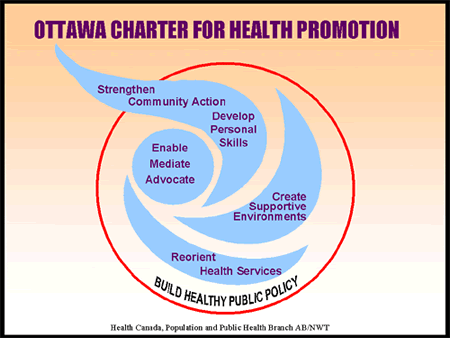
The basic strategies for health promotion were prioritised as:
This planning model emerges from the Ottawa Charter for Health Promotion, an international agreement signed at the First International Conference on Health Promotion, organised by the World Health Organization (WHO) and held in Ottawa, Canada, November 17-21 1986. It launched a series of actions among international organisations, national governments, and local communities to achieve the goal of "Health For All" by the year 2000 and beyond through better health promotion.
The basic strategies for health promotion were prioritised as:
- Advocate: Political, economic, social, cultural, environmental, behavioural, and biological factors can all favour or harm health. Health promotion aims to make these conditions favourable.
- Enable: To support health equity and quality of life, individuals must become empowered to control the determinants that affect their health through mechanisms such as access to information, life skills, and opportunities to make healthy choices.
- Mediate: Health promotion cannot be achieved by the health sector alone; rather, its success will depend on the collaboration of all sectors of government (social, economic, etc.) as well as independent organisations (media, industry, etc.). These professional and social groups, alongside health personnel, have a responsibility to mediate between differing interests in society for the pursuit of health. To that end, health promotion strategies and programmes should be adapted to the local needs and possibilities of individual countries and regions to take into account differing social, cultural, and economic systems.
- Build healthy public policy, because joint action contributes to ensuring safer and healthier goods and services, healthier public services, and cleaner, more enjoyable environments.
- Create supportive environments, because there is a guiding principle for the world, nations, regions, and communities to take care of each other, our communities, and our natural environment.
- Strengthen community action, because, when communities are empowered through access to information and learning opportunities for health, etc., health promotion works through concrete and effective community action in setting priorities, making decisions, and planning and implementing strategies.
- Develop personal skills, because health promotion supports personal and social development by providing information, education for health, and enhancing life skills in school, home, work, and community settings.
- Re-orient health care services, because the responsibility for health promotion in health services is shared among individuals, community groups, health professionals, health service institutions, and governments.
"Caring, holism and ecology are essential issues in developing strategies for health promotion. Therefore, those involved should take as a guiding principle that, in each phase of planning, implementation and evaluation of health promotion activities, women and men should become equal partners."
Source
WHO website and Ottawa Charter for Health Promotion [PDF], Better Health Channel Fact Sheet - both accessed September 8 2014.
Comments

- Log in to post comments