










































Harnessing the Power of Behavioral Science: An Implementation Pilot to Improve the Quality of Maternity Care in Rural Madagascar
ideas42 (Smith, Lennon, Kau, Flanagan); TANDEM S.A.R.L. (Ranjalahy); Accessible Continuum of Care and Essential Services Sustained (Ingabire); Population Council (Warren)
"Whether offering a quick and easy way to record birth times or channeling what might have been a bothersome crowd of relatives waiting around the health facility into an enthusiastic support team, providers immediately recognized the value these solutions could bring to their work."
Postpartum hemorrhage (PPH) is the leading direct cause of maternal deaths worldwide, and women in low-income countries are at particularly high risk of dying from PPH-related consequences. Timely, appropriate management, outlined in various protocols, can prevent many of these deaths, yet providers do not consistently adhere to these best practices. Qualitative research conducted in Madagascar, for example, revealed that providers' perceived low risk of PPH may influence their compliance. Behavioural science has been used to shift provider behaviour in many settings. This article describes how the use of applied behavioural science and a codesign process resulted in cocreation and testing of 4 interventions in southeastern Madagascar that ultimately aimed to improve quality of care during labour and delivery.
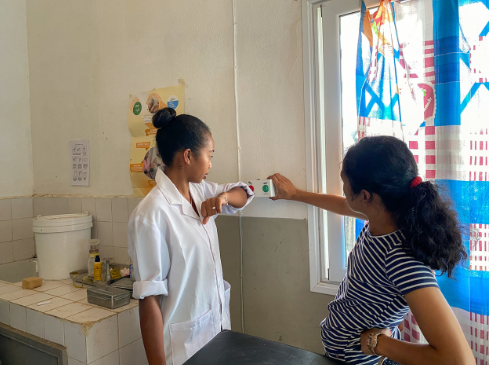
The behavioural design methodology (see Figure 1 in the paper) leverages insights from behavioural economics, social psychology, human-centred design, and other disciplines to develop and test innovative solutions that reshape people's environment to positively influence their behaviour. Researchers applied this methodology to identify behavioural drivers, develop solutions, and build a programme theory of change. Seven interventions were iteratively refined, discarded, or replaced during user testing in a collaborative codesign process that was conducted with postpartum women, healthcare workers, facility in-charges, and other community members. The 4 chosen solutions developed included: (i) a timer to remind providers of the 1-minute window to administer oxytocin; (ii) a glow-in-the-dark poster illustrating a simplified algorithm for PPH management; (iii) badges to assign family members tasks to support providers during labour and delivery; and (iv) a risk visualisation exercise. Implementation research was conducted to understand the adoption, desirability, feasibility, and appropriateness of the solutions and explore suggestive findings related to impact.
The implementation of solutions occurred in 10 rural facilities from 2 districts in southeastern Madagascar through clinical mentors managed by the Accessible Continuum of Care and Essential Services Sustained project funded by the United States Agency for International Development (USAID). Providers received orientation using videos during November-December 2020. Results of the test phase indicate that providers reported high adoption of the timers and task badges during routine deliveries. They remarked on the desirability and appropriateness of the timer, task badges, and algorithm poster, as well as the value of the cocreation process. However, the risk visualisation exercise that intended to convey the importance of adhering to PPH management protocols faced challenges in implementation and delivery caused by the COVID-19 pandemic.
The researchers gathered qualitative evidence around some of the intermediate outcomes or mechanisms in the theory of change to assess the promise of potential impact of the interventions. For instance, the intervention increased provision of oxytocin within 1 minute of birth by increasing the prominence of this time window in providers' minds, elevating the perceived consequences of delayed administration, and creating awareness of provider performance in the timeliness of administration. Qualitative evidence suggested shifts in all 3 of these mechanisms. Furthermore, during interviews, providers shared that the badges improved communication between providers and family members and helped ensure they are able to complete their work by clarifying roles. Family members also perceived task assignment as a sign of the provider's trust in them. One provider said, "The benefits are the empowerment of the family. Everyone participates in the tasks... [T]he distribution of badges creates solidarity."
In discussing the findings, one point of emphasis is the value of codesign. The researchers attribute the high adoption rates of the tools in Madagascar to careful attention to detail during collaborative codesign with healthcare workers, who shaped the solutions to fit their needs. Close collaboration and cocreation with the service delivery partner also helped to ensure that the interventions fit existing or feasible project channels and could be seamlessly integrated into their well-established operations. Per the researchers, their "experience suggests that, in certain cases, a relatively small up-front investment in time and resources for codesign would repay itself by starting implementation on much more solid footing and with stronger buy-in from stakeholders."
In conclusion: "It is time for quality-of-care efforts to include more targeted drivers of provider behavior, rather than primarily addressing knowledge gaps, and to consistently consider programmatic approaches beyond training and supervision. Insights from the behavioral sciences can illuminate how psychology interacts with features of a provider's environment to influence their consistent application of clinical protocols...The systematic incorporation of behavioral science evidence and approaches into quality-of-care efforts could further strengthen their impact and adoption."
Global Health: Science and Practice July 2023, https://doi.org/10.9745/GHSP-D-23-00007. Image caption/credit: A research team member engages with a facility-based provider in a codesign activity of the oxytocin timer. © 2020 Madeline Kau/ideas42