










































Happy Schools!: A Framework for Learner Well-Being in the Asia-Pacific
"[I]n response to trends such as demographic changes, rising mobility, growing intolerance and violent extremism, increased competition and rapid technological advancement, many countries have recognized that education has a key role to play in building happier, healthier and more peaceful societies. In particular, this requires reflecting on how to best prepare learners, especially in terms of their human 'competitive advantage' through developing skills and competencies such as creativity, critical thinking, communication and teamwork."
This regional report was prepared by the United Nations Educational, Scientific and Cultural Organization (UNESCO) Asia and Pacific Regional Bureau for Education (UNESCO Bangkok). It presents the research findings from a study conducted as part of the Happy Schools Project. Conceived by Gwang-Chol Chang (UNESCO Dakar, formerly UNESCO Bangkok), this project consists of a number of participatory activities that aim to capture the voices of stakeholders from almost 30 countries in the Asia-Pacific region and beyond on what a happy school means to them. The Happy Schools Project was launched in June 2014 in the aim of promoting learner well-being and holistic development. It follows on the findings of UNESCO Bangkok's research on 'Learning to Live Together', which examined the ways in which education systems can promote peace through education in the Asia-Pacific region. While the concept of 'Learning to Live Together' is often reflected at policy level, there is little evidence as to how it is implemented in practice. Therefore, this report on the Happy Schools Project aims to identify and recognise proven practices at school level that integrate this concept.
The premise of this endeavour is that schools that can promote happiness are key to helping fuel a genuine love of learning in and of itself, to the end of ensuring better well-being, health, and achievement as well as success in future life and work. However, a number of external and internal factors are undermining learner happiness. Firstly, factors such as increasing inequality, growing intolerance and the rise of violent extremism are leading schools to face increased cases of bullying from within and increasingly become a target of violent attacks from outside actors. Furthermore, our fast-paced world driven by technological advancement has also become rife with competition and "information overload". Secondly, internal factors within school systems such as poor learning environments, insensitivity of educators, obsolete curricula, and an overemphasis on academic content and test scores contribute to creating unhappier schools. In recent years, happiness has been recognised, both in global agenda-setting as well as in countries' development and education policies, as an important goal to be pursued. Examples include the 2011 United Nations General Assembly Resolution devoted to happiness and the references to well-being throughout the Sustainable Development Goals (SDGs). Growing efforts to measure happiness have also coincided with increased efforts to measure the quality of education, for instance through global indices and international student assessments.
This report presents the findings of a study based on several research methods, including a desk study, a survey (of over 650 students, teachers, parents, school principals, and support staff), a seminar, and a workshop with school-level stakeholders. It explores the global and regional context in terms of theories of happiness and global initiatives, and how happiness is reflected in the development and education policies of selected countries in the Asia-Pacific region. It then presents the main outcome of the study: the Happy Schools Framework, which consists of 22 criteria for a happy school, as well as examples of strategies for reaching each of the criteria in schools.
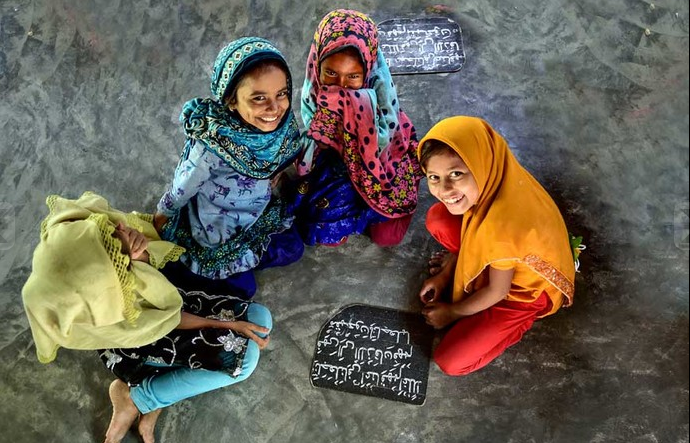
To cite only one example of a Happy Schools Project activity, the Happy Schools team hosted an art contest in early 2016 in an effort to capture actions, moments, and ideas that are promoting happiness in schools. All residents of the Asia-Pacific region were invited to submit images of any kind (photos, drawings, cartoons, paintings, graphics, and posters) along with a caption/description that answers the question: What does a Happy School look like to you? Thirty winners were selected from the pool of entries and then featured in this report (see example, above), displayed for the Happy Schools Art Exhibition from March 25 to April 3 2016 at The Commons in Bangkok, Thailand, and available to view here as an e-exhibition.
The results of the Happy School Survey provided the basis for identifying the 22 criteria for a happy school under 3 broad categories: People, Process, and Place. The feedback compiled through the Happy Schools Seminar highlighted many promising and innovative practices being implemented in schools and provided examples of strategies that schools can use to reach each of the criteria. The following describes some of these examples:
- People: Respondents cited: (i) friendships and relationships in the school community, with the findings identifying school practices that encourage parental involvement, foster interactions between students of different grades, and directly involve community members. (ii) positive teacher attitudes and attributes, which include characteristics such as kindness, enthusiasm, and fairness, and the role of teachers in serving as inspiring, creative, and happy role models for learners. Respondents saw a need for schools to take this criterion into account in teacher recruitment and evaluation, so as to place more emphasis on teacher personality, attitude, and ethics when hiring and assessing teachers. (iii) positive and collaborative values and practices, including love, compassion, acceptance, and respect. Strategies for promoting these values and practices include visual reminders displayed as posters or illustrations and "dual-purpose learning", whereby various values, strengths, and competencies are highlighted and promoted within the context of an academic topic or subject.
- Process: This category encompasses teaching and learning methodologies that can enhance learners' sense of well-being. The various criteria under this category include: (i) creation of a more reasonable and fair workload for students due to a growing imbalance between study and play that places an emphasis on memorisation in order to prepare for exams; (ii) learner freedom, creativity, and engagement. Accordingly, a happy school should allow for learners to express their opinions and to learn freely without the fear of making mistakes; and (ii) useful, relevant, and engaging learning content, which calls for the content of curricula to reflect contemporary and relevant issues, with guidance for teachers on how to make these issues relevant to learners' lives. According to 14-year-old Nguyen Ngoc Van Thao from VNIES Experimental Secondary school (Viet Nam), who participated in the Happy Schools Seminar, there is stark contrast between the learning content that is assessed and learning content that is useful in everyday life. In her words: "What do you think about a student who gets ten out of ten on a civic education exam about honesty, but has actually cheated in the exam to get such high marks? Or we learn biology to protect our environment - some students get really good marks in biology exams, but they litter trash in the street! We must emphasize that the main purpose of studying is to improve our real life and to help our countries develop..."
- Place: This category refers to contextual factors, both in terms of the physical environment and the school atmosphere. Among the criteria under this category: (i) a warm and friendly learning environment, with the findings indicating the need to place more emphasis on greetings and smiles, as well as introducing music and creating more open classrooms and colourful and meaningful displays; (ii) a secure environment free from bullying, with findings identifying strategies such as the installing of a "buddy bench" on the playground to signify that a student seen sitting on it is seeking friends and enabling learners to interact and better understand one another through shared learning and playing activities; (iii) the need for school vision and leadership, with examples from schools participating in the seminar showing how happiness can be prioritised through school visions, mottos, or slogans to create more positive school atmospheres; and (iv) the need for more open and green learning and playing spaces to enhance learner happiness and well-being. Suggested strategies include establishing relaxing and creative spaces, having a school garden, as well as making use of outdoor spaces so that learners can connect with nature while also engaging in investigative or physical learning activities.
Reflecting on the research findings presented throughout this report, as well as various theories and policy efforts described in it, demonstrate that happiness is defined as a human purpose, with education and learning recognised as a fundamental vehicle to enhancing well-being. "This calls on the need for education systems to embrace alternative forms of learning that allow for learners' unique talents and strengths to shine, while at the same time recognizing that happiness is something collective that can be promoted through learning experiences that foster friendships and relationships among the school community."
The report outlines 2 levels of intervention needed in order to make schools happier places: the policy level and the school level. Such interventions include considerations such as prioritising happiness and learner well-being as part of education policies, introducing a new generation of "positive teachers", and ensuring that the values, strengths, and competencies that can develop and nurture happiness among learners are recognised and evaluated as part of assessment efforts. A number of next steps are identified, with the findings presented in this report suggesting a call for policy dialogue, whereby the findings could be scaled up and translated into succinct conclusions and recommendations at the policy level. With regard to the school level, a number of selected strategies for reaching the criteria in this report provide a starting point for the collection and dissemination of strategies that can be accessed and used by schools. "At the same time, the over-focus on 'numbers' highlights the need for further advocacy to raise awareness and help change attitudes with regard to the meaning of a 'good quality' education, in order to give more public recognition to the importance of happiness and well-being in schools in a world driven by quantitative measures, benchmarking and competition. The relevance of many of the issues examined in this report also indicates the potential of the Happy Schools Framework to be scaled up, adapted and applied in other regions beyond the Asia-Pacific. Given growing efforts to measure both happiness and educational quality, the Happy Schools Framework could also present the basis for an integral measure of the quality of education."
UNESCO Clearinghouse on Global Citizenship Education, November 4 2016. Image credit: Debdatta Chakraborty, India
- Log in to post comments