Global Photography Campaign on Humanizing Development
Information and communication technologies (ICTs) are at the fulcrum of this effort to raise awareness of global successes in the development process and share innovative and successful actions. Everyone can and is encouraged to participate in this global effort by uploading a photograph to the campaign website, which is available in all United Nations (UN) languages as well as Portuguese. Entrants are asked to consider one of the campaign's 14 different thematic areas related to the Millennium Development Goals (MDGs), such as: eradicating extreme poverty and hunger; expanding access to food, clean water, sanitation, education, and health services for the economically poor; and promoting women's leadership and equal opportunity in education and employment.
An interactive blog is meant to stimulate conversation about the images. An invitation to dialogue there reads, "Far too often, people living in developing countries suffer from a pitiable image in the media and the world public opinion. Do you think such a campaign could allow a fresh look? Because some success stories can not come down to one single picture...[t]o illustrate your words, you can send us a photograph (your own or copyright free) and we will publish it along with your comment..."
Media outreach was a pivotal part of the process of galvanising participation. Organisers created a logo (in 7 languages) to represent the campaign in all media efforts, with a focus on portraying a positive and attractive representation of the campaign's hopeful and encouraging spirit. Posters highlighting some examples of the types of photographs sought - also printed in 7 languages - were created and mounted in places like subways and buses. Television and radio stations, and various types of social media, were used as outlets for spreading the word about the campaign (and the campaign website) and the deadline for submitting a photo.
The Selection Committee will choose the 50 photographs that best depict the campaign themes, and results will be released on IPC-IG website on October 30 2009. Some of the key outcomes of the campaign will include a photography gallery to be permanently displayed at the IPC-IG office and open for public viewing; a series of photography exhibitions in several cities around the world; and a photography database that will be shared with the campaign partners and several UN agencies and departments. There will also be a wider dissemination of the photographs through a range of UN communications tools, including:
- The selected photographs and the respective contributors' names will be highlighted in various UN communications channels, such as IPC-IG and UN media campaigns, releases, websites, and so forth.
- The selected photograph will be part of UNDP and IPC-IG photo databases and will be shared with the United Nations Department of Public Information in New York, promoting global visibility to contributors, their work, and participation in the global campaign.
- Contributors will receive a certificate jointly issued by the UNDP International Policy Centre for Inclusive Growth and the campaign partners.
- Contributors will have their names displayed at the IPC-IG photo gallery, which will be launched at a public event on November 2009.
- Photo exhibitions are to be organised in order to highlight the photographs and the contributors and to promote the campaign goals. Exhibitions are planned to be held in New York, Brasilia, São Paulo, and other cities in the so-called "South".
Development Aid.
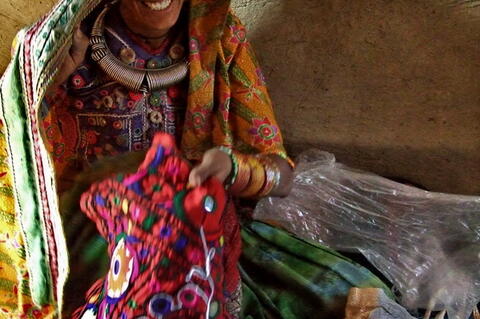
Editor's note: The above picture (credit: IPC Photo/Prayash Giria) is an example of a photo received as part of the Campaign. The situation it refers to is as follows: "The lady in the photo is a Meghwal Tribal residing in Hodka Village, some 70 kms from Bhuj, in the Kutch District of Gujarat. Once nomads entirely dependent on the arid landscape for sustenance, economic growth has recognized their exceptional skills in handicrafts. Today, the entire population of this village enjoys an elevated status because of their work which draws tourists (like myself) from afar. Their work is sold throughout the country and even beyond. although many essential services like drinking water and sanitation are still to be provided, the villagers have a much better life, even compared to the one before the devastating 2001 earthquake. so much so, that they opened a theme resort for the many visitors. And all began with just stitching."
IPC-IG is based on a partnership between the United Nations Development Programme (UNDP) and the Institute for Applied Economic Research (IPEA), which is linked to the Government of Brazil. By encouraging South-South cooperation, the centre specifically aims to expand the knowledge base and capacities of developing countries to design and implement nationally owned poverty reduction strategies.
United Nations Online Volunteers are supporting IPC-IG in the organisation of this campaign.
Emails from IPC-IG to The Communication Initiative on June 1 2009 and July 8 2009; Campaign website; and Communications & Outreach Strategy Report: Humanizing Development Global Photography Campaign [PDF], sent from Francisco Filho to The Communication Initiative on July 9 2009.