











































Gender and Adolescence: Why Understanding Adolescent Capabilities, Change Strategies and Contexts Matters
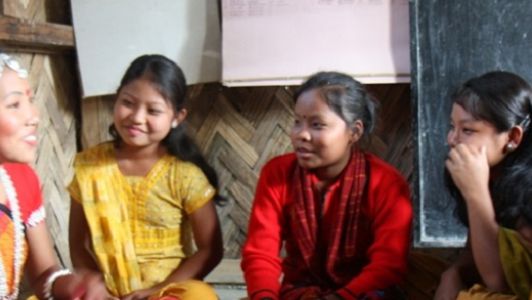
Adolescent transitions shape both girls' and boys' lives, but often in highly gendered ways. Advancing understanding of these gendered dimensions of adolescent experiences is a core aim of Gender and Adolescence: Global Evidence (GAGE), a nine-year (2015-2024) mixed methods longitudinal research programme generating and communicating knowledge on good practice initiatives and policies that support adolescent girls in diverse contexts around the world. To that end, this document explores GAGE's "3 Cs" conceptual framework, also laying out GAGE's core research questions on understanding adolescent experiences and perspectives, as well as on programme effectiveness.
GAGE's focus on gendered adolescence is echoed in the Sustainable Development Goals (SDGs), which include a number of adolescent-focused targets. For example:
- addressing the nutritional needs of adolescent girls (Target 2.2)
- ensuring universal access to sexual and reproductive health-care services (Target 3.7)
- ensuring that all girls and boys complete free, equitable and quality primary and secondary education (Target 4.1)
- eliminating all forms of violence against all girls (Target 5.2), including all harmful traditional practices (Target 5.3)
- ensuring sanitation and hygiene for girls (Target 6.2)
- achieving decent work for all young people (Target 8.5)
- providing access to safe and public spaces (Target 11.7)
- ensuring equal access to justice for all (Target 16.3)
According to the report, while the SDGs, as compared to the Millennium Development Goals (MDGs), "better reflect the rights and needs of adolescent girls, this alone is not enough to ensure that adolescents are adequately visibilised. GAGE is poised to make contributions to monitoring progress towards the Goals, ensuring that their 'leave no one behind' focus becomes reality." (See also Annex 2, including Table 2: Mapping the GAGE capability domains onto the SDG goals, targets, and indicators.)
GAGE's 3Cs approach focuses on:
- Capabilities outcomes, which GAGE's framework posits fall into two levels: those that relate to individual girls' capabilities and those related to collective capabilities (group-level capabilities that emerge through collective action, are often supported by champions, and refer to forms of cognitive and practical agency that emerge out of the social relationships that develop as a result of sustained interaction (see also Figure 2.2). The report outlines six broad capability domains - education and learning, bodily integrity, physical and reproductive health and nutrition, psychosocial well-being, voice and agency, and economic empowerment - as well as the challenges that adolescents in the Global South face in achieving these and the positive capability outcomes against which GAGE research is assessing progress over time. (For example, GAGE research will consider whether girls are developing a sense of themselves as members of a community, rather than merely their own families, and have access to school- and community-based venues for developing voice and agency.) For more details on the sub-outcomes, see Annex 1.
- Change strategies to support adolescent capabilities, which GAGE contends must facilitate other actors coming together to construct an environment that enables and supports girls to become the women they would like to become. It weaves together approaches that focus on girls with those that engage boys as well as families, schools, communities, and broader services and systems. GAGE is exploring the relative contribution of diverse interventions, including those that emphasise: (i) human capital development, such as vocational training for girls; (ii) gender empowerment approaches, such as clubs that provide girls with access to safe spaces and mentors; (iii) social norm change approaches, including programming that offers boys and men opportunities to explore new masculinities as well as parents' groups, community conversations and media campaigns aimed at re-valuing girls; and (iv) legal reform and awareness tactics that enhance local to national-level capacity for the protection of girls' rights.
- Context dependency, which recognises how local variation in socio-cultural and religious traditions, geographic location, and employment opportunities - combined with broader patterns in population dynamics, conflict, governance, and climate change - are likely to have a profound effect on development trajectories. To facilitate analysis, the GAGE framework's ecological approach distinguishes between family, community, state, and global context spaces and factors, while recognising that in reality, context factors may manifest as a web of influences with multiple sites of overlap and inter-connectedness. For example, when considering information and communication technology (ICT)-based approaches, understanding and building programming around even the most subtle differences in girls' geographical locations can be critical to whether programming helps or hinders progress. While text messaging and social media are transforming many (though not the economically poorest) girls' lives across the world, they can also be risky if adequate guidance is not available. Hmong girls in Viet Nam, for example, report that traffickers often rely on text messaging to tempt potential victims and then make plans with them once they are "hooked".
Stemming from this conceptual framework, GAGE is addressing two core sets of questions. The first is framed around adolescent perspectives and experiences and based on the capabilities narrative presented above. The second set concerns the relative efficacy of different types of change strategies in diverse contexts. GAGE will operationalise these research questions through four broad strands of research as follows: (i) evidence synthesis on what works where and why; (ii) mixed-methods longitudinal impact evaluations of programmes aimed at gender transformation for adolescent girls; (iii) participatory action research with adolescents living in conflict-affected contexts to understand programme legacy effects as they transition through adolescence and into early adulthood; and (iv) responsive research funding, including proposals developed through the GAGE Learning Exchange.
Hosted at the Overseas Development Institute (ODI), GAGE is funded by UK aid from the United Kingdom (UK) Department for International Development (DFID).
GAGE website, January 30 2018 and February 25 2022; and GAGE website, February 25 2022. Image credit: Nathalie Bertrams/GAGE
- Log in to post comments