










































Framing and Visual Type: Effect on Future Zika Vaccine Uptake Intent
Virginia Commonwealth University
Public health emergencies such as infectious disease outbreaks like Zika require quick, effective communication. While social media, including the photo- and videosharing platform Instagram, can play a role in distributing reliable information, it can also contribute to the spread of misinformation and can spark or exacerbate vaccine hesitancy. Seeing the need, then, to develop future Zika vaccine messaging and communication strategies specifically for social media communications, this paper examines two message-related variables - message framing and visual type - and their influence on reported future Zika vaccine uptake intent, as well as on the psychosocial variables leading to intent, as described by leading health behaviour change theories.
The premise of the investigation is that message framing can have an impact on the ultimate effect of messages on health behaviour intent and actions. Gain-framed messages focus on the benefits of engaging in a specific behaviour, while loss-framed messages focus on the consequences of not engaging in a particular behaviour. It would be reasonable to hypothesise that vaccinations, a known preventive behaviour, would be most effectively promoted using gain-framed messages. However, several studies have found that, instead, loss-framed messages work better to promote the HPV vaccine, the measles, mumps, and rubella (MMR) vaccine, and the H1N1 vaccine. A reason for this may be that, while vaccinations are preventive behaviours, they are also often associated with presumed, often disproven adverse consequences.
The concept of risk can be a difficult one for people to grasp. Visuals of all kinds - including graphs, infographics, and photos - are recommended and used more frequently than numeric and verbal communications of risk. Yet a relatively unanswered question is whether there is a difference between distinct types of visuals and their effect on message comprehension and risk perception. Regular photographs, whether in colour or black and white, overlaid with text seem to be similar to internet memes, which tend to have a high level of virality. Infographics (graphic representations of information) boost understanding of health information by utilising a person's visual ability to see patterns and trends, can present complex information or data in a visual format that is both quick and easy to comprehend, and can increase cognitive functions such as inference making.
Health behaviour theories are an essential component of designing effective public health messaging. Two of the most frequently used theories are the Health Belief Model (HBM) and the Theory of Planned Behavior (TPB). The HBM's constructs are perceived severity, perceived susceptibility, perceived benefits, perceived barriers, self-efficacy, and cues to action. The TPB's constructs are attitudes, subjective norms, perceived behavioural control, and behavioural intent.
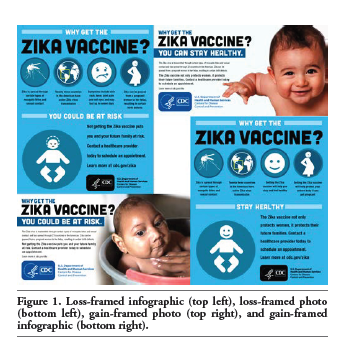
In order to study the effects of Zika message framing (gain vs. loss) and visual type (photo vs. infographic) on future Zika vaccine uptake intent, a 2×2 between-subjects experiment was performed via an online survey in 2017 among 339 United States (US) women of reproductive age (18-49 years). Participants were first provided with the following text: "The Zika virus (Zika) can be spread through mosquitos, through sexual transmission, and from a pregnant woman to her fetus. Most of the symptoms of Zika are mild, but the Zika infection during pregnancy can cause fetuses to have a serious birth defect of the brain called microcephaly - a medical condition in which the brain does not develop normally. Currently, no vaccine or treatment is available for Zika, but several versions of a vaccine are under development and could be available as early as sometime in 2017." They were then randomised to one of four arms: gain-framed photo/text (n=78), gain-framed infographic (n=90), loss-framed photo/text (n=83), or loss-framed infographic (n=88), followed by a questionnaire focused on attitudes and beliefs related to the future Zika vaccine, with the main outcome being intent to get the vaccine.
The study found no interaction between framing and visual type (P=0.116), and there was no effect for framing (P=0.185) or visual type (P=0.724) on future Zika vaccine uptake intent. Some reasons for this outcome:
- The dose of the intervention - the frequency and length of exposure - may not have been strong enough with a single image exposure, and repeated exposure to the message may be needed. This brief exposure, however, is typical for social media in general and Instagram in particular.
- Respondents may not have read the message or read it for comprehension.
- The survey was carried out in early March, considered off-season for mosquitoes in much of the US. The public conversation about Zika at this time was less intense than during the previous summer, a time of heightened risk perception and widespread media coverage. Other factors that were not manipulated in the current study may have influenced the outcome, including message source and virality.
Gain-framed messages emphasised the benefits of getting the vaccine (e.g., it helps you stay healthy), while loss-framed messages underscored the consequences of not getting the vaccine (e.g., you will be at risk for having a baby with microcephaly). The unique nature of the future Zika vaccine could provide a potential explanation: While the vaccine is administered to women, the most salient prevention affects the (potential) fetus. Notably, although this study recruited only women of reproductive age, there were very few women in the sample who were currently trying to conceive. It is possible that this high-risk population may respond differently to messages focused on threats to a fetus than those women not currently trying to conceive. This could indicate the relevance of using both types of message frames for Zika vaccine public health communication campaigns.
The study did find that, when focusing on intermediate psychosocial constructs that are known to influence behaviour and intent, gain-framed messages were more effective in increasing subjective norms (P=0.005) as related to a future Zika vaccine, as well as perceived benefits (P=0.016) and self-efficacy (P=0.032). A main effect of framing was present for the subjective norm composite variable, as well as for four of the five subjective norm items: valuing the opinions of people important to the person in general, parents, friends, and primary care. Among the potential reasons for the apparent effect of gain-framed messages in this study could be that, since the Zika vaccine is not available to the public yet, no reports about perceived adverse effects of the vaccine exist at this time. Thus, the vaccine may be perceived as less risky, which points to a greater effectiveness of gain-framed promotion messages on psychosocial predictors of intent. The researchers suggest that future research should examine whether these findings are reproduced when the Zika vaccine becomes available.
In conclusion, the fact that this visual, Instagram-targeted, social media intervention did not find an effect on reported future Zika vaccine uptake intent, and resulted in limited effects on intermediate outcomes that could lead to either future Zika vaccine uptake intent or future Zika vaccine uptake, underscores the importance of not over-estimating the efficacy of social media messages as standalone interventions and emphasises the importance of continued research into effective integration of these types of interventions as part of a larger campaign. That said, "public health and health communication professionals should consider targeting social norms and perceived benefits related to the Zika vaccine, using gain-framed messages, especially when considering platforms like Instagram. Communication campaigns should include repeated exposure to messages to enhance dose and increase potential effects. Because social media is still a relatively recent phenomenon, and there still is a relative paucity of research into the field, it is essential to continue to expand the small but growing body of interdisciplinary research in this area."
Journal of Public Health Research 2018; 7:1162. DOI: 10.4081/jphr.2018.1162