










































Eradicating Polio: Reaching the Last Child [Webcast]
The Forum at Harvard T.H. Chan School of Public Health - a live webcasting series - aims to provide decision-makers with a global platform to discuss policy choices and scientific controversies, allowing participants to leverage their collective knowledge. In this Forum event, held in advance of World Polio Day 2017 and in partnership with National Public Radio (NPR), experts from the Government of Pakistan, the United Nations Children's Fund (UNICEF), Rotary International, and the Harvard Opinion Research Program explained what factors contributed to the progress that has led to near eradication of the disease. Looking specifically at the latest findings from Pakistan, Afghanistan, and Nigeria, the speakers described the key roles of polling and data collection, community and family engagement, and new communication efforts in reaching populations that are on the move and building trust to enable widespread vaccinations.
For example, Gillian SteelFisher, senior research scientist and deputy director of the Harvard Opinion Research Program, talked about a collaboration between that programme and UNICEF, focused on polling to try to understand the views of parents in each of the three endemic countries. These data show that trust in the vaccinator is essential, and that trust increases as you get closer to home: The most trusted organisation is the local government, traditional healer, and local health organisation, etc. These data also indicate that social support for vaccination is not always visible to caregivers. In Nigeria, 88% of those polled thought vaccination is a very good idea. But when they looked at what they believed that other people thought of it, they weren't as convinced their neighbour thought so. But in fact, their neighbour should, because that neighbour was also polled. This implies that we should bring out people's support so that it's more visible to people, so people can see that this is something supported by "people just like me", by families who care about their children, too.
Ideas were also shared in terms of what steps need to be taken to end transmission and to transition beyond polio. For instance, Jalaa' Abdelwahab, polio unit deputy director, UNICEF, discussed the role of polio survivors, who are one of the partners that UNICEF collaborates with at the local level to actually deliver the message and to identify the risk their children could be vulnerable to moving forward. One of the approaches that the government of Nigeria is looking at, through their transition planning, is what resources/groups have been established from the polio eradication fight, and drawing on those for routine immunisation and for public health as a whole.
Click here to read the transcript, download the MP3 audio, and/or watch the webcast.
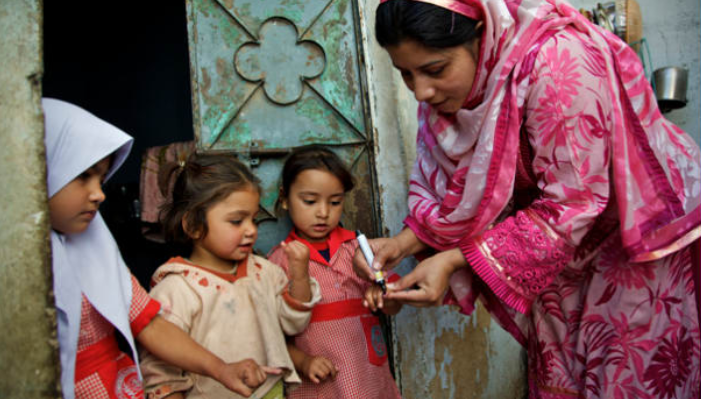
NPR website and The Forum website, both accessed on November 1 2017. Image caption/credit: A health worker in Pakistan marks the fingers of children with indelible ink to show that they have been vaccinated against polio. A. Zaidi / UNICEF
- Log in to post comments