











































Equitable Youth Engagement and Co-Leadership: A Guide and Call for Youth Partnership and Investment
"Equitable youth engagement and co-leadership is essential to addressing the world's most pressing issues, including sexual and reproductive health and rights, climate action, and economic justice and rights."
In September 2022, Women Deliver committed to working with partners in the gender equality and health sectors to delineate a new approach to youth engagement. This approach, called equitable youth engagement and co-leadership (EYECL), centres marginalised youth advocates as designers, experts, and leaders, alongside traditional decision-makers and powerholders, in all gender equality and health advocacy spaces, convenings, and formal mechanisms. This publication introduces the EYECL approach to youth engagement and is designed to provide a clear guide on implementing EYECL within government and other advocacy spaces. It also includes a call to decision-makers and resource holders to partner with and invest in youth using the EYECL approach.
As explained in the guide, "Current approaches to youth engagement within the gender equality advocacy space often stop at youth participation and consultation, yet seldom reach the level of true youth leadership and ownership. This approach not only presents a missed opportunity for stronger gender equality and health outcomes, but also denies young people their right to be in the driver's seat of their future and the planet. Another shortfall of this approach is that youth are viewed as an undifferentiated and homogenous group, thereby ignoring the unique experiences, vulnerabilities, and needs of distinct groups of young people. In doing so, only the most privileged youth are able to engage in influencing on gender equality and health policy. Yet the world's most intractable gender equality and health issues often have a direct, consequential, and disproportionate impact on the most marginalized youth, particularly those that have intersectional vulnerabilities and multiple marginalizing identities such as adolescent girls, non-binary people, those with differing abilities and coming from marginalized minority groups."
The guide defines EYECL as "a transformative, intentional process in which young people, in all their diversity, are in positions of power and leadership alongside other stakeholders who may be traditional powerholders. This includes authority to design and create policies, programs, and initiatives, to make decisions and set agendas, and to hold leaders and decision-makers accountable."
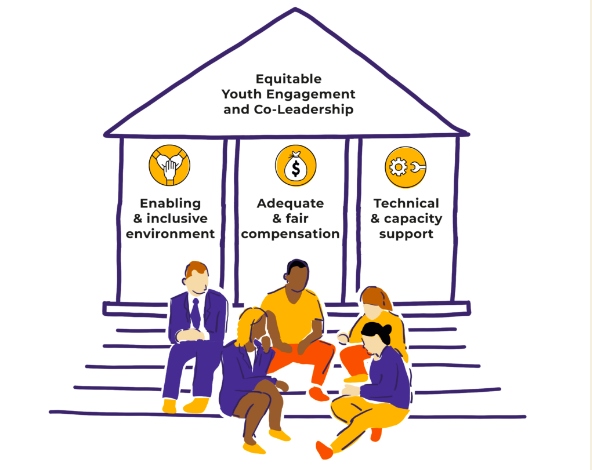
The three pillars of the EYECL process are:
- adequate and fair financial compensation in recognition of their expertise and energy;
- any technical or capacity support needed to be successful in their role; and
- the creation of an enabling and inclusive environment that ensures that: young people are institutionally and structurally recognised as experts (not solely as representatives of an age group) and treated with respect as equals; young people are free to express themselves, and their autonomy is respected without fear of retribution; there is robust safeguarding of young people's mental, emotional, and physical safety; information is shared in a transparent, timely, and youth-friendly way; and equitable youth engagement and co-leadership is integrated into the design or structure of a process at its conception.
The guide is structured as follows:
Chapter 1: Why Youth? - The case is presented for why decision makers should invest in youth and youth-led organisations and integrate young people into programme design and policymaking processes.
Chapter 2: Equitable Youth Engagement and Co-leadership - This chapter establishes a definition and framework for equitable youth engagement and co-leadership. It provides a checklist of best practices for decision-makers seeking to collaborate with youth, along with several case studies that showcase how equitable youth engagement and co-leadership can yield successful outcomes.
Chapter 3: Financing for Youth - This chapter examines barriers to youth financing, both on a global and national level, and positions equitable and trust-based financing as a solution for these collective challenges.
Chapter 4: Call to Action - This chapter delivers a call to action, urging national governments and other decision-makers to establish long-term, sustainable partnerships that support and empower young people as key agents of change.
The call to action puts forward the following recommendations to ensure long-term, sustainable partnerships and financing for youth:
- Adopt the equitable youth engagement and co-leadership approach and transform ways of working with adolescents and youth.
- Increase funding for youth-focused programming and direct funding to young people and youth-led organisations, especially at the national level.
- Convert inequitable funding practices with youth to trust-based, multi-year, flexible, and unrestricted funding.
- Evaluate and report transparently and clearly on actions taken to co-create, co-design, and co-lead with young people, and continuously reflect on learnings from the co-leadership process.
- Improve the quality and transparency of data on funding to youth.
Publishers
<p><p>
- Log in to post comments