










































Entertainment-Education and Rice Pest Management: A Radio Soap Opera in Vietnam
International Rice Research Institute (Heong); Visayas State University (Escalada); Plant Protection Department, Ho Chi Minh City (Huan); Voice of Ho Chi Minh City (Ba); Department of Agriculture, Can Tho (Quynh); Southern Plant Protection Center (Thiet, Chien)
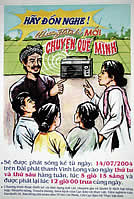
This report explores the entertainment-education (E-E) approach as a platform for rapidly reaching millions of farmers with resource management information. In short, the evaluators cite data here to support the claim that the radio soap opera "Chuyen Que Minh" (or Homeland Story) contributed towards creating favourable attitudes and changing practices related to managing pests, fertilisers, and seeds in Vinh Long province, Vietnam.
As the authors explain, rice farmers' main pest control tactic is the use of pesticides. However, large proportions of their sprays are often misused because of poor knowledge and decisions: although farmers generally focus on highly visible pest damages, like those caused by leaf folders in the early crop stages, these damages have little or no yield loss consequences. To explore the effectiveness of using E-E in integrated pest management (IPM), specialists and drama script writers developed and broadcast a radio soap opera serial featuring 3 sets of characters: those who were positive towards IPM practices, those who were negative, and a transitional group. Drama conversations were developed between these 3 sets of characters, discussing the pros and cons of agricultural inputs. The main character, whose role was transitional, eventually changed beliefs and practices in the series. A total of 104 episodes of "Chuyen Que Minh" were broadcast between July 2004 and July 2005 over the Voice of Ho Chi Minh City and Voice of Vinh Long.
Three surveys were conducted to prepare the drama, monitor its progress, and evaluate its effects: the audience analysis, the baseline or pre-test survey, and the post-test survey. Prior to developing the questionnaire for each of these surveys, the authors conducted focus group discussions (FGDs) to gather materials to structure and frame the questionnaires.
Between pre- and post-launch, farmers' insecticide sprays dropped 31% - from 1.9 to 1.3 sprays per season. Farmers also reported about 9% reduction in seed rates used - from a mean of 210.3 to 191.8 kilogram per hectare (kg/ha) - and about 7% reduction in nitrogen used, from 95.6 to 88.6 kg/ha. There were also slight reductions in the use of potassium and phosphorus; these were not significant. Yields reported were significantly different, with a mean of 4.75-5.12 tonnes (t)/ha in the pre- and post-test, respectively. More farmers in the post-test (30.3%) reported not using any insecticides at all than in the pre-test (17.5%).
The evaluators also compared the practices of those who had listened to the soap opera and those who had not. (See Table 5 on page 1395 of the report.) Farmers exposed to the soap opera had 33% reduction in their seed rates, 9% reduction in their nitrogen rates, and about 60% reduction in the number of insecticide sprays. In addition, there were significantly more farmers exposed to the soap opera who did not use any insecticides at all (54% compared with 15%).
Changes in attitudes were also reported. Fewer farmers (63.5%) believed that "all insects are bad" in the post-test than in the pre-test (79.1%). There were also significant reductions in farmers believing that insecticide sprays had to be applied in the first 40 days after sowing (from 79.8% to 47.6%) and that leaf damages would mean loss in yields (from 59.2% to 38.3%). On the other hand, more farmers believed that pesticides can affect their health, from 61.6% to 86.1%. More farmers in the post-test believed that reducing seed rates from 150-200 to 80-100 kg/ha would result in the same yields, and farmers also modified their beliefs that nitrogen would produce healthier crops.
Evaluators also compared the attitudes of farmers exposed to the soap opera with those who were not. "Soap opera-exposed farmers had significantly modified some of their beliefs that favored reduced inputs." (See Table 7, on page 1396 of the report.)
The evaluators conclude that "Chuyen Que Minh" contributed positively to changes in farmers' beliefs and practices - as evidenced by the statistically significant changes in farmers' beliefs and input practices in seed, nitrogenous fertiliser, and insecticides between pre- and post-test surveys. Comparison of farmers who had listened to the soap opera and those who had not in the post-test survey provided further evidence that the soap opera had contributed to the observed changes.
Furthermore, the evaluators found that the soap opera development process and played a role in facilitating communication of technical information. "The participatory process used in developing the soap opera serial involving technical experts and script writers served as a facilitating platform in the distillation of scientific information that was seamlessly built into drama conversations to educate, entertain and motivate listeners." The evaluators also pointed to the importance of on-the-ground support activities, noting, "The radio clubs established in the villages became primary sources to provide technical support, advice and discussions. The launching day, drama advertising, radio quizzes and 'meet-the-actors' day were also important in popularizing the drama."
The evaluators assert that this process "can easily be adapted to communicate other content for social change, such as environmental protection, crop management, gender equity, health and disease prevention. In most developing countries radio will remain the principal medium for communication in the rural areas....It has high potential to be the vehicle for new agriculture ideas and technologies, especially when the content is developed with high appeal. We showed that IPM contents in E–E soap operas can contribute to changes in beliefs and practices, when systematically developed. Similarly other resource management practices can also be built in, such as practices in land preparation, weed management, nutrient management, water management and environmental management."
The process and ideas piloted in the project described above led to the development of the "Environmental Soap Opera for Rural Vietnam", which revolved around a new drama series called "Que Minh Xanh Mai" (or, "Forever Green Homeland"). Launched on World Environment Day (June 5) 2006, this series was broadcast until July 2007.
Crop Protection, Volume 27, Issue 10, pages 1392-1397, October 2008.
Comments

IPM for rural people
It is really interesting to cope with reducing the use of pesticides...that is promoting a healthy environment and reducing global warming too. We are going to use this approach to go to organic production of vegetables
- Log in to post comments