










































Digital Discrimination: Political Bias in Internet Service Provision across Ethnic Groups
University of Konstanz (Weidmann, Benitez-Baleato); University of Santiago de Compostela (Benitez-Baleato); ETH Zurich (Hunziker, Glatz); Foundation for Research and Technology Hellas, and University of Crete (Dimitropoulos)
"The global expansion of the Internet is frequently associated with increased government transparency, political rights, and democracy....Still, we do not know how the provision of Internet services varies across societal groups in a country or how it is driven by politics. This information is key if we are to assess whether the Internet can indeed empower politically marginalized populations."
This research report documents "a strong and persistent political bias in the allocation of Internet coverage across ethnic groups worldwide.” Using estimates of internet penetration obtained through network measurements, the researchers show that politically excluded groups “suffer from significantly lower Internet penetration rates compared with those in power, an effect that cannot be explained by economic or geographic factors."
As the researchers explain (footnote numbers removed), "In most developing countries, governments are the major, if not the only, provider of telecommunication services. At the same time, in many of these countries, politics operates along ethnic lines, so that one or more groups hold political power at the expense of other, marginalized ones. This allows internet technology to be implemented in a way that benefits certain groups while neglecting others. Two mechanisms can account for this: First, ethnic groups in power can foster economic and technological development in their home regions, a phenomenon typically referred to as 'ethnic favoritism.' Second, governments can attempt to strategically exclude certain groups from access to communication technology because they are afraid of facilitating political mobilization and unrest. Either (or both) of these mechanisms can lead to digital discrimination, in which politically marginalized groups suffer from reduced access to modern information and communications technology (ICT)."
The analysis is based on the Ethnic Power Relations (EPR) list, which distinguishes between politically "included" and "excluded" groups. The former have access to (executive) political power at the national level, such as by having representatives in the government of a country, where as the latter do not (though they may have different levels of regional power).
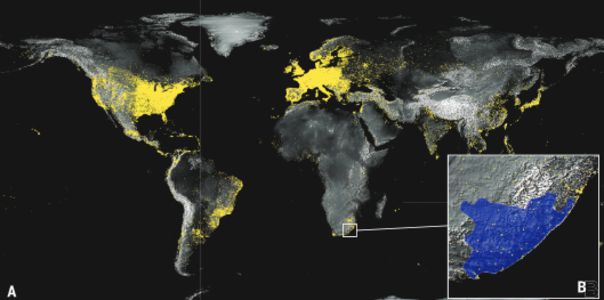
The researchers considered existing sources of statistics about internet penetration, such as the International Telecommunication Union (ITU)'s World Telecommunications/ICT Indicators Database. However, this database offers data only at the country level, which does not allow for subnational analysis across ethnic groups. So, they instead used a method (steps of which are detailed in the full paper) whereby internet penetration in countries and subnational administrative units (provinces or states) is approximated by the number of active internet subnetworks. They used subnetworks of size /24 (refers to the number of bits used for the network address), which correspond to ~256 IP (internet protocol) addresses each. In a validation study, the researchers confirmed that their indicator is able to capture subnational variation in internet penetration.
The paper explains in depth how the researchers determined the effect of political exclusion on internet penetration at the level of groups. In short (footnote numbers again removed), "The regression results...demonstrate that excluded groups' political status leads to significantly lower internet penetration rates compared with included groups in the same country. This result is not driven by the groups' level of development, their geographic location and quality of infrastructure, or their urban-versus-rural settlement pattern....This means that, all other factors being equal, an included group with an average level of Internet penetration for its country would receive only ~60% of that level if it were an excluded group." In additional analyses, the researchers "confirmed that this result is driven not only by lower penetration rates associated with exclusion (when comparing only groups that have some level of penetration) but also by excluded groups' higher probability of having no Internet coverage at all."
Data also suggest that "if democracies exclude groups politically, their level of digital discrimination is comparable to that of nondemocracies. Overall, however, because democratic countries have much lower percentages of excluded populations [on average 6%, compared with 21% in nondemocracies, according to the EPR data], digital discrimination is a much more severe issue in nondemocratic countries." Furthermore, the effect of internet penetration on the probability of collective mobilisation was found to be "insignificant. When estimating the effect across different levels of development among ethnic groups (as measured by per capita light emissions), a positive and significant effect emerged for poor groups only, suggesting that the Internet can increase collective mobilization capacity if few other resources are available."
These findings "underline one of the central impediments to 'liberation technology,' which is that governments still play a key role in the allocation of the Internet and can, intentionally or not, sabotage its liberating effects." That is, in many countries, access to the internet is determined by national governments. As the study showed, this can lead to selective provision of digital communication, with governments making these services available primarily to politically favoured groups. "Although the Internet clearly has the potential to foster collective organization and political change, governments can prevent this effect through their key role in the allocation and control of digital communication. This may be one explanation for the finding that Internet penetration is a weak predictor of collective mobilization at the level of ethnic groups."
The paper concludes by exploring consequences for research and policy. For instance, development policies aiming to promote peace and democratisation through the internet should take into account the uneven provision of digital services within countries. "Only if this digital inequality is alleviated can we expect these modern channels to empower people and societies in order to foster lasting political and economic development."
Science, vol. 353, no. 6304, 2016, p. 1151-1155 - sourced from Media Development Publications - July 2016 - June 2017 from CAMECO, August 2 2017.
- Log in to post comments