










































Dekha Andekha (The Seen and The Unseen)
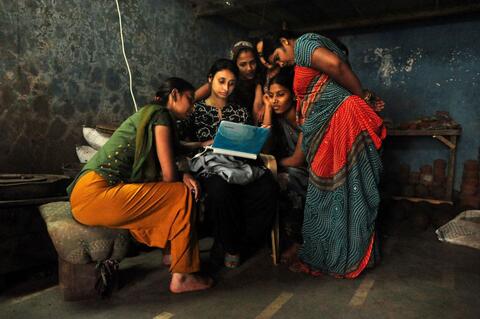
"...from one of the emerging photographers: "When I look through the camera, the unseen becomes the seen"
Carried out in 2011-2012, Dekha Andekha was a series of activities aiming to foster dialogues about health (in particular, women's health) between segregated communities in Mumbai, India: slum dwellers, professional artists, and health scientists. Artworks that spoke to the discussions were created, curated, and mounted in an exhibition in Dharavi, a Mumbai slum. Objectives included: (i) publicly acknowledge the contribution of urban slum dwellers to India's economic and cultural life; (ii) democratise the sharing of information on urban health science; and (iii) encourage artistic creation in a forum in which professionals and amateurs develop ideas together and communicate with international urban health experts and the public. The project was organised by India's Society for Nutrition Education and Health Action (SNEHA) and the Institute for Global Health, University College London (United Kingdom - UK), with Wellcome Trust funding.
The concept behind this project was based on three ideas: first, to arrange for local people with artistic skills to work together with established artists; second, to help them discuss urban health issues that they face in their everyday lives and to use the issues as inspiration for artworks; and third, to work with health experts to make sure that the artworks would be meaningful and important.
Three media - photography, textile art, and ceramics - coalesced in a site-specific installation called Ghar Pe/Ghari/At Home, held from late February 2012 to early March 2012. Located in a local school renovated to become a "turquoise cube", the exhibition was conceived as a home without walls: a representation of a home interior in which all the furniture and household goods were meant to be manifestations health concerns. The idea of a home as the theme of the exhibition was intended to provided concrete inspiration. Organisers theorised that it would be easier to conceive artworks designed around familiar items such as those present in the home. They say that "The artworks that emerged from the process were far from banal in health terms, treating subjects as obvious as water, sanitation and infectious disease, and as covert as the expression of women's suppressed emotions and domestic violence. The emerging artists initiated discussions on health that were relevant, real, and that they felt they understood enough to discuss with the outside world."
To make this happen, each team met regularly and included contemporary gallery artists and artisans. In a series of workshops held over a year, the participants worked together, developing medium-specific skills. "We wanted to avoid banality and received wisdom, to avoid delivering a series of humdrum health messages, and to avoid stereotypical representations of slum life and the easy but potentially disempowering sympathy that they elicit. At the same time, we wanted the artistic product to be challenging and aesthetically literate, and to be judged critically rather than patronizingly. We believe that these aspirations were achieved."
The evaluation of this engagement intervention was through a journalistic interpretation of the process and the outcomes, which was presented as a book that critiques and reflects upon this journey.
Health, Women
According to organisers: "The reception was overwhelmingly enthusiastic and around 3000 people came to the exhibition. The media and local people - residents, the police, and schools - got behind the project in an unprecedented show of support and enthusiasm for the artworks, each of which was named after a Bollywood movie. Students from local schools attended workshops associated with the exhibition, and visitors were encouraged to respond with artworks of their own. Many - including this resident of AKG Nagar - left comments in the visitors' book: "The goal of a public exhibition kept the participants enthusiastic and mindful of the need for quality of thought and execution. It was obvious to visitors during the process - several professional artists, journalists and curators visited the groups - that the emerging artists understood art and believed their ideas were valid. Visits to exhibitions were particularly thought-provoking and confirmed our belief that poverty is no barrier to an interest in art. Slum dwellers build and service the city and are as engaged in the project of urban modernity as the better-off."
SNEHA is a registered not-for-profit organisation that has been working since 1999 in partnership with communities and health systems in an effort to empower women and their families in urban slums to improve their health. One medium SNEHA has used, as illustrated above, is public engagement through art to stimulate wider discussion on urban health.
The Institute for Global Health, University College London takes a cross-disciplinary approach to global health in both its research and teaching, responding to the fact that health problems - and their solutions - are influenced by the social environment as well as medical innovation. "We collect evidence in the real world, evaluate interventions with communities and put our research into practice so it can provide practical solutions for policymakers to implement on a large scale."
The Wellcome Trust is a global charitable foundation that supports people working in biomedical research and the medical humanities. The Trust's breadth of support includes public engagement, education, and the application of research to improve health.
SNEHA and the Institute for Global Health, University College London. Funded by the Wellcome Trust.
Email from Sharmila Kher to The Communication Initiative on October 3 2012; Dekha Andekha Facebook page, October 4 2012; "Art and Health in the Slums: Exploring the Health Concerns of Mumbai's Poorest Communities", Wellcome Trust website, February 24 2012 - accessed October 4 2012 and November 28 2012; email from Priya Agrawal to The Communication Initiative on October 17 2012; and Institute for Global Health, University College London website, November 28 2012.