










































Declining Trends in Vaccine Confidence across Sub-Saharan Africa: A Large-Scale Cross-Sectional Modeling Study
Affiliation
London School of Hygiene and Tropical Medicine (Figueiredo, Larson); Africa Centers for Disease Control and Prevention (Temfack, Tajudeen); University of Washington (Larson)
Date
Summary
"A quantitative understanding the evolution of vaccine confidence via large-scale data collection can shed a light onto vaccination barriers, prompt further discussion and research, and facilitate the design of new public health policies."
Compared to 2019, six million fewer children received a third-dose diphtheria, tetanus, and pertussis vaccine in 2021, with similar losses for other routine vaccines. The role of demand-side barriers - such as vaccine confidence - in modulating uptake routine childhood immunisations over the course of the COVID-19 pandemic is not well understood. This study examines trends in vaccine confidence across 8 sub-Saharan countries between 2020 and 2022 via a total of 17,187 individual interviews. It measures perceptions toward the importance, safety, and effectiveness of vaccines, with the former of these two metrics now used in the World Health Organization (WHO) Behavioural and Social Drivers (BeSD) framework as the major elements of vaccine confidence. The measurement captures both perceptions toward vaccines in general as well as the COVID-19 vaccines specifically.
Between October and December 2020, 8,465 individuals were surveyed across Democratic Republic of Congo (DRC), Ivory Coast, Kenya, Niger, Nigeria, Senegal, South Africa, and Uganda, with an additional 8,703 individuals surveyed between January and March 2022. In each wave of data collection, at least 1,000 individuals were surveyed in each country via a cross-sectional design. Multilevel regression combined with poststratification weighting using local demographic information and Bayesian methods yielded national and sub-national estimates of vaccine confidence in 2020 and 2022, as well as its socio-demographic associations.
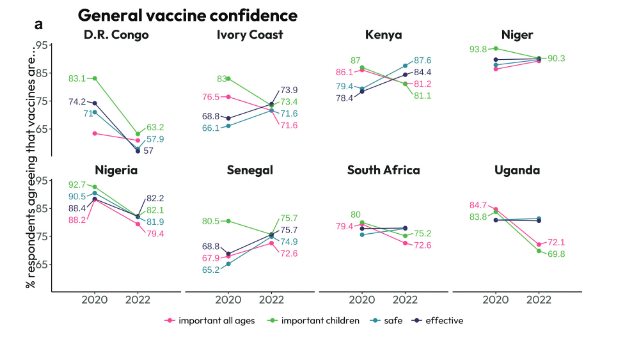
The study identifies declines in perceptions toward the importance of vaccines for children across all eight countries, with mixed trends in perceptions toward vaccine safety and effectiveness. COVID-19 vaccines are perceived to be less important and safe in 2022 than in 2020 in six of the eight countries, with the only increases in COVID-19 vaccine confidence detected in Ivory Coast. There are substantial declines in vaccine confidence in the DRC and South Africa, with the largest falls in vaccine confidence in the latter country in predominantly rural provinces, including Limpopo, Eastern Cape, and Kwazulu Natal.
While over-60-year-olds in 2022 have higher vaccine confidence in vaccines generally than younger age groups, the study did not detect other individual-level socio-demographic associations with vaccine confidence at the sample sizes studied, including sex, age, education, employment status, and religious affiliation.
In short, this study highlights declining vaccine confidence trends across many sub-national regions in sub-Saharan Africa - notably, in DRC, where confidence losses are particularly large. "As there is precedent for vaccine confidence losses in one vaccine to trigger confidence losses in others,...the losses in confidence in COVID-19 vaccines found in this study may be a cause for concern with respect to childhood immunizations, especially if the losses witnessed are related to institutional distrust, a key factor associated with uptake of routine immunizations for children." Furthermore, "Regional losses in confidence - such as those established in this study - can translate to an increased clustering of non-vaccinated individuals, which may pose challenges for herd immunity goals."
To help prevent such an outcome, the researchers suggest that:
Compared to 2019, six million fewer children received a third-dose diphtheria, tetanus, and pertussis vaccine in 2021, with similar losses for other routine vaccines. The role of demand-side barriers - such as vaccine confidence - in modulating uptake routine childhood immunisations over the course of the COVID-19 pandemic is not well understood. This study examines trends in vaccine confidence across 8 sub-Saharan countries between 2020 and 2022 via a total of 17,187 individual interviews. It measures perceptions toward the importance, safety, and effectiveness of vaccines, with the former of these two metrics now used in the World Health Organization (WHO) Behavioural and Social Drivers (BeSD) framework as the major elements of vaccine confidence. The measurement captures both perceptions toward vaccines in general as well as the COVID-19 vaccines specifically.
Between October and December 2020, 8,465 individuals were surveyed across Democratic Republic of Congo (DRC), Ivory Coast, Kenya, Niger, Nigeria, Senegal, South Africa, and Uganda, with an additional 8,703 individuals surveyed between January and March 2022. In each wave of data collection, at least 1,000 individuals were surveyed in each country via a cross-sectional design. Multilevel regression combined with poststratification weighting using local demographic information and Bayesian methods yielded national and sub-national estimates of vaccine confidence in 2020 and 2022, as well as its socio-demographic associations.
The study identifies declines in perceptions toward the importance of vaccines for children across all eight countries, with mixed trends in perceptions toward vaccine safety and effectiveness. COVID-19 vaccines are perceived to be less important and safe in 2022 than in 2020 in six of the eight countries, with the only increases in COVID-19 vaccine confidence detected in Ivory Coast. There are substantial declines in vaccine confidence in the DRC and South Africa, with the largest falls in vaccine confidence in the latter country in predominantly rural provinces, including Limpopo, Eastern Cape, and Kwazulu Natal.
While over-60-year-olds in 2022 have higher vaccine confidence in vaccines generally than younger age groups, the study did not detect other individual-level socio-demographic associations with vaccine confidence at the sample sizes studied, including sex, age, education, employment status, and religious affiliation.
In short, this study highlights declining vaccine confidence trends across many sub-national regions in sub-Saharan Africa - notably, in DRC, where confidence losses are particularly large. "As there is precedent for vaccine confidence losses in one vaccine to trigger confidence losses in others,...the losses in confidence in COVID-19 vaccines found in this study may be a cause for concern with respect to childhood immunizations, especially if the losses witnessed are related to institutional distrust, a key factor associated with uptake of routine immunizations for children." Furthermore, "Regional losses in confidence - such as those established in this study - can translate to an increased clustering of non-vaccinated individuals, which may pose challenges for herd immunity goals."
To help prevent such an outcome, the researchers suggest that:
- Early warning signals of confidence losses, such as those detected in this study, can provide time to respond in case of other epidemics, pandemics, or other emerging crises.
- Confidence monitoring at sub-national resolutions can provide signals to the regions and groups facing confidence losses and can better prepare policymakers and stakeholders for potential losses in vaccine uptake.
Source
Human Vaccines & Immunotherapeutics. 2023 Jun 8;2213117. https://doi.org/10.1080/21645515.2023.2213117.