










































The Critical Role and Evaluation of Community Mobilizers in Polio Eradication in Remote Settings in Africa and Asia
University of Connecticut School of Medicine (Lewis); global health consultant (LeBan); CORE Group Polio Project India (Solomon); CORE Group Polio Project Ethiopia (Bisrat); CORE Group Polio Project Nigeria (Usman); CORE Group Polio Project Horn of Africa (Arale)
"Critical community health worker criteria are important for all community programs, including those focused on a single disease. Areas of importance include community engagement, local adaptation, and linkage with the health system - critical areas for current and future epidemics."
Vertical health programmes - with specific, defined objectives, usually quantitative, and relating to a single condition or small group of health problems - often have limited impact on broader community health. This cross-country analysis of the CORE Group Polio Project (CGPP)'s community mobilisers (CMs) assesses how these personnel engaged communities not only for polio eradication but in other areas of maternal and child health. It uses the Updated Program Functionality Matrix for Optimizing Community Health Programs tool of the community health worker (CHW) Assessment and Improvement Matrix (AIM) to examine CGPP CM roles across 5 of the settings in which CGPP has worked over a 20-year period: India, Ethiopia, Angola, Nigeria, and Kenya/Somalia. The hope is that lessons learned could be applied to other community mobilisation and disease/epidemic control initiatives (e.g., during the COVID-19 pandemic).
The impetus for, and process of, CGPP's formation has been described elsewhere (see, e.g., Related Summaries, below). In brief, mass immunisation campaigns in the mid-1990s achieved high levels of oral polio vaccine (OPV) coverage around the world, but some children were repeatedly missed. Polio experts within United States Agency for International Development (USAID) increasingly recognised that each remaining polio-endemic country offered a unique set of challenges that required local solutions. CGPP started in 1999 with funding from USAID to address these issues. (The 5 CGPP country programmes discussed in this article began between 1999 and 2014.)
CGPP worked to increase OPV 0 (the newborn dose) and routine OPV and immunisation coverage, as well as to detect acute flaccid paralysis (AFP), in hard-to-reach and resistant populations in 11 countries, including the 5 covered in the present study. These populations were in difficult-to-access places due to conflict, rough terrain, and lack of roads. In addition, health services, staff, and infrastructure were limited, and people spoke multiple languages within countries and followed different tribal customs. The CGPP strategy depended on CMs providing behavioural change visits to households most at risk of missed vaccination, using detailed community maps. Numbers of CMs varied over time as partners, population, or geographic area changed.
The researchers used a mixed-methods evaluation approach to compare the evolution of CHWs within CGPP. A literature and document review about CGPP included multiple mid- and final evaluations reflecting different grant periods. They also conducted surveys through computer, phone, and in-person interviews with CGPP secretariat directors and staff. The time frame for data collection was April 2018 to September 2019.
CHW AIM 2018 uses 10 programmatic components that have been found to contribute to an effective CHW programme. Each of the 10 components is subdivided into 4 levels of functionality; this study used the criteria for level 3 ("functional") and used these to examine the long-term impact of CM roles in each country. In short, 3 of the 10 AIM components were partially met, and 6 achieved basic functionality (see Table 9 in the paper). More specifically:
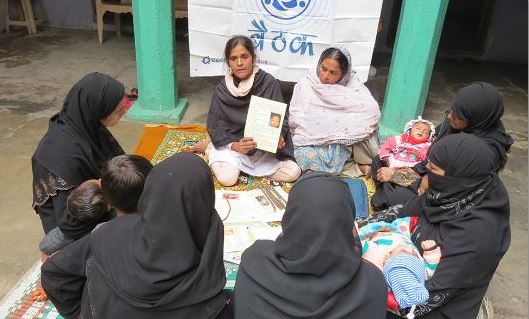
- Role and Recruitment - In all countries, communities played an important role in identifying candidates, who were from the same community and ethnicity. Table 7 in the paper identifies defining characteristics of CMs, which varied by cultural context (e.g., male vs. female ratio) and changed over time (e.g., moving from CMs' literacy as a priority to characteristics such as respect and trust by the community and knowledge of local customs and norms). Key CM roles included community mobilisation to increase polio and routine vaccination rates, community-based surveillance of AFP, data collection, and promotion of maternal and child health. CGPP programmes used a variety of social mobilisation methods, some of which evolved over time, to increase polio and routine vaccination rates, including household visitation, group counseling, and community activities to dispel rumours and build trust in the healthcare system. Broad social engagement required working with multiple sectors of the community: Angola, Ethiopia, India, and Nigeria worked with faith leaders and faith communities; Nigeria worked with traditional leaders; and India worked with teachers and children in schools, barbers, mothers' groups, community influencers, and brick kiln owners. Examples of activities included: Ethiopia's facilitation of traditional coffee ceremonies and meetings with people at encampments, food aid sites, and markets, and Nigeria's activities in the village square, motor parks, and markets, as well as public holiday gatherings.
- Training - Training initially focused on polio and immunisation, community/social mobilisation, and interpersonal communication, but the content expanded to additional maternal and child health topics. Trainings evolved from lectures and presentation into participatory and creative sessions with role playing and household visits, flipbook messaging, dealing with body language, arguments, showing respect, and active listening.
- Accreditation - No certification system was in place, but each country programme had an outside knowledge, practice, and coverage evaluation of the CMs, verified by community recollection of CM messages and support.
- Equipment and Supplies - All CGPP countries provided a continuous supply of job aids.
- Supervision - In each country, CGPP had a supervision system that reached upward to national and/or state government oversight. Supervision tools, forms, templates, and training manuals can be found on the CORE Group website.
- Incentives - None of the CMs in any country received a regular salary, though there were some honoraria/allowances. Each country programme was encouraged to introduce non-financial incentives to boost morale and celebrate CM achievements.
- Community Involvement - The community was involved in every aspect of supporting the CM. In addition, 4 of the programmes (all but Angola) identified and trained community influencers to help CMs solve problems with resistant households and monitor CMs' effectiveness. Some other examples: Ethiopia worked with religious and clan leaders, traditional healers, and ward (kebele) leaders to counter rumours. And in Nigeria, as the project evolved, men were trained as peer informants for polio education and advocacy.
- Opportunity for Advancement - Little potential existed for CM advancement within projects; however, in many countries, because CMs were respected, they were invited to other community positions.
- Data - The creation and implementation of high-quality data collection, analysis, and the utilisation of the information for programme improvement is described here as a major contribution of CGPP. In India, for instance, CGPP used a census-based management information system for planning, monitoring, and evaluation of its social and behaviour change communication activities, as well as Lot Quality Assurance Sampling surveys and Barrier Analysis to identify impediments to adopting healthy behaviours. CGPP commissioned 3 external final evaluations (1999-2007, 2007-2012, 2012-2017), each of which offered recommendations for improving programme performance.
- Linkages to the National Health System - CGPP programmes worked to connect with health facilities, health workers, and government agencies in all countries. Most CGPP systems evolved over time to provide referrals for health concerns other than polio.
This cross-country descriptive analysis of the CGPP demonstrates the importance of embracing the full range of CHW AIM components, even in a vertical programme. CGPP's country programmes demonstrate how a CHW model can be utilised in a vertical programme and adapted to meet specific country and community needs. In terms of what worked: "Data, including local registration of vital events and child registries, played a critical role in programme improvement and constitute an essential component. Community engagement is also critical to address misinformation, vaccine hesitancy, and mistrust of government - such engagement needs to be tailored to each culture and community. Community-based surveillance using local volunteers, especially in hard-to-reach populations, enhanced national and state efforts. Partnerships and communication with government health systems are important for program credibility, success, and sustainability."
According to the researchers, these lessons are important in the context of the variety of vertical programmes and disease challenges from measles, Ebola, and the COVID-19 pandemic, as well as noncommunicable diseases. "Responses to COVID-19 should engage the community through its community mobilizers for nuanced and repeated messaging and discussion to improve the knowledge and attitudes of different community groups about the virus and to keep their trust. The CM's role can add value to government efforts on disease prevention, testing, contract tracing, home visiting, and community support. Once a vaccine is developed, CMs could mobilize communities for high vaccination coverage."
Global Health: Science and Practice August 2020, https://doi.org/10.9745/GHSP-D-20-00024. Image credit: © 2012 Rina Dey/CGPP India
- Log in to post comments