










































Coñal Keele (Harvesting the Seeds of Life)
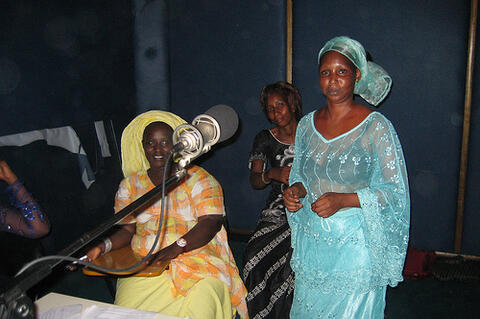
Coñal Keele is written in the Pulaar language and is being broadcast throughout the Matam region of Senegal, identified by the organisers as a priority region. The 2 main story lines address early marriage and adolescent reproductive health:
- Bokkiss' Story - Early Marriage: Bokkiss, a cattle merchant, is in debt with Kelli because of his underperforming business. Bokkiss' 12-year-old daughter, Leeldo, has big dreams and is doing well at school. Kelli offers to forgive his debt, provided that Bokkiss allows him to marry Leeldo. On the wedding day, she tries to run away but gets caught. Following the marriage, Leeldo has an extremely difficult pregnancy and a complicated delivery during which the baby dies. She also develops obstetric fistula. Kelli, angered by the loss of his child and Leeldo's incontinence, brutalises her. Bokkiis intervenes and ends the marriage. Full of regret, Bokkiis tries to help Leeldo recover her health by taking her to the hospital for surgery to repair her fistula. Following the surgery, Bokkiss helps Leeldo get back in school.
- Jahdigel's Story - Adolescent Reproductive Health: Twenty-year-old Jahdigel becomes pregnant, and her boyfriend Silli denies that the child is his. Jahdigel is thrown out of school. Alone and very distressed, she attempts a clandestine abortion, which results in her admission to the hospital in a critical state. The doctor examines her; the results of the HIV/AIDS test are negative, but she learns that she will never be able to have children. Jahdigel takes a job as a maid and, with the help of her friend and former classmate, Moyyo, she begins to study for her high school equivalency exams during the evenings. Silli, who is abusing drugs and engaging in high-risk sexual behaviour, contracts a bad sexually transmitted infection (STI) before being taken to court by the parents of a minor girl that he impregnated. He is sentenced to 5 years in jail. Jahdigel starts to help out at a health centre and at schools to create discussion and debate with youth about reproductive health, STIs, and HIV/AIDS.
PMC's work is based on an entertainment-education methodology first put to use by Miguel Sabido in Mexico over 30 years ago. The Sabido methodology involves creating serial dramas that are customised for the needs and circumstances of specific regions, cultures, and audiences. According to PMC, social learning theory demonstrates that humans adopt many of their values and learn much of their behaviour from role models. PMC's long-running serial dramas contain plots and sub-plots that unfold over many months. "Good," "bad," and "transitional" role models are developed, and audience members gradually learn the consequences of decisions the characters may make with regard to a variety of different issues.
Reproductive Health, HIV/AIDS, Maternal Health, Gender
PMC reports that each year, 529,000 women die from pregnancy-related causes and more than 10 million women suffer severe or long-lasting illnesses or disabilities. In addition, PMC outlines that the non-use of reproductive services and contraception leads to the spread of STIs and HIV/AIDS. Worldwide, the AIDS epidemic is responsible for over 20 million deaths, and 40 million people today are living with HIV. The organisation believes that educating populations about the transmission of HIV between sexual partners as well as from mothers to their children, and demonstrating behaviours that can prevent HIV/AIDS and other STIs, is a vital part of stemming the spread of these diseases.
United Nations Population Fund (UNFPA); RAES (Réseau Africain de l’Education pour la Santé); University of California School of Public Health.
Population Media Centre website on July 3 2009 and June 2 2010.
