










































Community Engagement Before Initiation of Typhoid Conjugate Vaccine Trial in Schools in Two Urban Townships in Blantyre, Malawi: Experience and Lessons
Malawi-Liverpool Wellcome Trust Clinical Research Programme (Meiring, Sambakunsi, Moyo, Misiri, Mwakiseghile, Patel (Pratiksha), Patel (Priyanka), Ndaferankhande, Gooding, Gordon); Oxford University United Kingdom (Meiring); Center for Vaccine Development and Global Health at the University of Maryland School of Medicine (Laurens); University of Liverpool (Gordon)
"The TyVAC Malawi experience confirms the value of community engagement on successful trial activities and enabling community awareness and recruitment."
Community stakeholder engagement is increasingly recognised as essential for both ethical research practice and feasibility of vaccine efficacy trials. Engagement can build trust with communities, generate awareness and understanding of the research, promote ownership among local stakeholders, and seek feedback that helps researchers ensure trial procedures are appropriate in the local setting. However, community engagement is a complex undertaking. This article describes community and stakeholder engagement activities before and during the TyVAC Malawi trial, as well as challenges and lessons learned.
To determine the efficacy of a new typhoid conjugate vaccine (TCV) in an endemic setting in sub-Saharan Africa, the Typhoid Vaccine Acceleration Consortium is conducting a phase-3 randomised controlled trial in Blantyre, Malawi, involving 28,000 children aged 9 months through 12 years. In October 2017, approximately 5 months before the first vaccination with Typbar-TCV® at 2 health centres and multiple primary schools, Malawi-Liverpool Wellcome Trust (MLW) conducted a range of engagement activities within the communities of Ndirande and Zingwangwa townships. They included:
- Community engagement taskforce - Under the guidance and leadership of the Blantyre district health office (DHO), a taskforce designed and implemented engagement activities for trial initiation. The taskforce consisted of education officers, school health and nutrition officers, Extended Programme on Immunization (EPI) officers, health promotion officers, the chief nursing officer, members of the Malawi TyVAC team, and DHO administration. The DHO provided district-level permission to perform the study and to use designated health and educational facilities for study activities, which helped the trial be seen as a legitimate activity by the community.
- Community advisory group (CAG) meetings - The TyVAC team explained the trial and engagement plan to and sought feedback from MLW's resident group of about 20 community advisors.
- Ministry of Health and Ministry of Education (MoH/MoE) - In order to secure permission for study implementation, the TyVAC team provided study protocols to the ministries, answered questions, and clarified planned activities. Because this was the first time schools were used for a large-scale medical research trial in Malawi, TyVAC Malawi obtained face-to-face permission from the Minister of Education and Permanent Secretary for Education prior to regional and local engagement. Subsequent contact with individual schools was mediated by the School Health and Nutrition Officer. Study information was disseminated at each school via presentations, discussion groups, flyers, posters, and letters home.
- Community leaders' meetings in Ndirande and Zingwangwa - Over 2 days, TyVAC Malawi brought together traditional village chiefs and headmen, ward councillors, religious leaders, business representatives, women's groups, and community-based organisations to explain the study and answer questions.
- School-based meetings - The engagement taskforce visited 22 schools to present a study overview and seek participation to establish vaccine clinics on school property.
- Community health committee meetings - Engagement with health surveillance assistants (HSAs) and village health committees focused on their assistance disseminating study information and relaying questions and feedback from the community to the study team. Time was spent ensuring HSAs understood the study protocol, eligibility criteria, and key messages.
- Mobile van with invitation to come for vaccination - A local musician created a jingle containing study messages and played it via a mobile van with large speakers on the roof that drove through the communities. The van operated in the early evening when parents were home and before nighttime, when vehicle security became problematic.
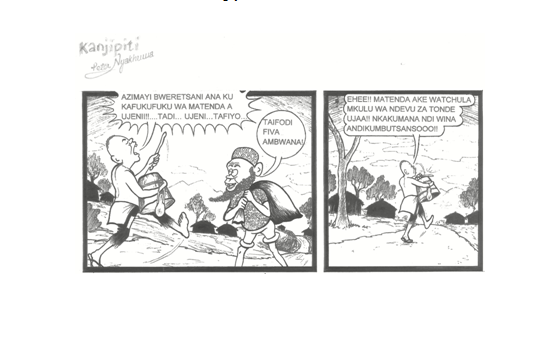
- Engagement with media outlets - The TyVAC team conducted interviews with multiple national newspapers, radio programmes, and television broadcasters, further increasing community awareness of the trial and raising the topic and importance of typhoid fever and TCVs. The print media was also involved, in one case resulting in an output that was unsolicited and entirely unrelated to the public engagement teams: See the cartoon reproduced above (translation may be found in the Source section, below). When the cartoonist was contacted, he confirmed that the study van campaign and other engagement efforts prompted him to write the cartoon.
- Assessment methods - TyVAC Malawi held reflection meetings with trial and engagement staff throughout the vaccine campaign. To generate additional feedback, they held a focus group discussion (FGD) with 6 frontline trial staff to better understand community reactions and recruitment challenges. To support open discussion, a nontrial team member facilitated the 1-hour FGD.
The school-based vaccine campaign increased community participation, exceeding recruitment targets to date (on average, more than 200 children/day). According to the researchers, community engagement encouraged uptake in a number of ways:
- Generating feedback (e.g., through discussions with the CAG) that helped design engagement activities and consent procedures;
- Creating awareness and increasing recruitment, especially through the use of the mobile van with key messages;
- Providing the opportunity to convey information and answer questions (e.g., through the community leadership and school-based meetings); and
- Promoting policy interest in future rollout as Malawi and other African countries consider applying for Gavi funding for vaccine introduction.
Lessons learned include:
- The value of a combination of activities: Delivery of messages at a number of levels in the community from grassroots to upper ministry ensured individuals were aware of the trial and informed of details.
- Use of trusted information channels: Community trust in, and accessibility to, local leaders helped reassure the public.
- The importance of the trial team addressing misconceptions at enrollment: Information provided at enrollment traveled through the wider community as those messages were delivered back to friends and family by participants.
- Selection of appropriate channels for the context: Vans with loudspeakers are commonly used in the local community for advertising and other health campaigns, which meant the community was familiar with the approach. For this trial, chiefs played a limited role because of challenges associated with holding community meetings in an urban setting where people are occupied with income-generating activities.
- The influence of wider social context on community enrollment: Combined with concern and knowledge about the severity of typhoid (in part due to several years of typhoid research and engagement in the community prior to this trial), high levels of trust in vaccination in Malawi encouraged trial participation. Other aspects of social context included reduced engagement of relatively wealthy families in Zingwangwa, who prefer to attend private sector health facilities rather than the government facilities where vaccine administration and follow-up visits occurred. According to the researchers, the social context is important to consider, as traditional authorities have less influence than in the past, religious leadership remains influential, and online social media use grows.
In conclusion, the TyVAC Malawi trial team confirm that the van and local activities improved awareness and turnout for the trial, and they would recommend this approach in other urban areas in sub-Saharan African. However, prior engagement with a wide range of stakeholders - including local government and community leadership - is an essential mechanism to provide details of the study, answer questions, communicate the value of the study, and address safety concerns. Multiple channels of communication should be used to reach the community and deliver information needed for participation and provide opportunity for dialogue with the trial team. Community engagement needs to be started early and continued throughout the process.
Clinical Infectious Diseases, Volume 68, Issue Supplement_2, 7 March 2019, Pages S146–S153, https://doi.org/10.1093/cid/ciy1110. Image credit/caption: Peter Nyakhuwa, Kanjipiti Times Malawi national newspaper cartoon. Translation:
- "Mothers, bring your children for research study of...whatchamacallit....Tadi...ugghhh...Tafiyo."
- "Typhoid fever, my brother!"
- "Yes! The disease is the one mentioned by that goat like bearded man! When I meet another person they will remind me again."
- Log in to post comments