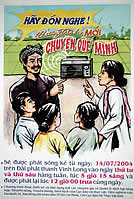
Chuyen Que Minh
This project centred around the use of entertainment-education (E-E) to communicate IPM to Vietnamese rice farmers - that is, to raise awareness of the fact that misuse of insecticides hurts harvests. (IRRI had learned that, by spraying early in the cropping cycle to kill leaf-feeding larvae that cause no yield loss, the farmers were inadvertently killing the natural predators that control damaging pests, like brown planthoppers, later in the season.)
Understanding that farmers used simple rules of thumb, such as "all worms are pests", IRRI developed a counter-heuristic ("Don't spray in the first 40 days after planting") and confirmed through participatory research with farmers that those who followed the rule would not experience yield loss. In the words of the IRRI entomologist who spearheaded the soap opera's development, "We showed that you can add value to biological research by integrating it with social science. First, understand the root causes of farmers' decision-making. Then distil research information into a simple heuristic. Build strong partnerships with lots of local stakeholders - as we did in workshops for developing the radio scripts and poster and leaflet designs. And remember that your innovation must be attractive both to farmers and to the implementing government agencies."
A multi-stakeholder participatory process was adopted in formative research, designing and developing the soap opera series, launching the programme, implementing on-the-ground support, and monitoring progress. To facilitate the accurate and seamless weaving of educational content into the drama, a collaborating team comprising technical experts and scriptwriters was established. They conducted an audience analysis of 605 randomly selected farmers in two districts in Vinh Long and then identified a typical farm family to serve as the model for the drama series. The team then developed a document with descriptions of the family, home surroundings, common activities, and a map. These materials guided the team's regular visits to this family, which involved them staying overnight at times to learn about activities, behaviours, and commonly used local words to be incorporated in story development. The results of the audience analysis, the creative document, and the experiences of the farm visits were used as resource materials in the drama design workshop where stakeholders developed the title of the soap opera, frequency and broadcast times, drama characters, and story lines.
The soap featured 3 sets of characters: those who were positive towards IPM practices, those who were negative, and a transitional group. Drama conversations were developed between these 3 sets of characters, discussing the pros and cons of agricultural inputs. The main character was transitional, and eventually changed beliefs and practices in the series.
A message design workshop was held to develop a strategy, materials, and activities to promote the new drama series. A poster, a leaflet, advertising plugs for TV and radio, and a launching ceremony were also developed. All the support materials were pre-tested before they were finalised and mass-produced. In parallel with the drama broadcasts, radio clubs (where farmers gather together once a month to listen to previous episodes and discuss the stories and educational issues) were organised, quiz competitions were held weekly, and a "meet the actors" day was offered in the Vinh Long town hall.
Environment, Natural Resource Management.
The process and ideas piloted in the project described above led to the development of the "Environmental Soap Opera for Rural Vietnam", which revolved around a new drama series called "Que Minh Xanh Mai" (or, "Forever Green Homeland"). Launched on World Environment Day (June 5) 2006, this series was broadcast until July 2007.
IRRI is an international agricultural research institute that was established in 1960 by the Ford and Rockefeller Foundations in cooperation with the Philippine government. IRRI works in rice-producing and -consuming countries, conducting research and providing training and education for those helping rice farmers by disseminating information and sustainable technologies.
IRRI, with Rockefeller Foundation funding.
Agriculture Comes Clean with Soap", New Agriculturist On-line; and Entertainment-Education and Rice Pest Management: A Radio Soap Opera in Vietnam" [PDF], by K.L. Heong, M.M. Escalada, N.H. Huan, V.H. Ky Ba, P.V. Quynh, L.V. Thiet, and H.V. Chien. Crop Protection, Volume 27, Issue 10, pages 1392-1397, October 2008.