










































CGNet Swara
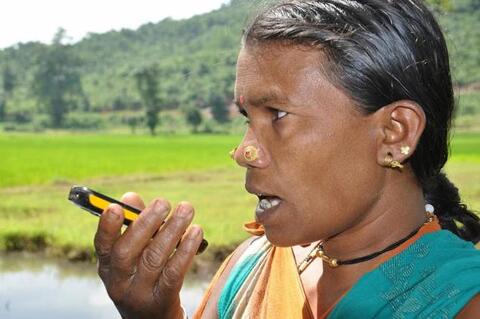
CGNet Swara is a voice-based portal, freely accessible via mobile phone, that allows people in India to report and listen to stories of local interest. Reported stories are moderated by journalists and become available for playback online as well as over the phone. The cell-phone-based social media networking system operates inside sensitive territory termed "Maoist areas".
Set up by former BBC journalist Shubhranshu Choudhary, CGNet Swara is designed to give the Adivasi (an umbrella term for a heterogeneous set of ethnic and tribal groups claimed to be the aboriginal population of India) of central India a voice that reflects their interests, their local news, and events. CGNet Swara's Bangalore-based server was set up by Bill Thies, a researcher in Microsoft with an interest in user-generated technology. Using open-source code and a simple desktop computer with a modem, Thies built a piece of software with 10 voice lines that automatically call the caller back and record his or her message.
Most interactive voice service (IVR) platforms are designed for callers to listen to messages, but on CGNet Swara, they can also record their own messages for others to hear. The platform includes a moderator's interface that enables privileged users to review the recordings and optionally annotate or edit them, prior to making them public. Specifically, they call a phone number (+91 8050068000) using any mobile (or fixed line) phone. Callers are prompted to press "1" to record a new message, and "2" to listen to messages that have already been recorded. Each Swara message goes to the moderator, Choudhary, and through him to about 50 strategically located volunteer sub-editors for cross-checking facts through on-site visits or a follow-up with someone trustworthy from the area, according to the sub-editor's geographical area of residence. These volunteers are educated citizens, culled from a web-based Yahoo group called CGNet. Set up in 2004 by Choudhary and journalist Frederick Noronha, CGNet's 2,500-odd members discuss various matters related to Chhattisgarh. In addition to being made available for playback over the phone, approved reports also can be accessed on the CGNet Swara website. (Organisers say that they are happy to offer guidance to other organisations who are seeking to establish similar services around the world.)
As of November 2013, CGNet Swara receives up to 400 calls daily. The callers talk about local happenings, a lot of it related to their interaction with government schemes. Choudhary calls it citizen journalism of a different kind. In an area neglected by mainstream media (unless the news concerns Maoism), there is now a system to get across local Adivasi news to others in the community. Thies talks of CGNet Swara's recorded reports of malaria cases in the villages. "CGNet Swara had more malaria incidents in a single year than what the government reported in a decade; we even had reports of government health workers dying of malaria". Reportedly, the Swara reports made the government machinery pay attention to the malaria cases, and the reported figures rose more realistically thereafter. One of the offshoots of CGNet Swara is Swasthya Swara, a health-based system running on the Swara infrastructure. It gathers local traditional healers for consultation on the mobile phone system. It is funded by non-Adivasi callers who are able to pay. Thus, a caller from Bangalore can now pay for a consultation with a herbal practitioner for, say, diabetes, and thus cross-subsidise others who cannot pay.
Democracy and Governance, Health, New Technologies
"Many of the estimated 100 million members of India's tribal communities lack access to any mainstream media outlets. This often poses serious barriers to their socio-economic development, as their grievances about government neglect and economic exploitation remain unvoiced. In addition, certain factions (such as the Maoist insurgency) can exploit their frustration and isolation to violent ends."
CGNet Swara was launched as part of the Knight International Journalism Fellowships, a programme of the International Center for Journalists.
"The New Jungle Drums", by Keya Acharya, The Hindu, November 12 2013; CGNet Swara website, November 14 2013; and email from Shubhranshu Choudhary to The Communication Initiative on November 15 2013. Image credit: Purushottam Thakur for The Hindu