











































Bringing HIV, Substance Abuse and Homelessness into the University of Pennsylvania Anthropology Museum through Photo-Ethnography
University of Pennsylvania
"Our hope is that the merger of the mediums of photography, anthropology and public health can convey more than the sum of the parts methodologically, theoretically and representationally. Once again, by imbuing social science analysis with the emotional, documentary and aesthetic power of photo-ethnography we hope to open intellectual debate to a wider audience and to promote practical engagement."
This article documents the experience and research strategies of two men who, in San Francisco, United States (US), integrated photography into an ethnographic project documenting the lives of a social network of homeless heroin addicts - with the intention to draw attention to the unhealthy effects of indigence and substance abuse and advocate for changes in US public policy related to indigent drug users. What emerged from the 12-year project (funded by a National Institutes of Health HIV prevention grant) was a book, Righteous Dopefiend, and an exhibition.
Following a background section, author Philippe Bourgois reflects on what it was like to carry out team ethnography with photographer Jeff Schonberg amongst a social network of addicts. "They allowed us to accompany them as they scrambled for money, food, shelter, drugs and community while fleeing the police in their race to flood their bodies every day, several times a day, with heroin, alcohol and cocaine." The team "assisted and accompanied the homeless to seek care with a secondary, complementary goal of constructively documenting the institutional mismanagement - with notable exceptions - by frontline services of poverty, ill-health and addiction. Consequently, we spent long hours attempting to facilitate (often unsuccessfully) their access to hospital emergency rooms, drug treatment centers, social service offices, community-based clinics and subsidized housing programs." Bourgois notes that "Conducting ethnography with a friend or colleague enables one to relax, concentrate more, and brainstorm during the very process of fieldwork itself."
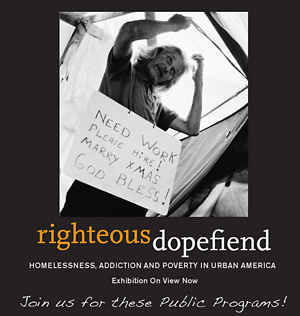
Bourgois explores the thinking that undergirded the creation of the book and exhibition. One of his insights: "To avoid objectifying or trivializing the photographs, we did not accompany them with captions (except as thumbnailed appendices at the end of the book); but neither did we trust the images to stand on their own. The topics of poverty and substance abuse - not to mention HIV, crime, racialized ethnicity, childhood trauma, non-normative sexuality, and interpersonal violence - are subject to moral judgmentalism. Consequently, we embedded Jeff's pictures strategically in the text to encourage humane as well as critical analytical readings/viewings and to diminish ethno/class-centric or righteously normative projections.... The goal is to communicate to a wider public without dumbing-down or sanitizing an uncomfortable analysis. It requires entering policy debates and devoting energy to accessing wider media forums than those offered by our peer-review journals and university press publishers..." As noted here, University of Pennsylvania (PA)'s museum sought to draw patrons to its long hallway gallery of the images of homelessness, addiction, and the war on drugs that had emerged from the project by erecting billboards above the two major freeways leading into Philadelphia, PA. The museum also ran advertisements in local weeklies, including the one that can be seen above.
Bourgois notes that the museum extended the exhibit for an extra year and a half (running from December 2009 to March 2012). Community groups, homeless and addiction services organisations, and educators used the space, bringing their clients/patients/inmates/students for visits and reflection sessions. A blackboard and a comment and donation box allowed visitors to leave their input.
He reflects on another exhibit of the work - this time, a multimedia installation at Philadelphia's Slought Foundation. Bourgois and Schonberg prepared audio loops of excerpts from their hundreds of hours of recordings and combined them with photos of the daily activities of the participants speaking on the recording. "This foray into audio-editing paired with photographs made us realize how much more the sound of voices communicates....The limits of agency become evident to audiences listening to conversations-in-actions among the homeless. Stutters, pauses, self-corrections, hyperbole and emotional tones reveal personal ambivalences and bring alive the intimate structural and interpersonal quandaries and inconsistencies that condemn dreams and good intentions to failure - including, in the case of street addicts: safe injection practices, sobriety and consistent relations of social solidarity."
Philadelphia Social Innovations Journal, Issue 10 - Arts & Culture Edition. Image credit: © Jeff Schonberg
- Log in to post comments