Brazilian Landless Workers Movement [Movimento dos Trabalhadores Rurais Sem Terra]

Since 1985, the MST has peacefully occupied unused land where they have established cooperative farms; constructed houses, schools, and clinics; worked to raise awareness about and promote indigenous cultures, a healthy and sustainable environment, and gender equality; and highlighted the need for a serious discussion on ownership of the media and its role. While these and other consciousness-raising efforts of the grassroots within the MST utilise Paulo Freire's techniques of "popular education," for those outside the movement, the tool of choice is "popular communication." Popular communication, as in popular education, is centred on the actors' own appropriation of the process in which they are participating: It is the actors themselves who execute, question, and direct the output of their own project.
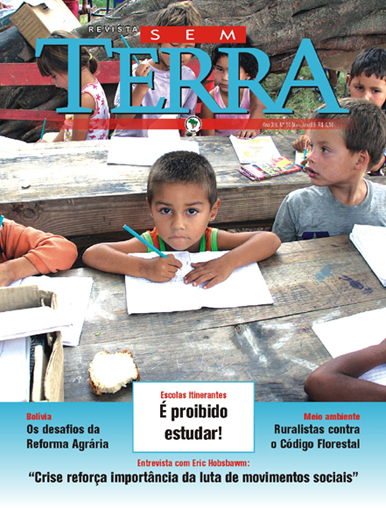
Given Brazil's scale, one of the primary tasks is to develop fluid communication channels so the movement can progress with a unified national strategy. The counterweight to this is that any central control should not clash with the movement's grassroots, who implement their own projects and design their own communications. There is a perceived strong need to communicate in a style which is commonly understood, enough to make an impact in Brazil's cities where media monopolies dominate public information. To that end, the MST produces 3 principal media outlets: the monthly Jornal Sem Terra, the Revista Sem Terra, and a website. The latter - the MST website - is the sum of the movement's mechanisms and proclamations, and links are provided to both aspects of the MST's work. The movement's manifestoes on a wide range of topics are published, and radio programmes, books in PDF format, videos, and photos can all be downloaded. These media sources, particularly the magazine Revista Sem Terra, are directed toward the general public. The idea at the heart of the project is to provide more detailed coverage of the rural situation and peasant demands for those in the urban centres, thereby hopefully ensuring that predominantly rural concerns such as agrarian reform are not removed from the urban movements. The publications are distributed free from strategic locations, and subscription is encouraged so that the enterprise can support itself financially.
At the same time, many diverse MST communications experiences have come into being on the regional level, such as community radio stations, newspapers, and news lists. For the most part, these are directed at local communities. A common feature of alternatives is the vocation for involving the grassroots in the production of the materials. The recipients are both the campesinos themselves and other individuals who identify with the MST's causes. The aim, as in the case of the newspaper Semeando, recently launched by the regional MST branch in Campinas de São Paulo in the settlement of Elizabeth Texeira, is "both to influence popular opinion and to call them to participate in the movement." Surprise and pride at the reported genuine involvement of the grassroots in this communication effort has led MST state leaders to begin making a documentary to share this experience with other Brazilian regions and states.
MST also uses face-to-face advocacy efforts to communicate its strategic objectives, such as this one [point 16 in the document produced at the last national congress of the MST, held June 11-15 2007]: "Fight so that each settlement or community in inland Brazil has its own popular media outlet, such as a free community radio station. Fight for the democratization of all of society's media, contributing to raising people's political conscience and valuing the culture of the people." The National Communications Conference, held December 1-3 2009, was designed to put communication justice issues on the agenda (the MST supported and accompanied the Pro-Conference Committee). João Paulo Rodrigues of MST explained, "The conference has been a standard demand of social movements in their call for the democratization of the media. They see it as a potential space to discuss and design proposals related to communications in Brazil, its monopolized and exclusive structure, and the need to create working-class media outlets. The fact that the conference is being held at all is therefore a result of the social movements' long-held demands." MST's specific demands presented at the conference included: the execution of effective proposals to make electronic media accessible to the public, the creation of measures so that everyone has access to these spaces, and the destruction of the barrier between transmitters and receptors of information.
MST has also recognised the need to create bonds of solidarity with social movements in (at least) the neighbouring countries. This was the reason behind the birth of La Vía Campesina, a coalition of 148 organisations in 69 countries around the world. Their principal rallying cry is that genuine food sovereignty should be based on sustainable family agriculture. Using the internet as its communication tool, the movement's web page is designed to create solidarity with other movements. There is also a section of contacts for organisations with which the MST is in solidarity - e.g., Amnesty International, Brazilian human rights organisations, etc.
Rights.
According to MST, in Brazil, 1.6% of the landowners control roughly half (46.8%) of the land on which crops can be grown. Just 3% of the population owns two-thirds of all arable lands. The surge in agribusiness has led the MST to conclude that traditional agrarian reform, which breaks up latifundios and redistributes the land, is no longer sufficient. It argues that with the onset of neoliberalism, Brazil's middle class negotiated directly with the transnational companies and abandoned the nation's internal markets. The business of the middle classes is now based on imposing monocultures, creating a monopoly in seed sales, and patenting genetically modified organisms (GMOs). For this reason, the MST believes the struggle must be renewed and revitalised.
The MST has won land titles for more than 350,000 families in 2,000 settlements, and 180,000 encamped families currently await government recognition.
MST claims that, nationwide, fewer than 10 groups - made up of families or religious groups - control the major communication networks, including television, radio, newspapers, magazines, and web pages. MST calls for the creation of alternative information, rather than that produced and disseminated by Brazil's media monopoly.
Concerned that the cause of the MST will become isolated in rural matters and forget to include the cities (where the majority of Brazil's population lives), MST recognises that campesinos will become more reliant on establishing relationships with urban workers to achieve their aims. One of the tools used to consolidate connections between urban and rural workers is the settlements in the economically poorer suburbs of the big cities, or on the outskirts of urban centres. According to MST, the residents understand the movement's rural slogans, since many of them are second-generation internal migrants who moved from the country to the city: MST's regional newspapers, community radio, and bulletins are designed for them.
The Friends of the MST (FMST) is a network of individuals and organisations that works to build solidarity and educate the public in the United States (US) and English-speaking world in order to raise the international profile of the MST. The FMST has a direct relationship to the MST and is a fiscally sponsored project of Global Exchange.
"Popular Communication in the MST", by Diego Gonzalez, June 11 2009 - part of the CIP Americas Program's series of 10 Citizen Action Profiles on Communication Rights; and Friends of the MST website, January 25 2010.