










































Behavior Change and HIV Prevention: (Re)Considerations for the 21st Century
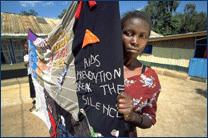
Global HIV Prevention Working Group
This 26-page paper calls for significantly expanded delivery of HIV prevention programming aimed at reducing high-risk behaviours, including unsafe sex and drug use. It shares the perspectives of the Global HIV Prevention Working Group (PWG), an international panel of more than 50 public health experts, clinicians, biomedical and behavioural researchers, advocates, and people affected by HIV/AIDS, convened by the Bill & Melinda Gates Foundation and the Henry J. Kaiser Family Foundation. Citing hundreds of clinical trials and observational studies, the report concludes that behaviour change communication (BCC) programmes have been associated with an overall 50%-90% decline in HIV infections in key populations, but do not currently reach enough people to have a decisive impact on the epidemic.
While acknowledging that it is challenging to design effective BCC programmes and monitor their impact, the report emphasises that there is clear evidence that expanding all scientifically proven HIV prevention strategies could cut global rates of new HIV infections in half by 2015. The Working Group report points to diverse examples of success in reducing HIV risk behaviours, including national programmes in Uganda, Thailand, Australia, and Brazil. While effective BCC programmes can take many different forms, PWG indicates that they share several common elements. Namely, they:
- use a combination of scientifically proven risk-reduction strategies, such as one-on-one counselling, small-group programmes, and community education to encourage people to adopt safer sexual behaviours and avoid risky drug use.
- achieve sufficient coverage, intensity, and duration - that is, become widely accessible - to have a long-term impact.
- strategically address the main drivers of HIV transmission, and are tailored to specific needs and circumstances of groups at high risk.
- reflect local needs and circumstances, and have strong community involvement and support.
The report includes an analysis of gaps and limitations in BCC implementation and evaluation. As documented by the PWG, few trials of behaviour interventions have used such biological end points as incidence of HIV or sexually transmitted infections (STI). Questions remain about the transferability of behaviour change successes to other communities, subgroups, and types of epidemics (for example, high-prevalence, concentrated, etc.). Few clinical trials have measured for long-term sustainability of the changes achieved. Because existing models are based on assumptions of individual agency, while behaviour is often heavily influenced by broader socio-economic, cultural, and environmental factors, "[m]ore validated program models are needed that affect social norms and institutions..." The paper also recognises the need for prevention trials that study combinations of interventions.
The Working Group report provides detailed recommendations to help rapidly expand and strengthen HIV behaviour-change programs globally. Key recommendations include the following (see the report for comprehensive details):
- National political and public health leaders should develop and implement national AIDS strategies and operational plans that are tailored to the particular dynamics of national epidemics, integrate prevention and treatment services, and bring prevention interventions to a scale sufficient to have measurable impact. Countries scaling up medical male circumcision and other new interventions that prove effective should combine these efforts with complementary behaviour interventions to avoid the increases in risk behaviour that can occur when new strategies or tools are introduced.
- International donors should commit to rapidly fund national HIV prevention programmes that are tailored to national epidemics. Additionally, they should make available by 2010 at least US$11.9 billion annually to support scale-up of evidence-based HIV prevention programmes. Donors should ensure robust financing for community-driven responses that build local civil society capacity and leadership.
- Multilateral and other technical agencies should develop a mechanism to assess the soundness of national HIV prevention strategies, identifying instances where national plans conflict with available evidence about the dynamics of HIV incidence, or where selected prevention strategies are not based on evidence of what is effective with particular populations. Technical agencies should increase their assistance to countries in integrating social-research findings into national strategic planning. Improving national HIV-information systems and their use in national planning should remain a priority for technical support.
- Sponsors of HIV prevention programmes should forge strong working partnerships with affected communities to ensure that programmes are optimally tailored to local circumstances and needs and are ethically conducted. Providers of HIV prevention services should integrate their efforts with other service systems, such as those for tuberculosis and sexual and reproductive health. Drug treatment programmes should be adequately resourced to provide for the routine provision of HIV prevention services to their clients.
- AIDS activists and other civil society groups should strongly advocate for the simultaneous scaling up of HIV prevention and treatment. Civil society groups should participate in the development of national HIV prevention targets, monitor national progress toward their achievement, and push for strategies that deliver evidence-based interventions to those populations most at risk of HIV infection.
- Researchers should undertake additional studies to address limitations in knowledge about how to best implement HIV behaviour change programmes. For example, more research is needed on how to translate findings from controlled prevention trials into "real world" settings, how to best reach high-risk groups with prevention services, and how to sustain behaviour change for the long term. (That said, PWG stresses that "The central problem in HIV prevention is not lack of evidence but failure to bring to scale programming that addresses the major drivers of HIV infection in specific national settings.")
In conclusion, PWG also stresses that, "[t]o be more effective in the 21st century, the HIV prevention effort must confront several challenges of perception: a misplaced pessimism about the effectiveness of behavioral HIV prevention strategies; the unfortunate confusion between the difficulty in changing human behavior and the inability to do so; and the misperception that just because it is inherently difficult to measure prevention success - a 'nonevent' - prevention efforts have no impact."