Aswatona Project
In an effort to ensure the project's overall positive impact, the Aswatona team works in close coordination with local independent radio and television stations, as well as non-governmental organisations (NGOs) working towards improving local broadcast media throughout the West Bank and Gaza. Together, these personnel constitute the Aswatona network.
As an illustration of this collaborative approach, Aswatona's response to the conflict in Gaza was to pull together the partner stations to concretise a strategy for the media. Aswatona connected them with key personnel in organisations like CHF, the United Nations (UN), United Nations Relief and Works Agency for Palestine Refugees in the Near East (UNWRA), International Committee of the Red Cross (ICRC), and CARE - both in the West Bank and Gaza - to cover the humanitarian aid and activities in Gaza. Television and radio stations opened their airwaves and screens so that citizens could send announcements and stories of their activities (e.g., peaceful demonstrations). Municipalities soon joined the campaign with support - advertising dates of shipments for certain items, calls for blood donations, etc. The media outlets adjusted their programming with special segments on dealing with trauma and stress, especially dealing with children.
To facilitate this kind of coverage, Aswatona provides assistance and support to media outlet owners and managers to strengthen professional media. From seminars on law and its implementation, to strengthening the voice of media associations in setting standards for the industry, Aswatona is working to help the independent media to play a positive role in society. In addition, Aswatona provides workshops and in-house mentoring on business and strategic planning, sales and marketing, and audience research. The hope is that, by developing better business and organisational management plans, media outlet owners and managers can discover ideas for sustaining their stations and maintaining their independence.
Aswatona also works with journalists to enhance their role in society as both reporters and activators. Workshops are conducted on the rights, responsibilities, and protections of journalists, as well as on various topics such as reporting on sensitive issues, maintaining objectivity, legal and legislative issues, and municipal issues. Aswatona encourages local media outlets to reconnect with their local communities by working with journalists to produce reports on local issues and connecting them to civil society organisations to cover events and topics important to the community. It also provides stations with information on their audience and community interests.
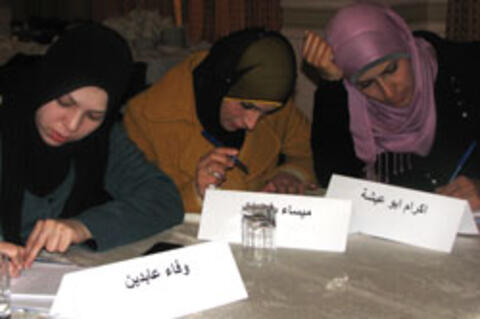
Aswatona's citizen journalism trainings are designed to encourage young journalists to cover under-reported issues in their communities and to utilise multimedia storytelling techniques. For example, 50 young reporters from the West Bank and Gaza, most of whom are recent journalism school graduates, took part in a series of citizen journalism trainings in January and February 2010. Each journalist completed a print, radio, or television story, which was critiqued by the trainers and submitted for publication. Internews helped the journalists make connections with local media so that their stories will be broadcast or posted locally.
Aswatona focuses on building capacity in the use of new media and social networking. For example, at the citizen journalist experience described above, a visiting American documentary producer trained the participants in Gaza for 4 days on creating a good video story. They discovered the techniques of capturing a story through images and interviews in the field. Split into three groups, they then produced stories exploring, for example, an international artist who created a mural on a wall in Gaza City, a new centre for gifted children, and the economic situation in Gaza as seen through the eyes of the owner of a second-hand clothing store. Also, trainers explored how the reporters can use social networks, blogs, YouTube, and other tools to publish their own stories in the future. (Visit the Citizen Journalist Internews Network Group on Facebook).
Media Development, Democracy and Governance, Conflict.
Aswatona is funded by a grant from the United States Agency for International Development (USAID).
"New Tools and Innovation in Palestinian Media", sent from Internews to The Communication Initiative on February 23 2010; and Aswatona website, March 2 2010.