











































Association of Community Engagement with Vaccination Confidence and Uptake: A Cross-sectional Survey in Sierra Leone, 2019
U.S. Centers for Disease Control and Prevention, or CDC (MF Jalloh, Kulkarni, Eboh, Prybylski, Wallace); FOCUS 1000 (Sengeh, Ibrahim, MB Jalloh, Pratt, Webber); Ministry of Health and Sanitation, Freetown, Sierra Leone (Sesay, Thomas); Sierra Leone Country Office, CDC (Kaiser, Singh); Yale University (Omer); University of North Carolina (Brewer)
"In...emergency contexts, community engagement using dialogue, role modeling of promoted behaviors, and collective action planning is critical to safeguard confidence in immunization services, respond to misinformation about vaccines, and foster optimal vaccination uptake..."
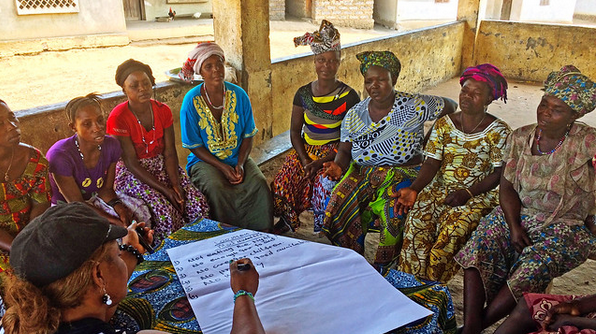
Childhood immunisation services are often disrupted during and after major health emergencies. Numerous community engagement efforts were implemented in Sierra Leone during and after the 2014-2016 Ebola epidemic to strengthen health systems and restore public confidence in health services, including childhood immunisation. To support the Sierra Leone Ministry of Health and Sanitation (MoHS) in these efforts, the researchers assessed potential drivers of vaccination uptake after the Ebola epidemic ended, including the potential role of perceived community engagement in planning the immunisation programme at the community level.
Community engagement efforts that make caregivers feel that their communities are listened to in the planning of a childhood immunisation programme may boost confidence and motivate completion of the infant immunisation schedule. To that end, the MoHS's post-Ebola recovery plan included support for community-based networks to promote childhood immunisation and to bring community stakeholders into the planning of immunisation services, including through on-the-ground support from civil society, who, for example, engaged in dialogue with community and religious leaders to ask them to serve as advocates for immunisation in their communities. The country has a platform comprising more than 100 organisations that work to strengthen community engagement in the planning and delivery of childhood immunisation services. Moreover, community health workers (CHWs) have had a longstanding role in supporting childhood immunisation in Sierra Leone, and were strongly leveraged in the post-Ebola recovery period.
In 2019, the researchers conducted a population-based household survey with primary caregivers of 621 children aged 12 to 23 months in four districts with low vaccination coverage. In total, 71% of the children in the sample were considered fully vaccinated, and 29% were under-vaccinated. Self-reported vaccination refusal was low (3%); self-reported vaccination delay was more frequently reported (19%). Nearly all children received their last vaccine at a health facility (99%) compared to via community outreach (1%).
Selected findings:
- Association with beliefs and norms: Children whose caregivers thought vaccination is "very much" compatible with their religious beliefs were 79% (95% confidence interval (CI) = 71%-85%) fully vaccinated, compared to 51% (95% CI = 40%-63%) of children whose caregivers thought vaccination is "somewhat" compatible with their religious beliefs. Children whose caregivers felt that community discourse about vaccination is "mostly positive" were 79% (95% CI = 70%-85%) fully vaccinated compared to 24% (95% CI = 6%-59%) of children whose caregivers felt it is "mostly negative" and 57% (95% CI = 49%-64%) of children whose caregivers felt it is "mixed".
- Decision-making power related to vaccination: Most caregivers said the child's father held the final decision to vaccinate the child (56%), followed by the mother (37%) and other relatives (7%). When mothers were the decision-makers, 80% (95% CI = 68%-89%) of the children were fully vaccinated versus 69% (95% CI = 60%-77%) when fathers were the decision-makers and 56% (95% CI = 38%-72%) when other relatives were.
- Preferred communication channels: Most people preferred to get immunisation information through health facilities (55%) and household visits by CHWs (25%). Caregivers who preferred health facilities as communication channels were more likely to have fully vaccinated children than caregivers who preferred radio programmes (82%, 95% CI = 74%-88%, versus 59%, 95% CI = 48%-70%).
- Trusted communicators: Health workers were largely viewed as the most trusted communicators of immunisation information (67%), followed by spouses (15%) and CHWs (8%). Preference for trusted communicators was not associated with vaccination uptake (P=0.1).
- Accessibility of vaccination services: 52% of caregivers reported that it usually takes too long to get to the vaccination site, and 36% perceived that health workers expect money for vaccination services that are supposed to be given at no charge.
- Perceived community engagement: 6% of respondents perceived a low level of community engagement, 41% perceived a medium level, and 53% perceived a high level. In bivariable analysis, perceived community engagement was associated with vaccination uptake (P<0.01). For example, children whose caregivers perceived high level of engagement were 82% (95% CI = 72%-88%) fully vaccinated, compared to 63% (95% CI = 53%-71%) of children whose caregivers perceived medium level of engagement and 36% (95% CI = 22%-53%) of children whose caregivers perceived low level of engagement.
- Vaccination confidence: 78% of caregivers scored above the mean in the Childhood Vaccination Confidence Scale, which was validated here. A caregiver was more likely to express high vaccination confidence when both parents have some education versus no education (adjusted prevalence ratio (aPR) = 1.19; 95% CI = 1.02-1.40). In bivariable analysis, among caregivers with high confidence in vaccination, 78% (95% CI = 70%-85%) of their children were fully vaccinated compared to 53% (95% CI = 41%-64%) among caregivers with low confidence. In multivariable analysis, caregivers who perceived high community engagement were nearly three times more likely to express high vaccination confidence (aPR = 2.60; 95% CI = 1.67-4.04) as compared to caregivers who perceived low community engagement.
- Perceived priority areas of improvement: These included: more vaccination sites closer to the community (35% of respondents), enhanced community engagement and education (32%), and improved interactions between vaccinators and caregivers (11%). In bivariable analysis, perception of the priority areas of improvement was not associated with vaccination uptake (P = 0.29).
In short, this study found that, compared to caregivers of under-vaccinated children, those with fully vaccinated children were more likely to encourage vaccination, perceive religious compatibility with vaccination, feel respected by the vaccination staff, and prefer to receive immunisation information from health facilities. In multivariable analysis, caregivers who perceived a high level of community engagement were nearly three times more likely to express high vaccination confidence and nearly twice as likely to have children that were fully vaccinated compared to caregivers who perceived low level of engagement.
In conclusion, this study of four low-coverage districts in Sierra Leone has "provided exploratory cross-sectional evidence to inform future longitudinal assessments to further investigate the potential causal effect of community engagement on vaccination confidence and uptake." They note that, in 2020, the United Nations Children's Fund (UNICEF) developed a set of minimum quality standards for community engagement that can be used to guide the development and evaluation of community engagement interventions (see Related Summaries, below). "Future assessments of community engagement in immunization programs would benefit from adapting these standard indicators to enable cross-country comparisons of the effects of specific attributes of community engagement on immunization outcomes."
Disclaimer: The findings and conclusions in this paper are those of the authors and do not necessarily represent the official position of the U.S. Centers for Disease Control and Prevention.
Journal of Global Health 2022;12:04006; and email from Mohamed F. Jalloh to The Communication Initiative on March 23 2022. Image credit: Monica Pasqualino via Flickr (CC BY-NC-ND 2.0)
- Log in to post comments