










































Altruism and Vaccination Intentions: Evidence from Behavioral Experiments
University of Edinburgh Business School (Cucciniello); Bocconi University (Cucciniello, Pin, Imre, Melegaro); Università di Siena (Pin); School of Public Affairs and Administration at Rutgers University (Porumbescu); Yonsei University (Porumbescu); Centre for Economic and Regional Studies (Imre)
"[C]rafting messages that emphasize how many have already vaccinated and who benefits from vaccination may be effective strategies."
One approach to mitigating vaccine hesitancy is to trigger altruistic behaviour. The idea is that prompting greater concern for others' welfare may lead individuals to vaccinate even when the coverage level is above herd immunity and the incentive to free-ride is high. This study assesses how vaccination intentions are influenced by the presence of people who cannot vaccinate, such as the immunosuppressed, newborns, or pregnant women, using a laboratory experiment where there is a passive player whose welfare depends on the decisions of other, active players.
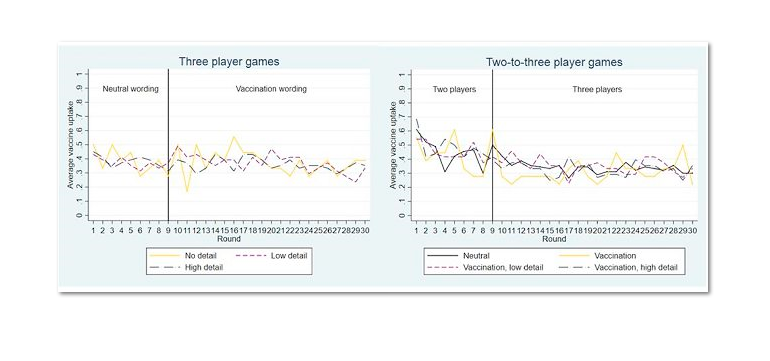
The researchers conducted a laboratory game experiment in April 2018 among 374 Italian university students, whereby subjects received monetary payoffs according to answers they gave and, as a consequence, the outcome of the game. The experiment also tested the effect of framing (vaccination-specific messaging vs. neutral messaging) and the level of detail of the narratives (high detail and numerical vs. low detail and narrative). In the two-player game, both participants were active and could decide among two strategies that initially were framed in neutral terms: a risk-free strategy that provides a positive outcome for the other player (i.e., a cooperative strategy that provides the same payoff no matter what the other player does) and a risky strategy that pays off only if the other player is playing the risk-free strategy (i.e., a non-cooperative strategy that pays off only if the other person plays the cooperative strategy). In the three-player game, the third player had no choice (passive player) in the sense that he or she could not decide on the strategy and his or her final payoff was completely determined by the strategy chosen by the other two active players.
After each round, every subject had to guess how many other active players had played the cooperative action in that round. Perceived cooperation refers to this personal guess, expressed in round numbers by the subject, about how many other active players were playing the cooperative action in that round.
This design mimics the tradeoff between vaccinating and not vaccinating in a real-world decision context, even when the game is framed in neutral terms. There is a risk-free decision that is collaborative (representing vaccination) and a risky decision to free-ride on the behaviour of others (i.e., no vaccination). Both players are slightly better off if one cooperates and the other does not, when compared to what would happen if both cooperated. This is because the player who free-rides is protected by herd immunity while not incurring in any personal cost (i.e., risks associated with vaccines). The worst outcome is obtained when no one cooperates. In the three-player version of the game, the passive player mimics those who cannot get vaccinated and relies on other people choosing the cooperative strategy to achieve herd immunity to keep their personal risk of getting infected under control. The best outcome for the passive player occurs when both active players cooperate, whereas the worst outcome occurs when no one cooperates. The two active players in the game are aware of the presence of the third passive player and the way that player's payoff depends on active players' cooperative or uncooperative actions.
The study found that the presence of a third passive player alone does not have a clear effect. Conversely, a strong pervasive and robust effect is found when considering the experience of being passive, which increases the probability of cooperation by around 30 percentage points with the simple model (two-player, neutral wording, no detail) and by 46 percentage points in all the specifications. Perceived cooperation is also found to have a strong and significant effect: For each additional subject in the same session that the player thinks is cooperating, there is an increase in the individual's probability of uptake of 1-2%.
The neutral framing was found to be more effective than the vaccination wording for the third player scenario, with the difference driven by a strong negative reaction to the high-detail wording for the vaccination treatment. In line with cognitive load theory, this finding implies that the inclusion of details in messages encouraging vaccination suppresses forms of comprehension that are essential to persuading members of the public to vaccinate. In other words, attempting to persuade the public to vaccinate through the use of facts may backfire.
The results suggest that pro-vaccine messages targeting altruism can increase vaccination intentions by:
- Invoking past experiences of dependence and vulnerability - The study found that individuals who at one time belonged to a vulnerable group are more inclined to vaccinate than those without such experience. One explanation: empathy.
- Stressing cooperation as a social norm - Subjects vaccinate more when they believe others vaccinate at higher rates.
- Emphasising the presence of vulnerable individuals in a given society - Conveying how actions affect the wellbeing of vulnerable groups may be an effective way of triggering more altruistic actions.
The researchers suggest that "it would be interesting to examine whether the findings we have uncovered in [the] study, conducted in the pre-coronavirus era where most of the population only had limited experiences with outbreaks, generalize to the post-coronavirus era, where nearly the entire population has directly or indirectly been touched by a virus that is now considered a VPD [vaccine-preventable disease]....[T]he world is now grappling with the equally important question of how to convince a hesitant public to vaccinate and to continue to engage in behaviors that safeguard those unable to vaccinate until herd immunity is reached...While the findings from this study are unable to directly map onto coronavirus vaccine behaviors, they do suggest governments would be wise to consider supplementing appeals to individual self-interest with altruistic messaging, social norm cues, and invoking memories of past vulnerability in their efforts to encourage individuals to vaccinate."
Social Science & Medicine https://doi.org/10.1016/j.socscimed.2021.114195.
- Log in to post comments