










































Alive & Thrive (A&T) in Bangladesh

Alive & Thrive (A&T) is 6-year initiative (2009-2014) funded by the Bill & Melinda Gates Foundation to improve infant and young child nutrition by increasing rates of exclusive breastfeeding and improving complementary feeding practices. The goal is to reach more than 16 million children under 2 years old in Bangladesh, Ethiopia, and Viet Nam, and to inform policies and programmes around the world. In Bangladesh, A&T will work to reach 8 million children through community-based interventions in 90 rural sub-districts and 10 slums in Dhaka, and through national media campaigns. A&T will use multiple communication platforms in the context of high rates of malnutrition in an effort to improve infant and young child feeding (IYCF) practices.
Communication Strategies
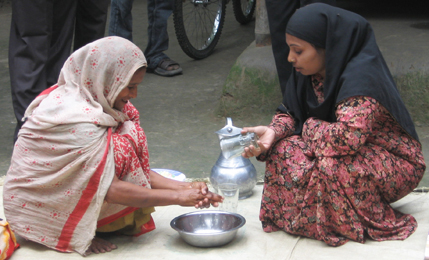
In Bangladesh, A&T draws upon scientific evidence, assessments of IYCF practices, and programmatic experience globally and in Bangladesh to implement a strategy including these elements: policy dialogue, community-based and media activities, promotion of a micronutrient powder to fortify home foods and hand washing before feeding young children, and monitoring and evaluation (M&E).
Strategy 1: Policy dialogue to encourage investments in IYCF programmes and implementation of national-level policies by:
Strategy 3: BRAC's community volunteers will promote micronutrient powders and counsel on better use of local foods and appropriate IYCF practices, including feeding frequency, consumption of animal foods, and safe and hygienic food preparation.
Strategy 4: The IFPRI (International Food Policy Research Institute) will evaluate the impact of the programme strategies as well as the process for delivering the interventions by conducting a baseline survey in rural areas in 2010 of 3,000 children in A&T sub-districts and 3,000 in non-A&T sub-districts, as well as an endline survey in 2013. In addition to assessing the impact of the A&T community activities on IYCF practices, stunting, and anaemia, A&T will study the impact of A&T on different stages of the policy process.
Click here to watch short videos and access hands-on tools to see how A&T Bangladesh helped stakeholders use research findings to craft a national IYCF communication strategy. It features information about how organisers used trials of improved practices (TIPs), concept testing, and pretesting to refine ideas and materials for a mass media campaign. The video below is the 6th episode of Tiny Tales, a series that follows a family in rural Bangladesh during their baby Limon's first year of life. This particular episode focuses on family dynamics and child growth.
Strategy 1: Policy dialogue to encourage investments in IYCF programmes and implementation of national-level policies by:
- Engaging policymakers and community leaders in dialogue and forums;
- Creating a group of respected national journalists to garner support for IYCF investments and policy implementation; and
- Recruiting and training IYCF and nutrition champions from professional associations, the medical community, youth leaders, and the informal health sector.
- Strengthening the skills and performance of frontline workers through incentives and capacity building to ensure quality, efficient, and equitable services supportive of IYCF practices;
- Reaching families with timely and accurate IYCF messages and support for improved practices through interpersonal counseling during home visits by frontline workers;
- Reaching those who influence feeding decisions through religious leaders and village organisations; and
- Mobilising community leaders, youth, and schoolchildren to build awareness about nutrition and IYCF in their communities through traditional and community-based media such as village theatre and community forums.
Strategy 3: BRAC's community volunteers will promote micronutrient powders and counsel on better use of local foods and appropriate IYCF practices, including feeding frequency, consumption of animal foods, and safe and hygienic food preparation.
Strategy 4: The IFPRI (International Food Policy Research Institute) will evaluate the impact of the programme strategies as well as the process for delivering the interventions by conducting a baseline survey in rural areas in 2010 of 3,000 children in A&T sub-districts and 3,000 in non-A&T sub-districts, as well as an endline survey in 2013. In addition to assessing the impact of the A&T community activities on IYCF practices, stunting, and anaemia, A&T will study the impact of A&T on different stages of the policy process.
Click here to watch short videos and access hands-on tools to see how A&T Bangladesh helped stakeholders use research findings to craft a national IYCF communication strategy. It features information about how organisers used trials of improved practices (TIPs), concept testing, and pretesting to refine ideas and materials for a mass media campaign. The video below is the 6th episode of Tiny Tales, a series that follows a family in rural Bangladesh during their baby Limon's first year of life. This particular episode focuses on family dynamics and child growth.
Development Issues
Children, Nutrition.
Key Points
In Bangladesh, exclusive breastfeeding rates remain stagnant, and stunting rates are high. Thus, in A&T programme areas, the initiative hopes to:
- Increase exclusive breastfeeding among infants under 6 months old by 49% (from 43% to 65%);
- Reduce stunting by 10% (from 43% to 39%) among children under 5 years old;
- Reduce anaemia by 10% (from 50% to 45%) among children 6-23 months old.
Partners
Bill & Melinda Gates Foundation, Academy for Educational Development (AED), BRAC, GMMB, and IFPRI.
Sources
A&T Newsletter, Issue 1 (January 2010); Bangladesh page on the A&T website, January 20 2010; emails from A&T Bangladesh to The Communication Initiative on March 21 2012; and A&T Newsletter, August 2013.
Comments

alive & thrive
hi
lot of thanks to initiate this type of program in Bangladesh.
lubna.ismat@gmail.com
- Log in to post comments