










































Adolescents with Disabilities: Enhancing Resilience and Delivering Inclusive Development
Al Quds University (Hamad), University of Oklahoma (Hicks), George Washington University (Baird, Muz), ODI (Jones, Pereznieto, Stavropoulou), GAGE ( Baird, Hamad, Hicks, Jones, Lunin, Muz, Odeh, Presler-Marshall, Stavropoulou, Yadete), Debre Berhan University (Tilahun)
"This report takes stock of current evidence [on adolescents with disabilities living in the global South low- and middle-income countries (LMICs)], drawing on findings from a thematic evidence review combined with emerging findings from the Gender and Adolescence: Global Evidence (GAGE) survey and qualitative research baseline studies in Bangladesh, Ethiopia, Jordan and Palestine."
This GAGE report draws on interviews involving approximately adolescents, including girls and boys with physical, visual, hearing or intellectual impairments, as well as interviews with their parents, teachers and other service providers. GAGE, managed by Overseas Development Institute (ODI), is a mixed-methods longitudinal research programme, started in 2015, exploring the gendered experiences of young people aged 10-19 years, following 18,000 adolescents in six focal countries.
From the Executive summary:
Of the 93 million and 150 million children and adolescents living with disabilities, 80% live in the developing world, likely below the poverty line. The report focuses "specifically [on] the unique needs of adolescents with disabilities – and the gender dynamics that shape girls' and boys' lives. Alongside this, it also looks at the particular experiences of adolescents with disabilities who grow up in rural areas and conflict-affected contexts…" and considers: six domains listed in the following paragraph, "as well the skills, assets and support [adolescents] need to become economically independent once they transition into adulthood."
The report is organised around six capability domains, as charted on page 22: education and learning; health (including sexual and reproductive health - SRH) and nutrition; psychosocial wellbeing; bodily integrity and freedom from violence; voice and agency; and economic empowerment and their challenges for adolescents with disabilities. It includes key evidence gaps and promising practices. Research methodology in the evidence review included searches specific to the above domains, then findings from the GAGE quantitative survey involving more 7,042 adolescents without disabilities and approximately 558 girls and boys from Bangladesh and Ethiopia (7.9% of the sample) with physical, visual, hearing or intellectual impairments, alongside caregivers, service providers, and policy actors. Community stakeholders identified additional hard-to-reach adolescents where high levels of stigma might prevent adults from being forthcoming about family members. Qualitative interviewing started with adolescents identified in the quantitative survey and their parents and key informants, supplemented with snowballing to ensure inclusion of those with diverse impairments, using "hands-on and participatory tools, including a 'favourite things' exercise, a tool focused on support networks, and a tool on resilience and worries (for individual adolescent girls and boys); group exercises included bodying mapping, community and institutional mapping, and vignette exercises to understand social attitudes towards young people with disabilities. We adapted the participatory tools depending on adolescents’ impairment types, and in the case of adolescents with hearing impairments, we worked with local sign language interpreters (or teachers or family members where interpreters were not available) where possible and where the young people involved had some sign language skills."
Promising practices include, for example, an intervention on teacher preparedness to educate children with disabilities within the Lakes Region of Kenya that “increased teacher self-efficacy and produced more favourable attitudes (albeit with no measurable impact on classroom practices).” Others were: work done by Motivation, an NGO that engaged Ugandan adolescents with disabilities in sports (Langford, 2017); a training programme for Ethiopian Health Extension Workers that included dealing with developmental disabilities; and a programme to reduce violence in schools in Uganda.
Policy implications include the following:
- "Support adolescent capabilities and healthy, safe and empowered transitions" - through the six domains: detailed and costed action plans for quality inclusive education; access to primary and disability-specific health care, including provider training with attention to sexual and reproductive health training, as well as addressing under nutrition; accessible safe spaces and recreational opportunities; tailored information about the risks of violence, protection measures, and how to report abuse; training of providers to encourage listening to adolescence and ensuring their participation in decision-making in the family, at schools, and in their community; and weighting of poverty-targeted social assistance programmes to cover costs for families of adolescents with disabilities.
- "Addressing intersecting disadvantages to leave no adolescent behind" - mapping services by impairment to identify gaps.
- "Engaging and supporting caregivers of adolescents with disabilities" - have tailored information and guidance for caregivers, as well as support networks.
- "Tackling data and evidence gaps to support evidence-informed programming" - invest in data and evidence gathering.
- "Promoting better multi-sectoral coordination and accountability" - through strong national bodies and national working groups doing multi-sectoral coordination and information sharing; undertake budget monitoring and develop a disability marker (akin to gender markers), to better track funding and hold donors to account; ensure that adolescents are included in monitoring and evaluation.
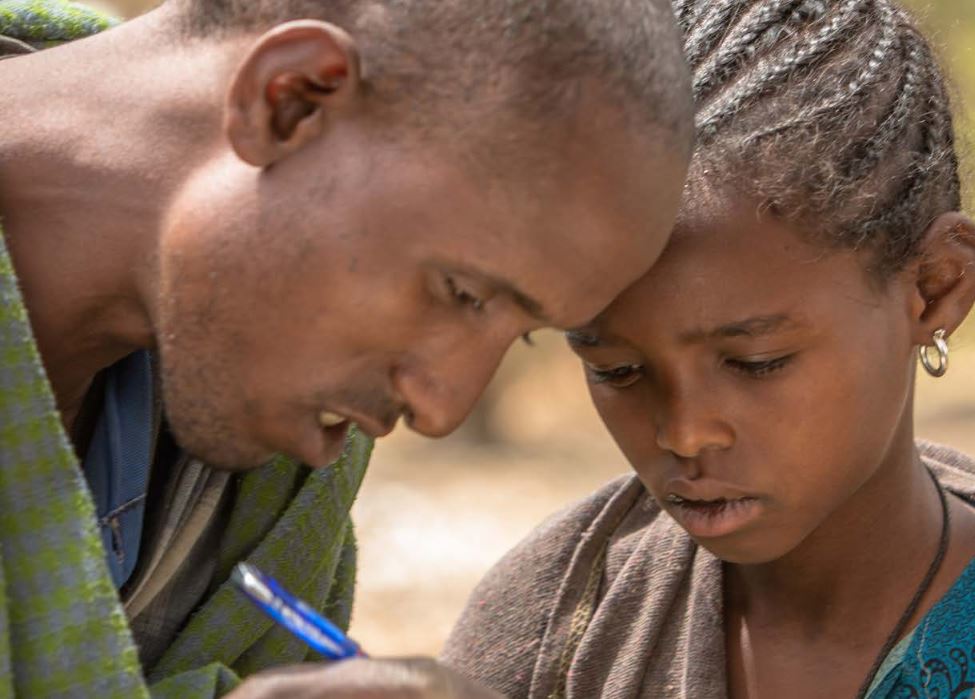
C4D Network website, November 10 2018. Image caption and credit: An adolescent girl with a hearing impairment, with her father, Ethiopia © Nathalie Bertrams / GAGE 2018
- Log in to post comments