










































Ab Shasan Humro Hoi
World Comics India has created a methodology - the "grassroots comics campaign" - that it has applied to several social change efforts (click here for other examples). As World Comics India's founder, Sharad Sharma, explains in his Grassroots Comics Campaign Manual, grassroots comics are comics which are not prepared by professional artists, but by socially aware people themselves, based on their own views. The idea is that people can tell their own stories using the comics format, i.e. storytelling with a combination of images and texts. Through a series of workshops, ordinary people learn that "making grassroots comics is relatively easy and does not require heavy duty technical expertise of any kind. All one needs is a story, paper, pen and access to photocopying."
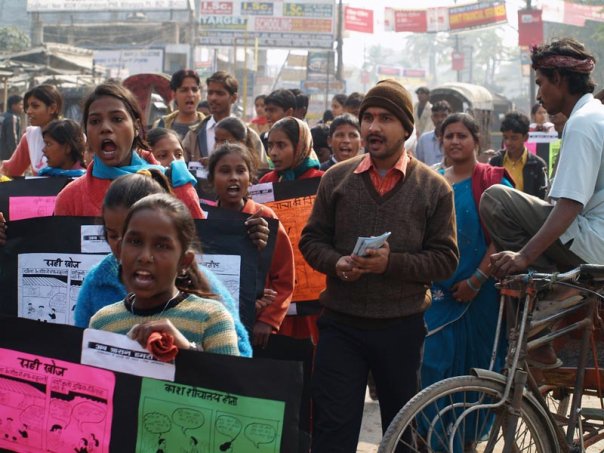
Recognising the power of being able to share their views with other people, comic drawers like the children participating in Ab Shasan Humro Hoi prepare black-and-white comics for distribution at a local level. After photocopying, the grassroots comics are pasted up in places where people gather leisurely, and in schools, at bus stops, in shops and offices, on notice boards, and even on electricity poles. "Only when the comics are distributed in the society, they make an impact. People become informed of new ways of thinking, and at best, the messages in the comics create local debate." There is also an experience of rallying - as is best communicated by viewing the series of photos available here - whereby children march with their comics on the streets and spark debate. As Sharma explains, "The close connection is the most important point here. The readers and the people who have made the comics are not very different from each other. Common people of the society, who feel strongly about some issues, prepare the campaign material themselves, instead of getting them done by an artist from the capital or abroad [the material produced will often lack a local touch, local language, and local culture]. One of the most important things...is the fact that when a wallposter comic is on view, not only a message is conveyed, but also debate takes place."
In short, "Grassroots comics help local people to bring forward their own issues and experiences by framing them in a visual story. Once the technique of making comics is understood by people, then they can prepare comics on almost any issue in a very short time."
Children, Governance.
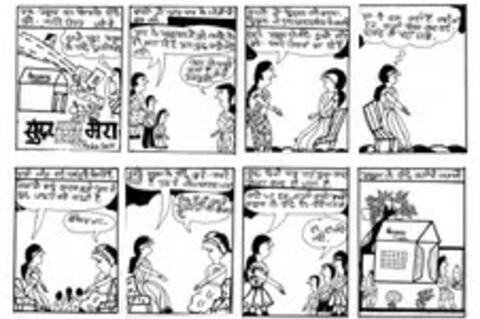
After viewing and discussing with children the comics they produced as part of Ab Shasan Humro Hoi, the Village Head sanctioned 2 hand pumps when children reported a water scarcity problem in school and village. Sharma shares another example of impact: Rinku studies in Class 8 and was quite angry at the garbage lying next to her classroom. She drew a comic and sent it to her ward member and soon the school compound was cleaned. Here is a summary of the text of her 8-page comic "My Beautiful School" (see above for an image of the comic): "People are annoyed by the stench that surrounds an otherwise beautiful school. The children go about complaining to people but not many show concern. A teacher understands the gravity of the situation and complains to the ward member. The ward member gets the school cleaned immediately. Further dumping in the area is also stopped. The children noticing the clean unused space now decide to plant trees there. The school that once smelt foul now looks very beautiful and it even has a pretty garden in its backyard."
World Comics India and Adithi-Plan.
OURMEDIA-L listserv, December 28 2009; email from Sharad Sharma to The Communication Initiative on January 27 2010; and World Comics India website, January 27 2010.


- Log in to post comments