










































Experiences, Challenges, and Lessons Learned From an Immunization Demand Generation Project in Afar, Ethiopia
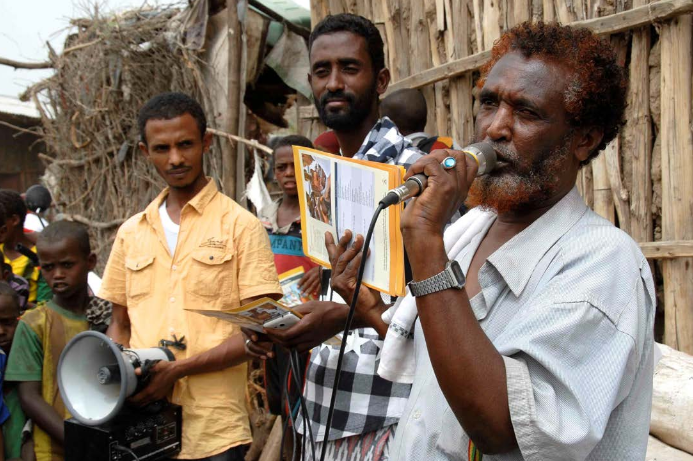
"Expanding this model to other remote and pastoral regions in Ethiopia, as well as similar communities in other countries, could improve community acceptance of and demand for immunization."
This report describes a pilot project that PATH conducted in the Berhale and Yalo districts in the Afar Region of Ethiopia that aimed to increase vaccination coverage through social mobilisation committees (SMCs) and communication activities. It examines the challenges to achieving vaccination coverage in the region, provides success stories demonstrating behaviour change, and outlines best practices and lessons learned.
As the opening pages of the report explain, the challenges to immunisation coverage in remote rural regions like Afar are not purely topographical but include misperceptions, low levels of knowledge, and cultural factors. For example, one contributing factor is that the majority of people in Afar are Muslim, and many community members were found to believe that vaccines contained elements of pork (forbidden in Islam), that vaccines can render women infertile, or that they were designed specifically to kill their children in order to suppress the number of Muslims. For these and other reasons elaborated on in the report, Ethiopia's Federal Ministry of Health cites average figures for children that show a level of only 47% vaccine coverage for Afar. Concerned that Ethiopia sees 1 in 16 children die before reaching the age of 5 years, in 2004, Ethiopia launched its Health Extension Program to bridge the gap between communities and health facilities through deployment of Health Extension Workers (HEWs) to reach the rural population. HEWs work in the midst of the community they serve at Health Posts, from where they deliver primary services that cover 16 separate health packages, of which immunisation is a key component. These HEWs are supported by "a health development army", consisting of volunteer health promoters. For pastoralist regions, such as Afar, SMCs were also set up at all administrative levels down to the kebele (village) level. At each level, the committee includes representatives from the administration, the ruling party, religious and clan leaders, and representatives from schools and women's groups. Each SMC member is meant to deliver different health messages to their specific community.
PATH found that, in Afar, more frequent and effective communication and advocacy around the benefits of vaccination, with tailoring of the messages and channels to the particular context, were needed to drive immunisation uptake. With support from Gavi, the Vaccine Alliance and working closely with the Afar Regional Health Bureau and the regional Islamic Affairs Office, in 2014, PATH began training and working with more than 100 Islamic leaders to advocate for immunisation. Following this outreach work, the Afar Regional Health Bureau asked PATH to support SMCs at both the district and kebele levels to plan, execute, and monitor immunisation promotion activities. SMC members in close collaboration with HEWs conducted a series of awareness and demand creation activities in the following forums: schools, market places, mosques/religious ceremonies, and Women's Federation meetings.
Information for this report was gathered through interviews and a workshop attended by 120 SMC members and HEWs. The reader can learn about the approaches to behaviour change the project undertook in the 4 different settings through the words of the participants themselves. For example, at market places: Kedir Biru Mulat, Disease Prevention and Health Promotions Coordinator, Yalo District, said: "I'm 28 and I’ve worked six years in here Yalo....Vaccination is a highly sensitive issue for our community. So when we go to the market, we also bring along a SMC member with us....Then we enter into the market place, and we will use the megaphone to deliver the messages. It's very important to have the local leaders along with us because people will gather and listen to them. We also run a competition where spectators can win phone cards - we read out the number and the first to punch the numbers into their phone wins. This way people stay and listen to our messages....I can witness that people's perceptions are changing. Now we are achieving good results and the number of children brought to us to be vaccinated is going up."
Reflecting on these and other experiences carried out as part of the pilot, PATH asserts that implementing the project with a relatively small donor grant has shown that creating a demand for immunisation and ultimately behavior change can be achieved very cost effectively in Afar. The main reason is that the project tapped into the established structure of the SMCs. The multiple approaches created cumulative effects on community members receiving messages from a variety of sources - particularly those sources that are respected and listened to in the community. This project has supported local leaders (especially religious leaders) - and in turn, the community - to take ownership of promoting immunisation.
According to PATH, focusing on supporting and strengthening the SMCs can have wider effects than creating demand for immunisation and can transform the knowledge and uptake of other health services. In Yalo and Berhale Districts, the SMC members and HEWs did not only advocate for vaccines during outreach sections but also used the opportunity to speak to the community about other aspects of the 16 health packages, including family planning, hygiene, and institutional delivery, for example. HEWs promoted immunisation in conjunction with the distribution of seeds to farmers by the Safety Net Program following recent severe drought conditions. Similarly, HEWs spoke to mothers about the importance of immunisation whilst conducting a therapeutic feeding programme for malnourished women and children.
The SMCs would benefit from additional training and support regarding monitoring of activities, PATH finds. It may be useful for SMCs to deliver reports by mobile text messaging as well as in hard copy. This way, reporting problems could be spotting early and rectified, and clarifications can be requested immediately. Another option worth exploring is to involve a senior HEW (coordinator level) in reporting.
A remaining challenge is to reach the most remote, the most mobile, and possibly the most traditional nomadic communities with immunisation advocacy, followed by reliable, routine coverage and follow-up across the scorching, mountainous ranges and deserts of the Afar Region. A Yalo kebele administrator sees advocating for immunisation during wedding ceremonies as key to reaching mobile communities, because Nika wedding ceremonies attract large numbers of wedding guests, who stay for several days. Messaging is again delivered by an Imam, and there is ample time to advocate and answer questions from the attending wedding guests. Hasna Muftah, Head of Women's Affair in Berhale District, suggested engaging and training traditional birth attendants to become immunisation allies as another approach to reaching the nomadic segments of Afar society.
PATH concludes that the pilot project conducted in Afar demonstrates that SMC engagement and communication activities can effectively increase levels of community uptake of vaccines, and that community engagement can overcome barriers to vaccine acceptance.
PATH website, November 29 2016. Image credit: PATH/Therese Bjorn Mason
- Log in to post comments