










































Supporting Informed Decision-making about Vaccination: An Analysis of Two Official Websites
Institut national de santé publique du Québec (Vivion, Dubé); ORS PACA, Regional Health Observatory Provence-Alpes-Côte d'Azur (Hennequin, Verger)
"Existing communication materials could be improved to better align with best practices in risk communication."
Misinformation and rumours about vaccination found online have been cited as a leading cause of vaccine hesitancy, and studies have found that the quality of vaccination-related content on websites or social media platforms is highly variable. In this context, the purpose of this study was to evaluate the content of webpages on childhood vaccination of two official websites dedicated to vaccine promotion, in Québec, Canada, and France.
It is estimated that one-third of parents in Québec and approximately half of French parents are vaccine hesitant. While reasons behind vaccine hesitancy are similar in the two countries, multiple controversies surrounding vaccine safety and effectiveness have impacted vaccine acceptance in France. In addition, very different approaches have been also adopted to reduce vaccine hesitancy and enhance vaccine acceptance. Québec has opted for educational strategies and decided to implement, in 2018, an intervention using motivational interviewing techniques in many maternity wards to inform parents about childhood vaccination. Vaccination is not mandatory in Québec; in contrast, based on a law passed on December 4 2017, non-vaccinated children in France will not be admitted to any collective child services such as nurseries or schools, and no exemption other than for medical reasons will be considered.
Two websites developed by public health institutions to inform health professionals, parents, and the general public about vaccination were selected for the analysis: France's Vaccination info-service and pages on vaccination on Québec.ca. These websites represent the "official health authorities" discourse around vaccination in their countries. In total, 32 webpages (27 from the French website and 5 from the Québec website), 14 videos (6 from the French website and 8 from the Québec website), and 2 infographics (both from the French website) were downloaded and analysed according to evidence-informed risk communication metrics.
The following were the most frequent risk communication approaches: 'debunking common misconceptions about vaccination' and 'answering common questions about vaccines.' Harm and benefit information focused primarily on the risks of vaccine-preventable diseases and the risks of adverse events following immunisation. Most materials used qualitative terminology to describe the risk (e.g., "vaccines are among the safest tools", "adverse events are rare"). Very few materials provided numeric likelihood of harms and benefits. When numeric information was provided, the intent was only to present the risks of the diseases or number of cases in an outbreak.
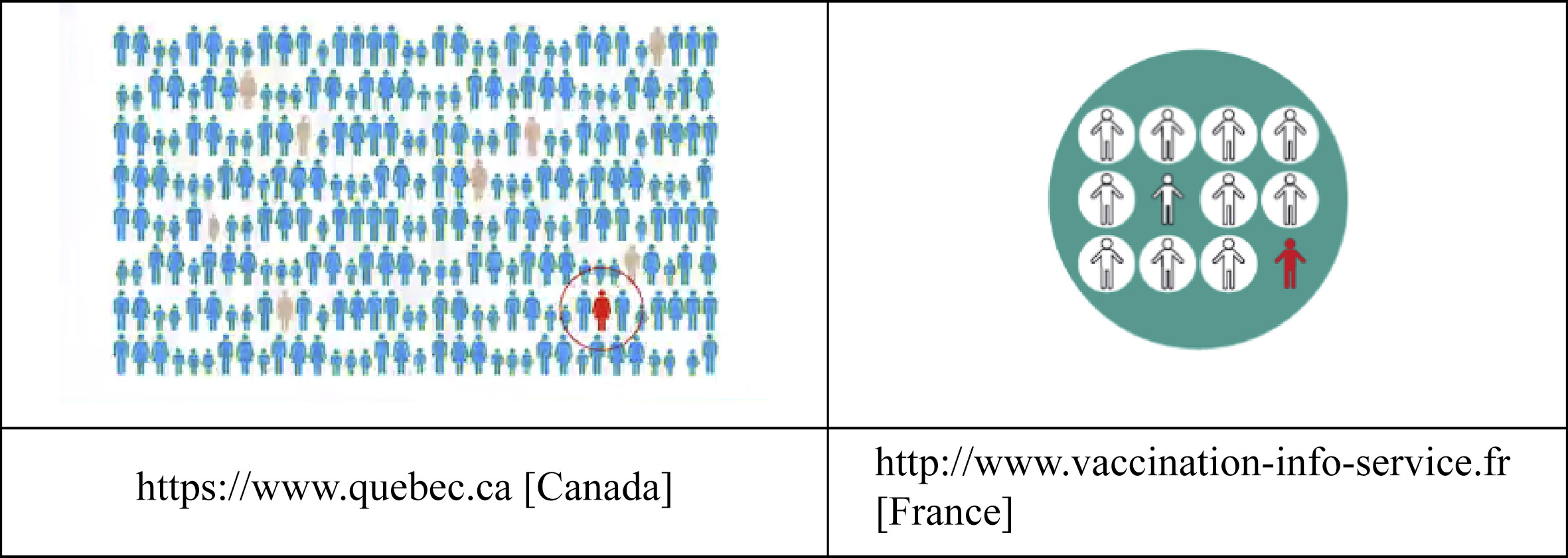
In addition, both websites relied mostly on written information. Very few pictures were used (none on the French website and only 7 in the techniques to reduce pain and anxiety during vaccination on the Québec website). Few webpages on both websites used visual aids other than videos (e.g., graphics, pictures, icons arrays, etc.) to convey important information. Videos on the French website were mainly animations that aimed to explain complex concepts such as herd immunity. On the Québec website, 4 videos presented by experts addressed different issues about vaccination (e.g., doubts and concerns about vaccination).
In reflecting on the findings, the researchers note that, even though these websites have been developed to reach parents in two different cultures and contexts (France and Canada), they appeared to be very similar in terms of content and approaches. In addition to practical information on when, why, and where to get children vaccinated, most of the content was designed to address common misconceptions about vaccinations, mainly by providing more factual information.
They add that "[b]est practices in risk communication recommend providing numeric likelihood of risks and benefits of vaccination, using visual aid and qualitative information to ensure comprehension of the quantitative information....The information presented on both websites analyzed in this study was not always perfectly aligned with these recommendations...[and] may be perceived by vaccine-hesitant parents as a way to minimize vaccine risks."
Furthermore, studies in risk communication have shown that visual aids can help people, especially for those with low numeracy skills, understand health risk. However, very few visual aids were used in both websites, and some of these aids featured textual information, in technical language. According to the researchers, information should be provided in an understandable way, but people should also be given the possibility to obtain more in-depth, scientific, information.
In conclusion, "the role of official public health websites appears to inform and maintain trust in vaccine safety and effectiveness for the majority of the population who is still favorable to vaccination....However, this type of communication approach may not correctly respond to the needs of vaccine-hesitant parents who are...looking for detailed and 'balanced' information about vaccination." However, because vaccine-hesitant parents may already be mistrustful toward governmental information, "the needs of vaccine-hesitant parents might be better served by more tailored communication approaches, such as online decision-aids."
Public Health. 2019 Oct 29;178:112-119. doi: 10.1016/j.puhe.2019.09.007.
- Log in to post comments