










































Japanese Anti- Versus Pro-Influenza Vaccination Websites: A Text-Mining Analysis
The University of Tokyo
"[A]nti-influenza vaccination messages may spread online and contribute to molding negative public opinion about influenza vaccination, consequently increasing the number of vaccine hesitant and vaccine refusers."
Anti-vaccination sentiment, which includes doubt, fear, and opposition to vaccination, exists worldwide; Japan is no exception. Health professionals publish pro-influenza vaccination messages online to encourage proactive seeking of influenza vaccination. However, influenza vaccine coverage among the Japanese population is less than optimal. Vaccine-hesitant people may be vulnerable to persuasion by anti-vaccine websites that often use heuristic appeals to emotions, such as personal stories and photographs of individuals who have allegedly been injured by vaccines. Considering that the contents of pro- and anti-influenza vaccination websites may contribute to readers' acceptance of one or the other position, this study used a text-mining method to examine frequently appearing content on websites in Japan for and against influenza vaccination.
Some context may illuminate the impetus for the study. The Maebashi report describes a study conducted in the 1980s during an anti-vaccination campaign against mass influenza vaccination of schoolchildren. The study compared absence rates among elementary school students between 3 cities with mass influenza vaccination programs and 2 cities without; the study found no differences between the groups. However, the study outcome was not morbidity but rather absence rate, which included reasons for absence other than influenza; this resulted in a skewed interpretation of the study results. Nevertheless, this report has often been referenced by anti-influenza vaccination activists as evidence of the ineffectiveness of influenza vaccination; in 2004, it was published on the internet by these activists. The researchers of the present study note that, by enabling people to easily share links to scientific articles, the internet allows for diffusion of study findings outside of the scientific community, often using captivating titles and without presenting detailed scientific information.
The researchers conducted online searches on January 10 and 11 2017, using a formula for Japanese language input entered into the 2 most popular search engines in Japan, Google and Yahoo! Japan.
- Of the total 334 materials evaluated, 201 items (60.2%) propagated pro-influenza vaccination messages, and 113 (33.8%) propagated anti-influenza vaccination messages.
- About half of the pro-influenza vaccination items were authored by health professionals, and most of the anti-influenza vaccination items were authored by laypersons.
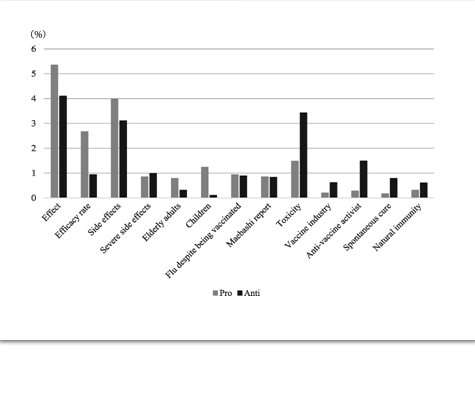
- The 3 most frequently appearing content topics on pro-vaccination websites were: vaccination effect for preventing serious cases of influenza, side effects of vaccination, and efficacy rate of vaccination. The 3 most frequent topics on anti-vaccination websites were: ineffectiveness of influenza vaccination, toxicity of vaccination, and side effects of vaccination.
The discussion section of the paper delves deeper into the findings. Some takeaways:
- As noted above, on pro websites, the effect of influenza vaccination was most frequently referenced, and efficacy rate of influenza vaccination was the third most frequent content. Lack of confidence in the effectiveness of influenza vaccines is one of the main reasons for not being vaccinated, in Japan as well as in other countries. Accordingly, the findings were encouraging; however, the researchers indicate that the benefits of vaccination should be more thoroughly promoted.
- The ineffectiveness of influenza vaccination was the most frequently referenced content on anti-vaccination websites and was most frequently mentioned by mass media. For example, some websites quoted and linked to a misleading article in a major Japanese newspaper (Mainichi Shinbun) that appeared in August 2015, entitled "Influenza vaccination has no efficacy in infants and junior high school students: a study by Keio University". According to the researchers, these findings are of concern because content from a major newspaper may be strongly persuasive.
- Severe side effects were mentioned, to some degree, on both anti and pro websites. "Pro websites should more clearly assert that the probability of severe side effects such as anaphylaxis is quite low and that a causal relationship between vaccination and severe side effects, such as Guillain-Barre syndrome or acute disseminated encephalomyelitis, has not been found. Even so,...[s]ome individuals may choose to disregard the evidence and may become vaccine hesitant or vaccine refusers because of emotionally persuasive accounts of severe side effects [on anti websites]."
- "Contracting influenza despite vaccination was discussed both by pro- and anti-websites, to some degree. Anti websites referenced this as a good reason for not receiving influenza vaccination. The negative experience of contracting influenza despite being vaccinated is more salient and memorable than the positive experience of not getting sick owing to vaccination. This can generate a so-called 'availability heuristic' and easily give rise to misconceptions about the effectiveness of vaccination..."
- Health professionals were the main disseminators of the above-mentioned Maebashi report on anti-vaccination websites. Such content may be strongly persuasive, with scientific-like data and assertions by health professionals.
- Anti-vaccine activist content was the fourth most frequent on anti websites. These anti activists are all health professionals (physicians, researchers, or pharmacists) who have published books containing anti-vaccination assertions; they are often quoted on anti websites. Mass media stood out as the main disseminator of these anti-vaccine activist contents, which is worrisome because "mass media audiences often have blind faith in what scientists say."
- The vaccine industry was frequently referred to on anti websites. The conspiracy theory of vaccination policies that are motivated by profit has also been reported in countries other than Japan, and one study demonstrated that such anti-vaccine conspiracy theories are associated with lower intention to vaccinate.
- Preference for spontaneous cures and improving natural immunity were also frequently mentioned on anti websites.
Means to enhance the usability and persuasiveness of pro-vaccination websites may be as follows:
- Regarding contents of pro-vaccine websites, using emotionally powerful stories as well as evidence-based vaccine information may be important. For example, stories that describe people feeling relief at knowing they and their loved ones are protected by vaccination during an outbreak, or describe the pain of someone who lost a loved one owing to a preventable disease, may enhance salience of the beneficial effects of influenza vaccination.
- Ease of readability of online anti-vaccination messages may contribute to readers' acceptance of those sentiments. To counter this, using clear and plain language is important when writing online pro-vaccine information.
- Authors of pro-vaccine messages are advised to consider the readers' prior knowledge, their capacity to process the information, and their preferences for how information is presented, to appropriately target the information.
- The crucial role of health professionals (the authors of about half the pro-websites in this study) in maintaining confidence in influenza vaccination should be stressed because many physicians and paediatricians are frustrated with influenza vaccine efficacy, especially in Japan.
- As a potential device for vaccine promotion online, scholars suggest the use of social media to learn more about knowledge gaps, deficiencies in awareness, problematic attitudes, and potential misperceptions, so as to intervene effectively. More studies are needed in this area, say the researchers.
Health Promotion International 2018, 1-15. doi: 10.1093/heapro/day015
- Log in to post comments