










































Understanding Immunisation Awareness and Sentiment Through Social and Mainstream Media
"As immunisation uptake is mediated by socio-cultural and political influences, locally appropriate communication responses are required to meet and sustain coverage goals."
This brief describes a multi-country study by United Nations (UN) Global Pulse that was designed to track and analyse online conversations related to immunisation on social media and mainstream media in India, Kenya, Nigeria, and Pakistan. The project shows how methods including sentiment analysis, topic classification, and network analysis can be used to support public health workers and communication campaigns.
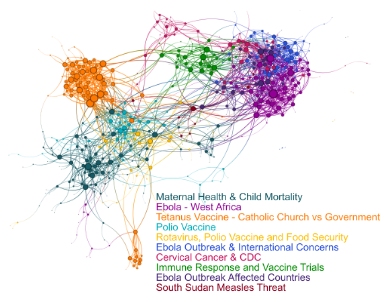
From January-December 2014, researchers analysed public, English-language content relating to vaccination from 2 social media platforms (Twitter and Facebook) along with mainstream media. Relevant content was first extracted by filtering for one of a comprehensive set of terms (a taxonomy) directly related to immunisation such as "vaccine" OR "antivaccine" OR "anti-immunisation" OR "anti-vax". Additional taxonomies were used to categorise each message into the following categories: "Religion/Ideals", "Distrust/Refusal", "News/Events", "Side-effects", "Safety", and other topics. Using network analysis via the news analysis software Quid and demographic classification of users, the researchers identified key influencers and their audiences to compare the nature of the conversation in these four countries. They analysed news narrative in each country by clustering together articles with related content into distinct topic clusters. This revealed the structure of the news narrative and how key events and organisations were discussed. Sentiment analysis is a method to automatically analyse a piece of text and extract a measure of how positive or negative that text is. For example, strong negative sentiment to a tetanus vaccine was driven by the Kenyan Catholic church. Conversely, events such as the official announcement of India's polio-free status were met with many messages with positive sentiments.
Findings from the study showed that in social media, Nigerian and Pakistani politicians are active and influential in the vaccination debate, and the political dimension is often referred to when discussing the failure to eradicate diseases such as polio. However, in Kenya, religious and ideological aspects were more frequently discussed. Twitter activity was primarily driven by sharing of news stories in all countries, whereas Facebook allowed for longer discussions touching upon many different sub-topics at once (with a primary focus on the "distrust" and "ideals" categorisation). Finally, it was found that mainstream media related different actors and entities than social media.
Implications and recommendations derived from the study include:
- Campaigning for vaccination efforts should be targeted to a sub-national level and be responsive to local events. (Spikes in content were strongly driven by specific events such as attacks on polio workers and polio campaigns in Pakistan.)
- Users of Facebook and Twitter seem comfortable with English, suggesting that campaigns may reasonably be conducted only in English if resources are limited.
- For listening purposes, it could be important to focus on local platforms and new audiences, who may not share the same knowledge of English. Therefore, it is important that investment is made in software libraries to analyse non-European languages such as Urdu and Hindi.
Global Pulse Project Series no. 19, 2015.
- Log in to post comments