










































A Social Networks Approach to Understanding Vaccine Conversations on Twitter: Network Clusters, Sentiment, and Certainty in HPV Social Networks
Grady College of Journalism and Mass Communication (Himelboim); Washington State University (Xiao, Lee, Borah); Stephen F. Austin State University (Wang)
"Our approach helps communicators find the right groups of users to engage with."
In recent years, as user-generated content online become easy to produce and convenient to access, more and more individuals are receiving health information from social media platforms such as Twitter. This study applies social network analysis to identify the clusters - silos of information flow - that users create on Twitter when posting and sharing content about the human papillomavirus (HPV) vaccine. On social media, content is discussed at a group level, as it is being shared and exchanged. So, applying computer-aided content analysis and manual coding, the researchers explore the communication dynamics within Twitter groups, as well as group members' affective and cognitive characteristics.
A plethora of studies has investigated public awareness of the HPV vaccine, as well as HPV-vaccine-related media coverage; the present paper reviews some of them. Individuals may have cognitive needs as well as emotional needs when they communicate about health issues on social media platforms like Twitter. In that light, also examined here is some of the literature on HPV and emotions, including as expressed on social media.
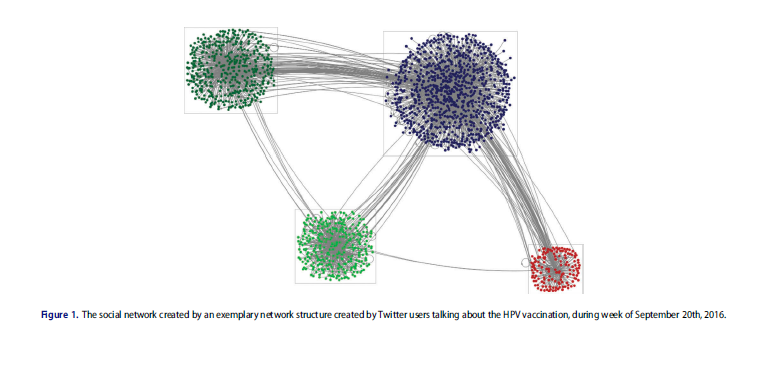
The researchers explain that, in social networks, people choose to interact with some more than others, creating subgroups of self-selected subgroups, or network clusters. Within each sub-community, people share similar information sources and tend to connect with similar others, a phenomenon called "homophily". High density, which indicates more interconnected relationships among members and more frequent exchanges of opinions, shows that those conversations on Twitter may be deliberative.
Twitter activity related to HPV vaccination was collected in one-week period datasets, starting 9/20/2016 for 10 weeks. The researchers combined network analysis using NodeXL, Linguistic Inquiry and Word Count (LIWC) for computer-aided analysis of the content, and traditional human-coding for more in-depth analysis of the conversation and shared hyperlinks.
A total of 42 clusters, involving 39,368 Twitter users, were identified across all 10 datasets. (Each dataset included self-descriptive information about users, the content of their tweets, including hashtags and hyperlinks, and relationships among users (i.e., retweets, mentions, and replies). These clusters differ in terms of their structure; some are denser, that is more interconnected, than others.
The analysis found that positive emotion is positively correlated with graph density, an indicator of strong ties and rapid information flow. An example of a tweet with positive emotion is: "...[H]ealth insurance is pretty sweet. Getting the HPV vaccine for $0. YAY". However, negative emotion failed to reach significance; only anger is a significant predictor for graph density. An example of a tweets with negative emotion is: "The vaccine I had in 2009 3 times has completely ruined my ability to sleep like a normal person...." Angry content was associated with more loosely interconnected users.
The researchers also found a correlation between certainty and tentativeness - both at cluster and at tweet level - suggesting that clusters bring together people who are sure about the HPV vaccine and people who are looking for answers. Certainty score counts words indicating confidence, such as "always", "absolutely", and "clearly". A sample tweet reads: "#Gardasil: The Decision We Will Always Regret." Tentativeness score counts words indicating hesitancy, such as "maybe", "fairly", and "perhaps". A sample tweet reads: "Maybe #hpv vax will affect cancer rates, we don't know yet."
The manual content analysis shows that clusters with popular pro-vaccine tweets contain more positive emotion than negative emotion, and clusters with popular anti-vaccine tweets contain more negative emotion and less positive emotion. In addition, clusters with popular pro-vaccine tweets contained institutional sources such as health organisations and news media, whereas clusters with popular anti-vaccine tweets mostly contained sources whose links did not work, there was no expert sources used, or site names such as "Passive Aggressive Raven" were used.
According to the researchers, the findings can potentially have meaningful implications for health communicators. In brief:
- Considering the finding that positive messages flow better within subgroups of users who interact more and exchange content with one another and are also associated with pro-vaccine and reliable sources, a denser community may benefit from a community-based approach, where a relationship is developed, and trust is built over time with a group of people.
- In contrast, per the results, the angry content may be shared extensively, but it is not often discussed. Such low-density clusters tend to be less stable, either because they rely on one source of information or because of overall sparse exchange of opinions. The intervention approach for angrier and low-density clusters, thus, would be hub-focused - in other words, identifying a focal source of content and responding to it with counter-message. Practitioners could, for example, approach and correct an inaccurate source, mentioning it in a post. Or, they may choose to ignore it so as not to give credibility to conspiracy theories, for instance.
One conclusion to emerge from the study: "Knowing that individuals will engage in more opinion/information exchanges when there are more positive sentiments may help health practitioners better communicate risk and benefits related to the HPV vaccine. Providers should use positively framed language to engage patients in the conversation about the HPV vaccine."
Health Communication, DOI: 10.1080/10410236.2019.1573446
- Log in to post comments