










































Understanding Social Norms Underpinning Domestic Violence in India
"Though VAWG [violence against women and girls] is a global pandemic, it does not often receive the attention and urgency that is needed to address it. Underlying this lack of political will is the justification and rationalising of violence within individuals, communities at large and even duty bearers. This justification and rationalising is deep rooted within the accepted social norms within countries and globally."
This paper from Oxfam is a review of existing literature on the social norms that underlie and exacerbate violence against women and girls (VAWG). Beginning with the reason for a renewed focus on social norms, the paper goes on to clarify the concept of social norms and its many aspects. It looks at evidence from existing programmes and campaigns on ending violence against women and the approach to changing social norms within them. It presents a possible framework for changing social norms while touching upon the complexities of measuring social norm change over a period of time. It highlights some of the principles that need to be kept in mind while initiating social norm interventions within any context. In conclusion, it attempts to bring to the forefront some key lessons to be kept in mind while designing a campaign on changing social norms that underpin domestic violence in the context of Indian realities.
As detailed here, the Ecological Framework highlights the fact that in order to have more effective interventions on ending VAWG, there is a need to understand how different levels interact to drive and sustain harmful behaviours. Individual, social, material, and structural factors work within this framework. "A word of caution here is that working on social norm change should not be seen as the magic bullet to address the issue of VAWG. In fact, it is the additional factor that needs to be addressed systematically and consistently to ensure that existing work on the other factors would bring the change that is aspired to. In short, it means that more holistic approach to all the four factors needs to be taken into account." The paper examines the difference between attitude, behaviour, and social norms. It also outlines 3 elements that make a social norm: Firstly, social norms provide or lay out the social expectations of what is typical and appropriate; secondly, social norms exist within reference groups; and thirdly, social norms are maintained by social sanctions - approval (positive sanctions) or disapproval. An analysis of social factors reveals that social norms can be manifested in two ways: They can be gender norms and gender norms perpetuating violence against women. "Given that the perpetuation of violence is also an expression of dominant power, it is natural that social norms and the concept of power are closely linked....Therefore, in order to change social norms, it is important to address the unequal power relations."
The next section looks at both the existing theories and available models that could help in providing an understanding to shifting existing social norms. (Models are different from theories, as they provide an insight into the understanding the psychological factors that explain or predict a specific behaviour.) These theories and models include: Theory of Reasoned Action Approach; Social Cognitive Theory; Theory of Interdependent Action (or Game Theory); Theory of Diffusion of Innovations; Ecological Model; Stages of Change Model; Input/Output Persuasion Model; Emotional Response Model; Tipping Point; role models; Positive Deviance Model; Modelling Positive Behaviour; Empowerment Model; Integrated Behaviour Model; Health Belief Model; and social movements.
A quick analysis of the existing campaigns on gender-based violence (GBV) or violence against women shows the following trends in addressing the issue:
- Showing VAWG is a crime that must be stopped: This approach is grounded in the Theory of Reasoned Action. It aims to influence behaviour by making perpetrators, survivors, and witnesses of VAWG aware of the fact that VAW is unacceptable and by inviting its audience to speak up against VAWG, seek support, or report it (for example, Zero Tolerance Campaign).
- Making VAWG survivors aware of solutions and encouraging them to take action: This approach is inspired by the Health Belief Model and Social Cognitive Theory. It is usually combined with raising awareness for women's rights. An example of this campaign would be Bursting the Bubble in Australia.
- Showing that VAWG affects the entire society and must be stopped: Inspired by the Health Belief Model, this approach aims to encourage people who consider they are not directly affected by VAWG to recognise it as a problem that needs to be addressed.
- Addressing the perpetrators and encouraging them to change.
- Making change to eliminating VAWG appear attractive and rewarding: Grounded in the Theory of Reasoned Action, this approach seeks to convince the intended audience that adopting a specific behaviour is good for them and appropriate for society.
- Providing models for the intended audience to take action against VAWG: All the theories mentioned above inform this approach.
- Guiding the intended audience through a personal development process: It is a relatively complex campaign approach to VAWG which consists in provoking and supporting personal development processes for the intended audiences to unlearn harmful behaviour over an extended period of time. Such campaigns require a mix of mass communication and person-to-person contact.
Going beyond campaigns on GBV/VAWG, the paper provides a summary and analysis of 23 other campaigns and programmes in bringing about a social norm change in society as either prevention of or response to VAWG.
In order to work on social norms, the following 3-stage framework, based on both theory and evidence of successful approaches, is presented:
- Along with shifting individual attitudes, social expectations regarding the behaviour within the reference group must be changed. This might involve promoting a positive alternative, where the new behaviour is highly visible and so are the benefits. Organisers could provide opportunities for public and collective change, like public pledges and public commitments. They could promote public debate and deliberation around the existing norm through community workshops, group discussions, edutainment, mass media, radio call-ins, social media, and mobile technologies.
- These changes in attitudes and expectations need to be publicised - e.g., through social norm marketing and edutainment, posters, comics, and information sheets. "Avoid reinforcing the negative behaviour, wherein messages need to be screened to ensure that they are not reinforcing the existing norm."
- New norms and behaviours need to be catalysed and reinforced through rewards, sanctions, and opportunities to conform.
Oxfam notes that one of the major challenges in social norm change is being able to capture the actual change in society. Included in the paper is a list of questions that evaluators could ask as a "proxy" or alternate way of seeing norms.
There are some key principles that Oxfam says need to be kept in mind while designing interventions on social norm change; in brief:
- Changes in social norms are critical to lasting, transformative change.
- Programmes/projects should target multiple levels, sectors, and timeframes.
- Intersectional and contextual analyses are central to changes in social norms.
- Women and their organisations are vital to creating lasting changes in social norms.
- Engaging men and boys is critical to sustaining change in social norms.
- Empowering women, girls, and non-gender-identifying people is central to shifting imbalances in power and critical to targeting gender inequality.
- Influential norm-setters, including traditional and community leaders, are powerful allies.
- Duty bearers are critical in both modelling positive attitudes and influencing their institutions to creating a positive enabling environment.
- Essential service provision is key to preventing and responding to VAWG.
Based on the existing literature and the current review, there are some key lessons that Oxfam indicates should be considered when designing a campaign on changing social norms:
- Focus on the most prevalent form of violence (intimate partner violence).
- Recognise that changing social norms is a long-term process.
- Identify the reference group.
- Carry out interventions across the levels within the Ecological Model.
- Integrate campaign thinking and interventions within existing projects.
- Draw lessons from existing VAWG campaigns.
- Follow the 3-step framework (as above) for social norm change. (One suggestion: "Including the idea of positive modelling by prominent influencers like film actors and sports personalities could help in achieving a critical mass of early adopters of an alternative [to VAWG].")
"To sum it up, addressing the existing social norms is the additional element that may be currently missing in the interventions on ending VAWG. Changing the existing, and often negative, social norms is a long-term process. Commonly held social norms within collectives have to give way to new and positive ones which highlight the fact that violence against women and girls is unacceptable under any circumstances and that girls and women have the same value within society as compared to boys and men. This has to fit in with the aspirational outlook of the younger generation, the demographic dividend for India. It is possibly the only way that there would be a visible reduction in the acceptance of violence by all (girls, women, boys, men, communities, duty-bearers and institutions) within the foreseeable future."
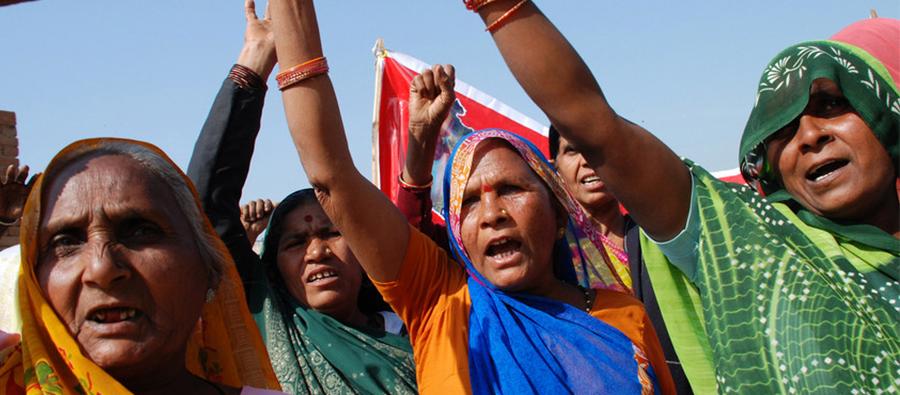
C4D Network Twitter Trawl: 22 – 28 May 2017. Image caption/credit: "Women rally to demand their rights in Uttar Pradesh, India, with support of Oxfam partner Samarpan." Rajendra Shaw/Oxfam
- Log in to post comments