










































Social Media Influencers Can Be Used to Deliver Positive Information about the Flu Vaccine: Findings from a Multi-year Study
The Public Good Projects (PGP)
"...community perceptions of vaccine acceptability are important drivers for positive social norms change, which in turn can drive behavior change..."
Large-scale health communication campaigns featuring pro-vaccine messaging on social media can suffer due to negative comments flooding the space, often from highly organised vaccine opponents. Thus, a nonprofit organisation in the United States (US) called The Public Good Projects (PGP) implemented a digital campaign to promote the flu vaccine that leveraged social media "micro-influencers" who are predominantly followed by African Americans or Hispanics. These groups may hold negative views and social norms that discourage flu vaccination, contributing to lower vaccination rates among them. An evaluation from the first year of the Stop Flu campaign (see Related Summaries, below) showed significant increases in positive attitudes toward the flu vaccine in areas that received the intervention. This study expands upon this evaluation, reporting on the qualitative analysis of comments posted in response to influencer posts during both years of the campaign, as well as digital metrics from influencer posts.
Prior research has separated priority audiences for flu vaccination messaging into three groups: (i) those who believe in the value of vaccination and typically receive a vaccine, (ii) those who may have questions about the value of vaccination and sometimes receive the flu vaccine, and (iii) those who reject the value of vaccination and never receive the vaccine. Using Perkins and Berkowitz's Social Norms Approach, which states that changing perceived norms can impact behaviour, PGP's intervention reached out to groups (i) and (ii) through personalised message delivery from influencers they follow, with the aim of increasing positive normative perceptions of flu vaccination.
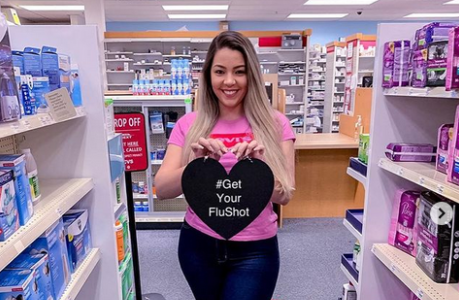
The campaign is described at Related Summaries, below, but in short involved recruiting (and paying) influencers with followings up to 50,000, the majority being either African American and/or Hispanic, to deliver at least one vetted and scientifically accurate health fact about the flu vaccine, using their own voice and style, during the 2018-19 (Year 1) and 2019-20 (Year 2) flu seasons. Prompts for posts were also based on the time of month or around holidays; for example, at Thanksgiving, influencers were asked to write a post about the tradition they would miss most if they were sick with the flu. Influencers were asked to use the following hashtags on their posts: #stopflu, #fightflu, and (during Year 2) #getyourflushot.
Across both years, 250 influencers took part in the campaign. The majority of influencers posted on Instagram, followed by Twitter and Facebook. Although influencers were allowed to post text, an image, or a video, a majority chose to post an image in both years. During Year 1, influencer posts achieved 65,721 likes, generated 1,515 comments, and potentially reached 9.9 million followers; during Year 2, influencer posts achieved 155,600 likes, generated 3,122 comments, and potentially reached 8.5 million followers. However, "the aim of the study was not to prove that an influencer campaign can garner high reach numbers, but rather to examine whether the approach can generate positive engagements among those it does reach. These positive engagements, in turn, may have positive impacts on the perceptions and social norms of those who may not comment on the posts but are exposed to the positivity in their feeds."
A majority of comments during both Year 1 and Year 2 expressed positive sentiment (92.9% and 94.8%, respectively). However, general negative sentiment increased from Year 1 to Year 2 (30.6% Year 1; 50.0% Year 2), and posts expressing no intention to receive the flu vaccine also increased.
PGP argues that "This approach has promising implications for communicating about other types of vaccines, with the most important recent example being the COVID-19 vaccines....Health communicators have recommended the adoption of a social norms and influencer-based approach to address COVID-19 vaccine hesitancy specifically....The positive results shown in this study support these recommendations."
Reflecting on the campaign and its implications for future efforts, PGP notes that, "Using influencer marketing software, interventions can engage individuals that have a specific reach in niche groups. These targeted influencers can be used to communicate tailored messages which have been identified as being effective in driving behavior change among specific groups. That messaging and hashtags could be refined mid-stream indicates that messaging can be flexible, taking into account events or topics as they happen, and shifting strategies to avoid vaccine opposition groups torpedoing the campaign."
In conclusion: "This strategy represents a more community-led and participatory approach than most large-scale vaccination campaigns have attempted, with immediate applicability to communications about the COVID-19 vaccine."
Health Education Research 2021 Jun; 36(3): 286-94. doi: 10.1093/her/cyab018. Image credit: tonosalto on Instagram via PGP
- Log in to post comments