










































Promoting Accountability through Debate in the Palestinian Territories
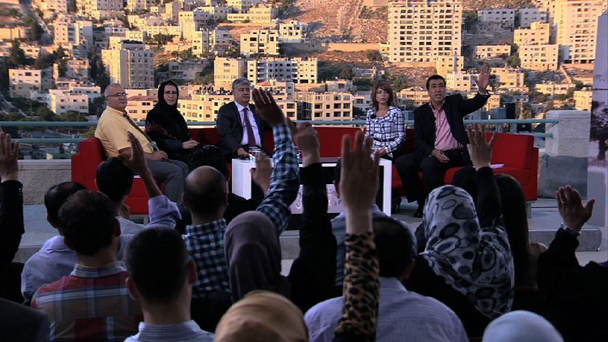
"These programmes are designed to provide Palestinians with the opportunity to question decision-makers face-to-face."
In this research, BBC Media Action surveyed audience reaction to the Palestinian Debates, two factual debate programmes. Launched in September 2012, the debates may be accessed through both traditional (TV and radio) and social media platforms with the goals of engaging the audience and encouraging their interaction.
The debates were developed because of political control varying by location: West Bank, Gaza, and other locations - under the control of the Palestinian Authority (PA), Israeli administration, and the Islamic Resistance Movement (Hamas) - which affects public dialogue and political participation. In addition, Palestinians are barred from freedom of movement and freedom of expression and can face political imprisonment.
"Aswat Min Filasteen (Voices from Palestine) is co-produced by the Palestinian Broadcasting Corporation (PBC) and BBC Arabic and airs quarterly. Hur El Kalam (Free to Speak) is produced fortnightly by PBC and broadcast weekly. Each episode has a varied studio audience of about 40 Palestinian adults who have the opportunity to put questions on issues that they believe to be important directly to decision-makers."
Following on its 2012 research, BBC Media Action surveyed 1,500 Palestinians aged 15 and over in September 2013 to measure exposure to and engagement with the Palestinian Debates among audiences in the Palestinian Territories. Its objectives were two-fold: to gain insight into audience perceptions of how effectively the programme contributed to accountability and to use insights in support of ongoing programme development, "for example by investigating citizens’ main local and national issues of concern, and tracking media consumption."
"Key findings
- Overall, audiences report that the programmes provide trustworthy, unbiased and useful information.
- Social media use is high, and a sizeable minority access the programmes through social media platforms. The majority, however, watch them on Palestine TV, PBC’s television channel.
- The programmes reach more men than women. The proportion of men reached by the programmes is 57%, however men made up only 52% of the total survey sample.
- The programmes reach the target audiences of youth and young adults aged 15 to 34 years.
- 83% of both audiences believe that the programmes improved their understanding of the issues debated. So far these include local elections, immigration, youth, gender issues, education, juvenile and tribal justice, and the peace process, among others.
- Audiences were positive about the programmes overall, with more than 80% of both audiences agreeing that the programmes play a role in holding decision makers to account.
- The Israeli occupation has increased in importance as a national issue of concern for Palestinians in both the West Bank and Gaza since... first surveyed in 2012.
- Palestinians in the West Bank reported more often that they understood the discussion and reports in the programmes, suggesting that the programmes are more relevant in the West Bank than in Gaza.
- There are some regional differences, with fewer audience members in Gaza compared to the West Bank reporting that Palestinian Debates feature people similar to them in discussion and reports."
Audiences found that the programmes: provide a platform for direct engagement between Palestinian citizens and decision-makers; play a role in holding decision-makers to account; and improve their own understanding of issues discussed on the programmes. The data also provided programming insight in that issues of concern vary by regions and can include concerns of poor infrastructure, such as lack of electricity and water in the Gaza Strip. It was found that the use of social media for increased interaction "provides important opportunities to engage with diverse audiences and provide an additional platform for freedom of expression."
BBC Media Action website, June 3 2014.
- Log in to post comments