










































Media and Governance in the Palestinian Territories
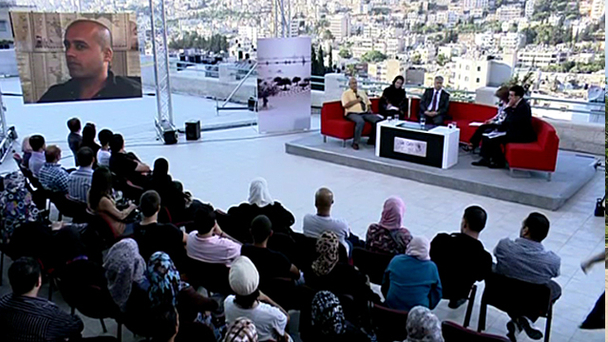
This research summary analyses findings from BBC Media Action research on a project in the Palestinian Territories, a Department for International Development (DFID)-funded project aimed at "facilitating greater transparency in political decision-making, deepening the democratic process and encouraging a culture of transparency and accountability": "Through the production of multi-platform factual discussion programmes, the project aims to provide Palestinian people with a platform to discuss political and social issues with key decision-makers and also hold them to account. The project also aims to equip the Palestinian Broadcasting Corporation (PBC) to produce audience-driven governance programming through an extensive programme of capacity building. It consists of two discussion programmes broadcast on TV, radio and available online, Aswat Min Filasteen (Voices from Palestine) a co-production between the Palestinian Broadcast Co-operation (PBC) and BBC Arabic - which airs quarterly - and Hur El Kalam (Free to Speak) produced by PBC - which airs monthly in the months between episodes of Aswat Min Filasteen."
The baseline research of August 2012 consisted of a representative survey of 1,500 Palestinian adults aged 15 years and above across the West Bank and the Gaza Strip. In January 2013, an audience panel (30 people) was established for longitudinal qualitative follow-up to explore the impact of the project over time. "The first round of fieldwork with the panel was completed in February 2013 and consisted of in-depth interviews with each of the panel participants."
Key findings of panel interviews include the following
- "Media access was high across the Palestinian Territories, especially access to TV (almost all adult Palestinians - 98% - can access TV at home). Social media usage was high among all demographics, especially those under 35 years of age, men, and those living in the Gaza Strip.
- TV was the most frequently mentioned source of information about politics and current affairs (by 51% of Palestinians). To what extent a media source represented local interest(s) and provided reliable information were key considerations for audiences."
The research document concludes with implications: "In order to reflect the priorities identified by audiences the project should build and maintain the credibility of the programmes. This includes the choice of panellists and topics, the provision of multiple viewpoints (through packages and diverse audience) and the demonstration of strong editorial values. Attention should be given to maintaining truth and accuracy while presenting information that serves the public interest.
Social media should continue to be integral to the project and may contribute to promoting transparency by providing an additional space for dialogue and discussion.
The programme might counteract apathy among audiences (and support the constructive nature of dialogue and discussion) by following up on stories covered during the programmes and providing examples of impact where questioning leaders has led to a response/resolution."
BBC Media Action website, May 26 2014.
- Log in to post comments